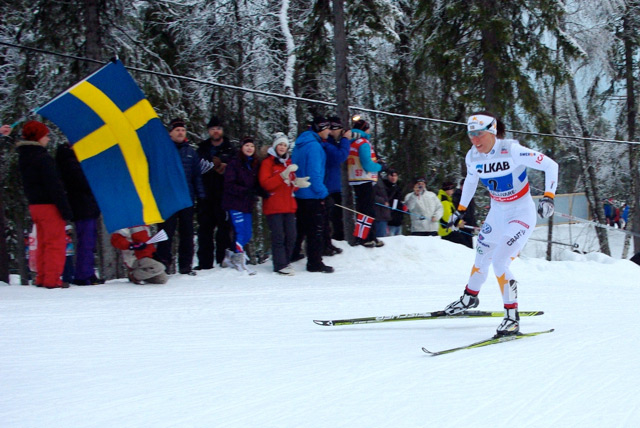

GÄLLIVARE, Sweden – It was more or less a foregone conclusion that Norway would win today’s 4 x 5 k World Cup relay.
After all, how many relays hasn’t Norway won recently? Their team was particularly stacked for today’s edition, with Saturday’s winner Marit Bjørgen and runner-up Therese Johaug on tap, as well as sixth- and eighth-place finishers Vibeke Skofterud and Martine Ek Hagen.
While Skofterud initially faltered (she took the wrong lane at the lap, and Sweden said they would protest the fact that Norway received only a warning), over the second half of the scramble leg she made up ground on the leader – who also happened to be her teammate, Heidi Weng, skiing for Norway II. The pair tagged off together, with a slight lead over Ida Ingemarsdotter of Sweden and, surprisingly, Virginia de Martin Topranin of Italy.

But that’s where things got interesting. Johaug took over for the second classic leg, and was expected to extend Norway’s lead and ski away towards the usual blowout. But the reigning Olympic and World Champions never again had a lead of over ten seconds. While Sweden faded and Italy shot towards the back, Kikkan Randall of the United States built on a solid scramble leg from Holly Brooks and actually gained ground on Johaug.
“I knew that it’s a fast course, but I wanted to play it safe so I made sure I started off with a little bit left,” Randall, who had started with an 11.7 second deficit, told FasterSkier. “I caught up with those girls in front of me and sat behind them for a little bit. And then I just took a good line around one of the corners and got in front of them and thought, well, we’re already halfway through this race, I’d better go. And then I looked up and, whoa, Johaug is right there. I need to go after her!”
That extra motivation allowed Randall to turn in the fastest second-leg time in the entire race. Staying ahead of Randall was no easy task, even for Johaug, who responded to questions from the Norwegian press about whether relays were simply a walk in the park for her team.
“Everybody has to do their job,” she told NRK. “It’s not just going out there and being first. But today, we did our jobs.”
When Johaug tagged off to Martine Ek Hagen, her lead had been cut to eight seconds – which actually could have caused some anxiety. At just 21 years old, she has little World Cup experience and has competed in only one relay, at least year’s opener in Sjusjøen, Norway. There, she competed on Norway’s fourth team, and she didn’t stand out. Nevertheless, she was called on to replace veteran Kristin Størmer Steira. Hagen was nervous.
“I am inexperienced and thought they would keep the same team [despite yesterday’s results],” Hagen told Norwegian newspaper Dagbladet. “I felt that if I did a bad leg or fell in a ditch, then I would be doing a disservice to the whole team.”
If there was an opening for the U.S. – or perhaps for another team, like Sweden or Finland – this was surely it. And with third-leg skier Liz Stephen out for blood after a frustrating crash in yesterday’s race, it looked like the Americans had a chance.
“I was just chipmunking around,” Stephen said of her leg. “I didn’t know what was going on. I just looked ahead and wanted to catch red. I didn’t look back, it wasn’t about who was behind me, I just was going for the red. I wanted to hand Jessie [Diggins] off right with [Marit] Bjørgen.”
Stephen couldn’t quite catch Hagen, but she put in a valiant effort, cutting the lead to just four seconds while preventing Sweden and Finland from gaining any ground. But Hagen was strong.
“I think Martine did a fantastic job,” Johaug told Dagbladet after the race. “It’s not easy to just go out there on the first team for Norway. You might get a little tight in the shoulders when you feel like you have to perform at that level. I told her that she had to ski her own race, and she did that in an awesome way.”