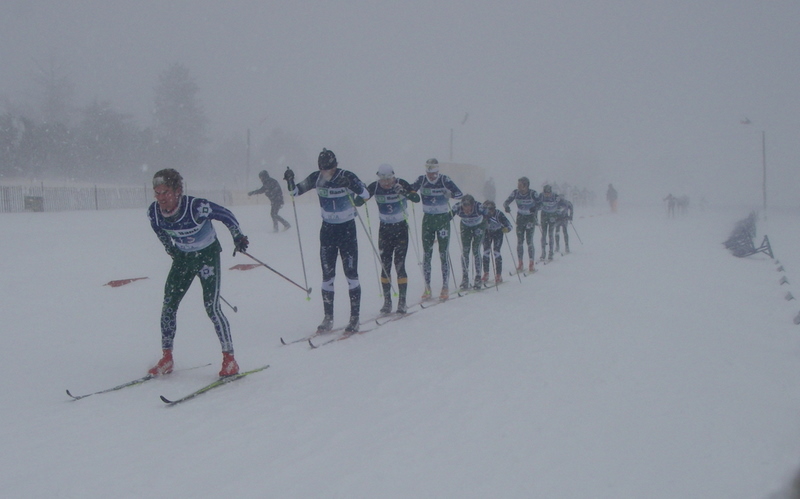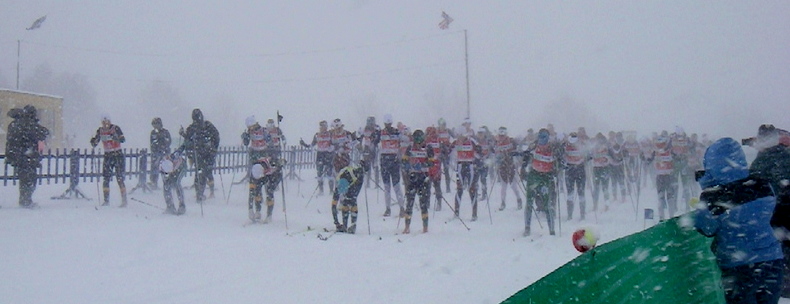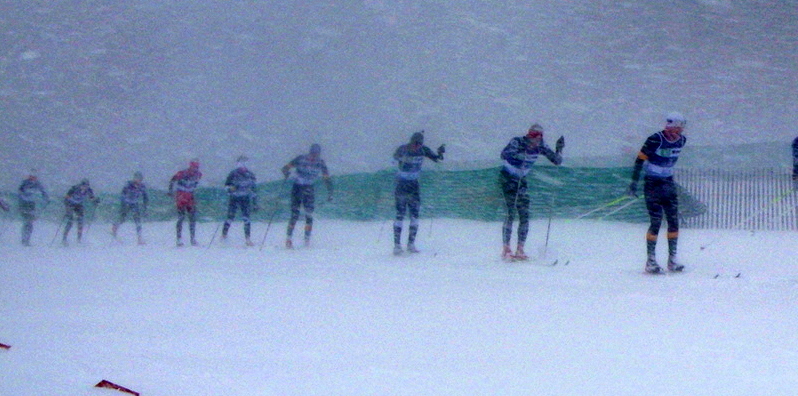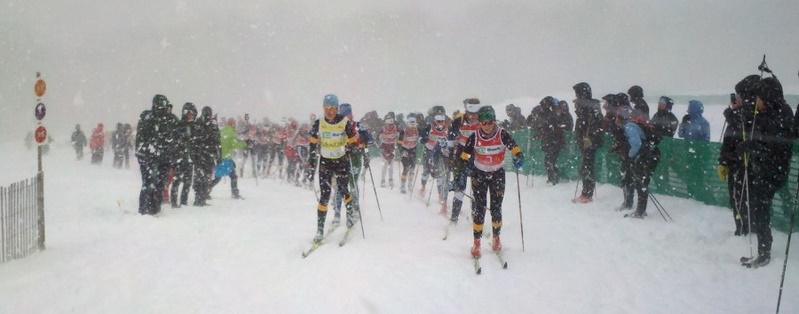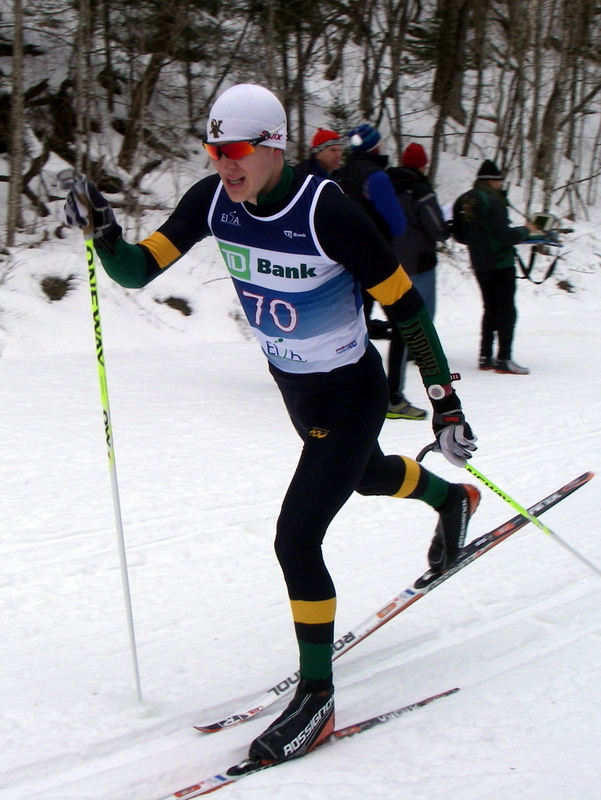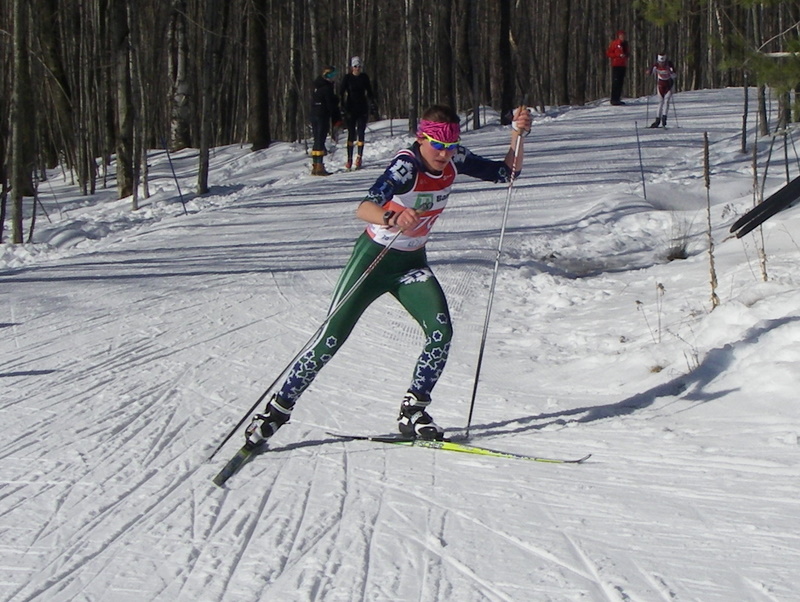

“It was absolutely nuts. A couple times coming through the field, one guy would turn to another and go, “Where are we?” and then we’d laugh and keep skiing, not sure we were still on the trail. Everybody knew it was going to be a slog, so the pacing was reasonable for a 1:20 race… in other words, comically slow for a 20K. I got really bored at about 7 or 8 K because we were moving so slowly, but then my wax started icing so I had something to focus on.”
– Gordon Vermeer, (DAR, 2nd place in 20k classic)
EISA Regionals

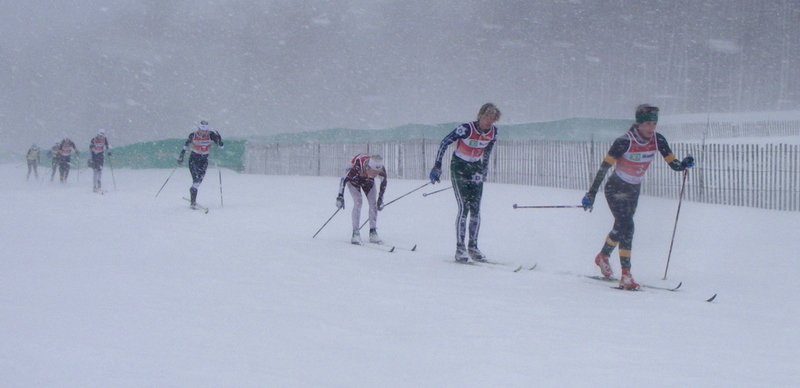
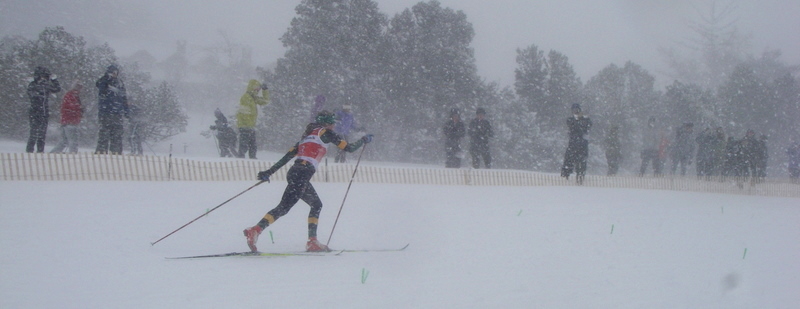
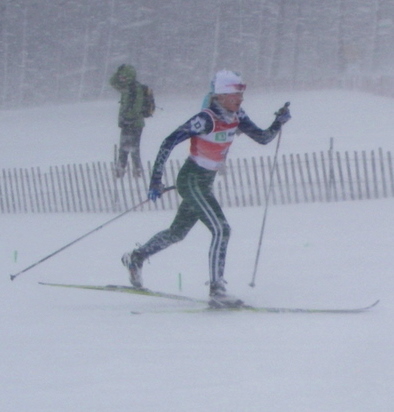
After a full “winter” of spring-like conditions, little snow, and numerous race relocations, Mother Nature got the last laugh at the last weekend of EISA races. Whereas the individual start 5 and 10k skate races were held on Friday with mild temps under partially cloudy and calm skies, Saturday’s concluding NCAA qualifying race, hosted by Middlebury College and held at Trapps Family Lodge in Stowe, Vermont, witnessed ten inch snow accumulations combined with 30 mile per hour wind gusts for blizzard-like conditions.
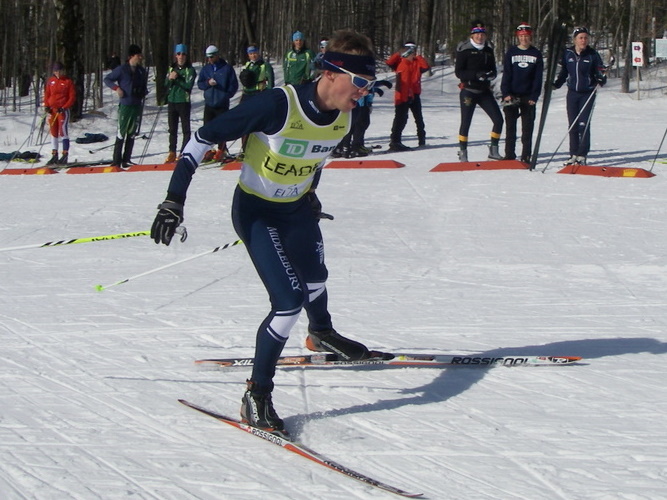
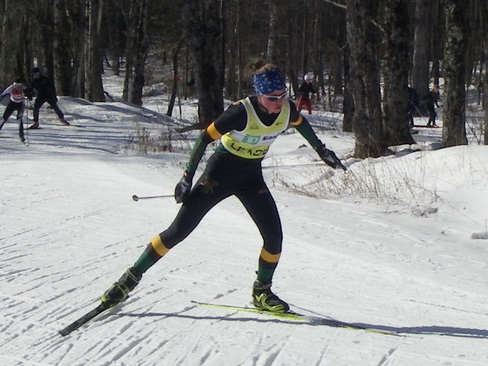
Racing in the yellow bib, Patrick Johnson of Middlbury won both skate and classic races handily, while UVM’s Caitlin Patterson and Lucy Garrec dominated their own respective races in the women’s field. All three race winners were also crowned EISA Points Champions in their victorious territories; Johnson was crowned points leader in both classic and skate techniques for the men’s EISA rankings, while Patterson tied with Sophie Caldwell of Dartmouth as points leader in skating and Garrec was the top-ranked classic skier. Caldwell was the EISA women’s combined points leader for the EISA.
Patterson and Garrec, along with teammates Amy Glen, Franz Bernstein, Alex Howe, and Dylan Grald, helped accumulate points toward UVM’s alpine-combined team victory. With a score of 955, UVM beat second place Dartmouth by 107 points, Middlebury and UNH in a tie for third with 724.5 points each.

5/10k Skate
Johnson out-skied his competition by a whopping two and a half seconds per kilometer – the only man on the EISA circuit to clock the two-lap course in under 25 minutes. Franz Bernstein (UVM) was the closest finisher, with a time of 25:02, while Dartmouth’s Sam Tarling finished third in 25:12.
Jordan Buetow (Bates) and Gordon Vermeer (DAR) rounded the top five, while UVM’s Alex Howe and Dylan Grald took 6th and 7th, respectively, to help the UVM men take the top team score.
In the women’s race, Patterson looked effortless on her way to a 16 second victory over the women’s field.
“I don’t know if I could really ever use the word effortless to describe ski racing,” Patterson wrote in response to the descriptor used by fasterskier, “there’s just too much effort and race-induced pain involved – but I was gliding very smoothly and particularly enjoying the uphills on the course at Trapps. Friday’s race certainly was the most natural and unforced I’ve felt during a race this year.”
When asked if she felt she was peaking now, just in time for NCAA’s, Patterson responded, “only time will tell.”
“My season has had a few ups and downs”, wrote Patterson, “not all of which are reflected in the carnival results, but I feel like I am progressing toward faster racing.”
Garrec was the second fastest intthe 5k race, making for a 1-2 UVM sweep and top women’s team score. Dartmouth’s Sophie Caldwell was just 5 seconds behind Garrec, for third place, and Annie Hart (DAR) placed fourth. SLU’s Caroline Carpenter underlined the top five.

15/20k Classic Mass Start
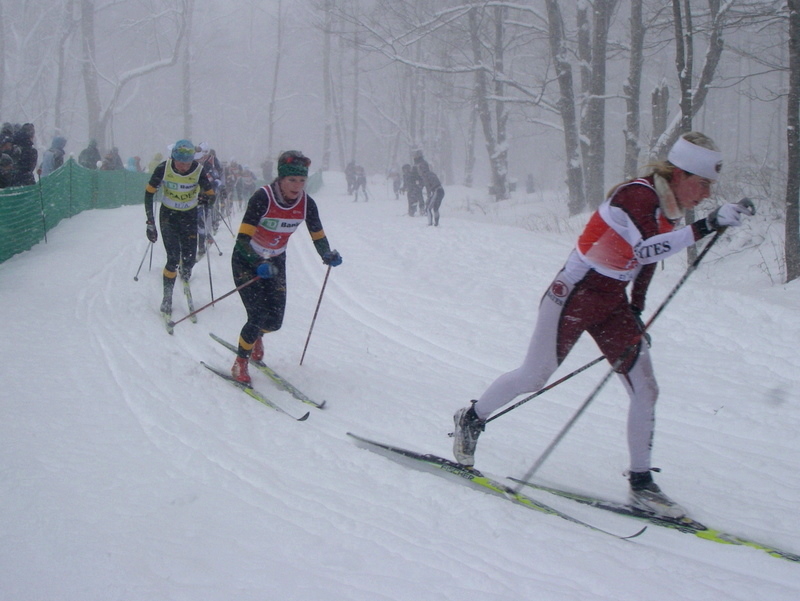
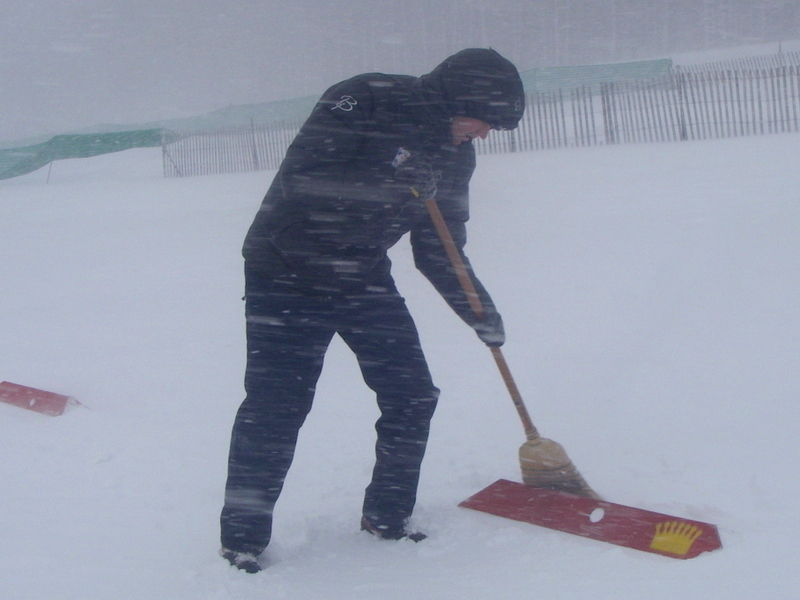
Though the groomers at Trapps Family Lodge did their best – sweeping the tracks just a couple hours prior to race time – quickening accumulations of snow combined with increasing wind gusts to obliterate the tracks around the 5k lap course by the time the gun went off for the women’s 15k race.
Caldwell, who finished second to Garrec, indicated by email to fasterskier that the varying conditions on course meant racers had to just ski as hard as they could and hope for the best. Caldwell said she was lucky that her skis started gliding better on the last lap of the race.
“I think Saturday was probably the craziest snowstorm I have ever raced in,” wrote Caldwell. “Not only was it extremely windy and snowy but the temperature was dropping so wax wasn’t really working (or I guess it was working too well!) and it made for one of the longest 15ks I’ve ever done. Skier’s wax would work at different points so people were constantly falling off and reconnecting to the lead pack, myself included.”
Garrec, who is known for her relaxed race form, used this style and technique to out glide her competitors across the finish line. Garrec wrote that although many racers were “getting really worked” about ski flex and wax, she tried not to get too caught up in the “pent up nervous energy”. Knowing that no one would have perfect race wax, Garrec decided to just do what she does best: stay relaxed, adjusted her technique to the variable conditions on the course, and then opened her stride whenever possible.

“When Sophie[Caldwell] and I broke away I tried to open up my stride on the last climb and it worked so I went. Amy[Glen] had quite a comeback on the last climb as well which was impressive - kind of going along with the idea that every part of the race was an opportunity to play to what was working.”
Garrec emerged from the woods alone and skied down the finish stretch without a challenge, crossing the line in a time of 1:05:12. Caldwell finished 20 seconds back and Amy Glen(UVM) another 28 seconds behind for third place.
Also in the top pack of finishers were Isabell Caldwell (DAR, 4th), Elizabeth Guiney (UNH, 5th), Beth Taylor (BAT, 6th), and Annie Pokorney (MID, 7th).
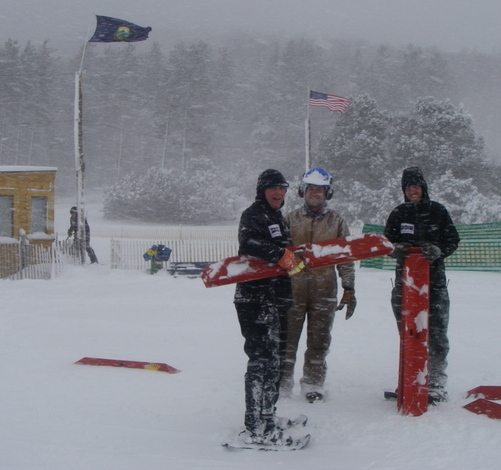
As an indication of the increasing intensity of wind and snow, the 70 women racers who lapped the 5k course three times did not help in clearing the diagonal tracks in time for the men’s race. Even lining up for the race was a feat, as the starting lanes with chevron-marked numbers were completely blanketed.

Dartmouth’s Gordon Vermeer, who ended up in second place behind Patrick Johnson, wrote to fasterskier about the race.
“It was absolutely nuts. A couple times coming through the field, one guy would turn to another and go, “Where are we?” and then we’d laugh and keep skiing, not sure we were still on the trail. Everybody knew it was going to be a slog, so the pacing was reasonable for a 1:20 race… in other words, comically slow for a 20K. I got really bored at about 7 or 8 K because we were moving so slowly, but then my wax started icing so I had something to focus on.”
Though several different men took the lead throughout the race, no single person was willing to blaze the track for too long. As the crowd waited for the lead pack to emerge from the woods near the finish, it was a solitary figure that appeared from the swirling white: Patrick Johnson , poling doggedly toward the line, had gapped the lead pack by enough distance in the final kilometer to not be caught by a finish line sprint.