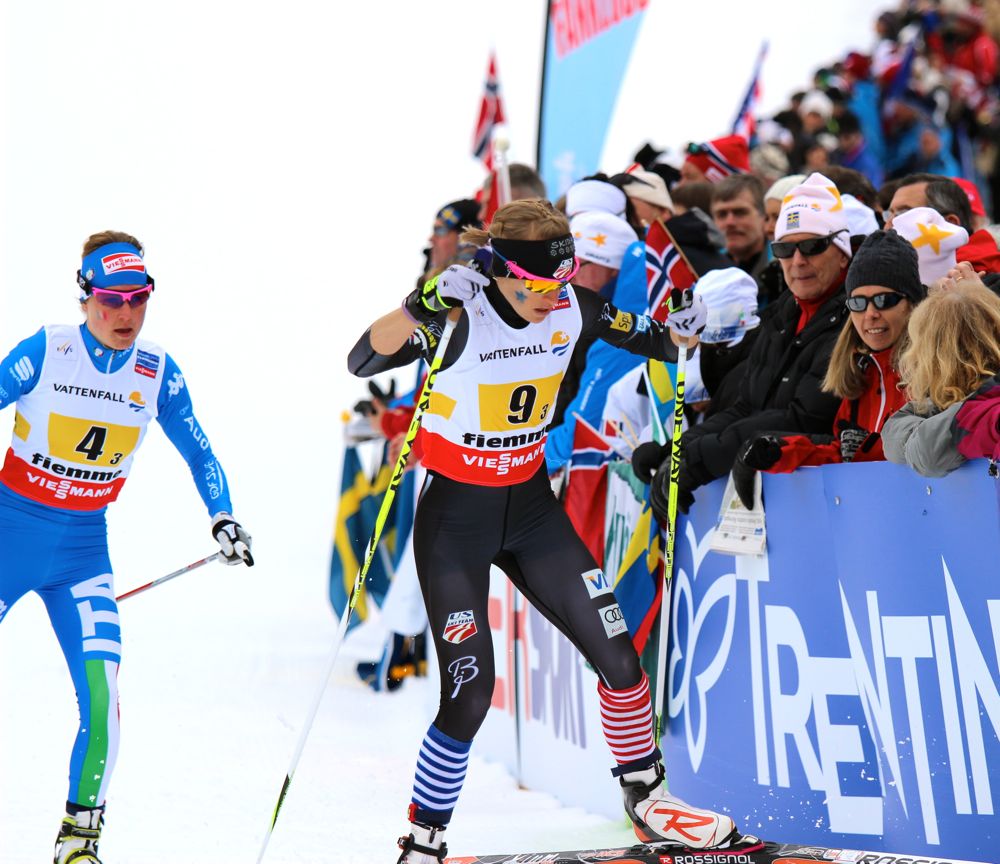
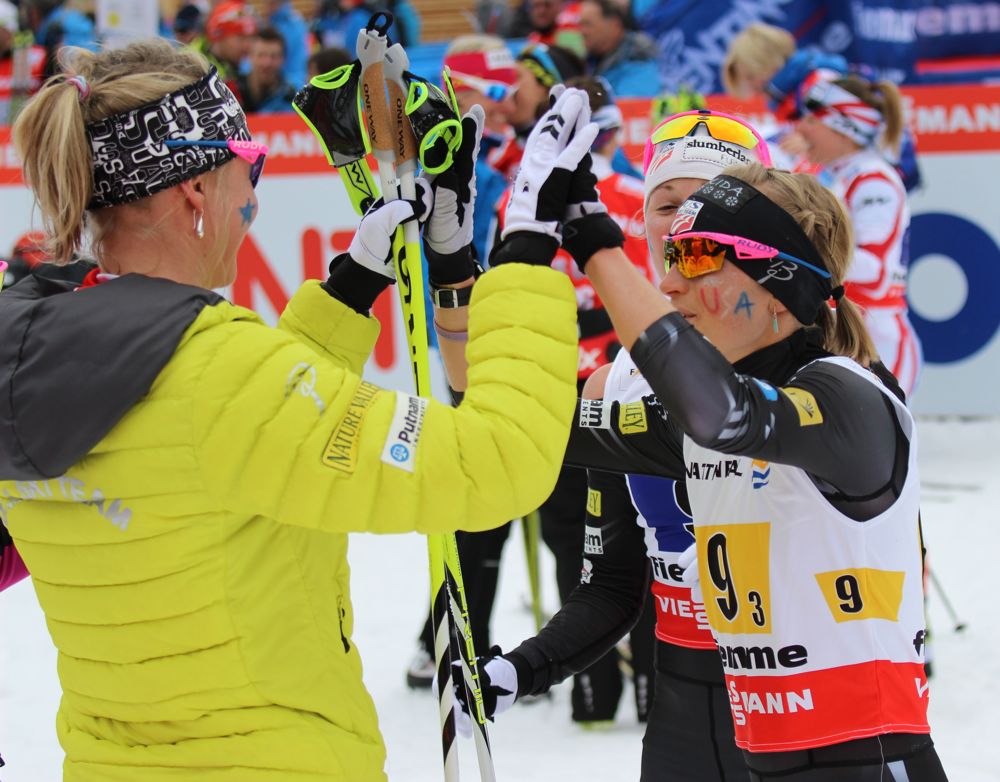
Liz Stephen on her way to bringing the team from ninth to fourth in the third leg of the World Championship 4×5 k relay on Thursday. Jessie Diggins kept the team in fourth in the anchor leg for the best relay finish the United States has ever had.
FasterSkier’s coverage of the 2013 FIS Nordic World Ski Championships in Val di Fiemme, Italy, is brought to you by the generous support of Fischer Sports.
VAL DI FIEMME, Italy – After producing enormously significant results at World Championships this week and with confidence from a bronze-medal relay performance in Gallivare, Sweden, this season, expectations were high for
Sadie Bjornsen, Kikkan Randall, Liz Stephen and Jessie Diggins in the 4×5 k on Thursday. They’ve tasted the podium and wanted to reach it again, but after four gutsy legs the Americans had to settle for fourth place behind Norway, Sweden and Russia, 26.6 seconds out of third.
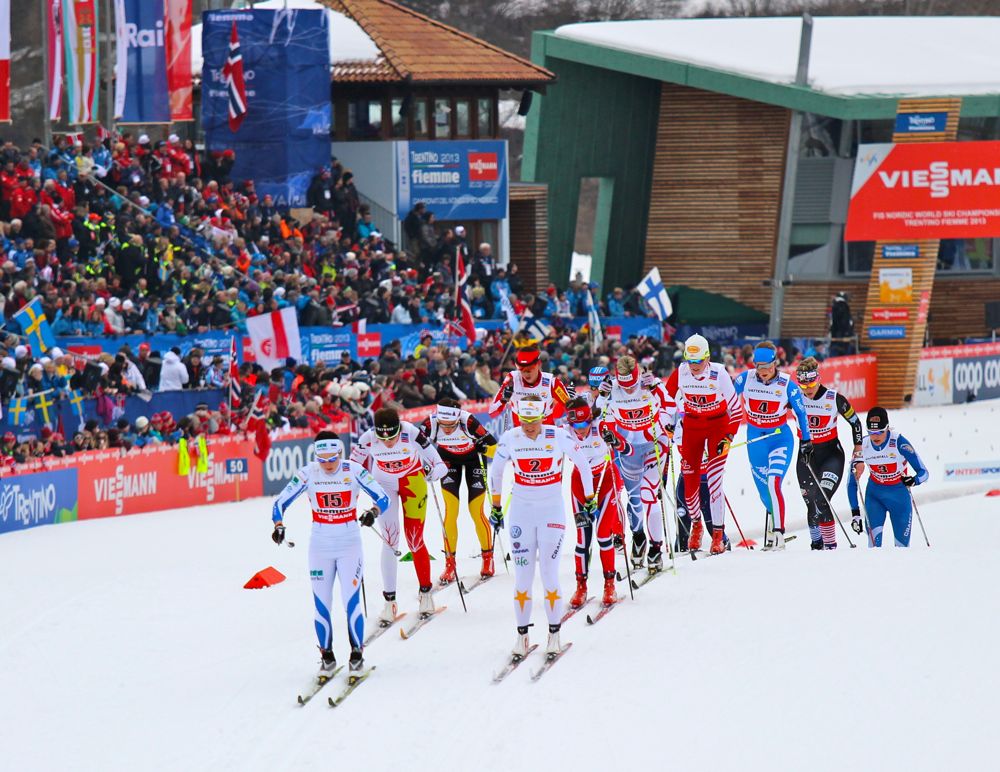
Sadie Bjornsen (bib 9) skis in the pack during the first leg’s second lap through the stadium.
“As a team you always hope for a medal, but man, fourth feels like a medal to me today,” Stephen said. “I mean, everybody skied their hearts out. Jessie could have easily decided that fifth was good enough and she couldn’t get fourth, and on that last climb she just decided, ‘I’m getting fourth.’ And she did it. And to me, that’s a medal.”
Fourth is the best result the United States has ever had in a relay, men’s or women’s, at a World Championships or Olympic Games. Bjornsen’s and Randall’s positioning in the classic half of the race set Stephen up to make a huge jump from ninth to fourth in the third leg. Diggins, after getting passed by a charging Yulia Tchekaleva (RUS), kept motoring on her own to catch Finland on her last lap and keep the Americans in fourth by well over ten seconds at the end.
“At first I was so disappointed in myself for losing the medal, because we were catching on,” Diggins said. “It was really hard not to be able to stay with the Russian girl, but I tried my best and you have to be satisfied with that because I couldn’t have pushed any harder.”
All her teammates felt they poured every ounce of energy they could muster into the race. The circumstances might not have been perfect for each of them, but at the end of the day they knew they skied with what they had.
“I think you could talk to every one of those girls and they could find places where they got tangled up or died over the top of a hill, but that’s relay racing,” said U.S. Ski Team women’s coach Matt Whitcomb. “It’s a testament to just how strong we are… It’s not just one person, it’s about us all putting it together.”
Bjornsen started things off for the Americans to keep the team in a fighting position. The early pack was a jittery one that featured at least one tangle between Germany and Finland on the first lap, but Bjornsen largely stayed out of trouble. She briefly caught a ski in the fence at the top of the course, but progressed to tag off to Randall in sixth place in a close group just behind Austria and Germany.
“It was pretty good,” Bjornsen said of her leg. “Midway through those girls took off and from the back you couldn’t really tell. All of a sudden I looked up and they were gone, and I just scrambled and tried to chase them down.”
She lost a bit of contact with the two women directly in front of her with the hiccup with the fence, but kept the opportunity there for Randall to catch back on.
“I had to try to tell myself to get up quickly, but unfortunately the two other girls had taken off and from there it was just chasing all the way until the end,” Bjornsen said.
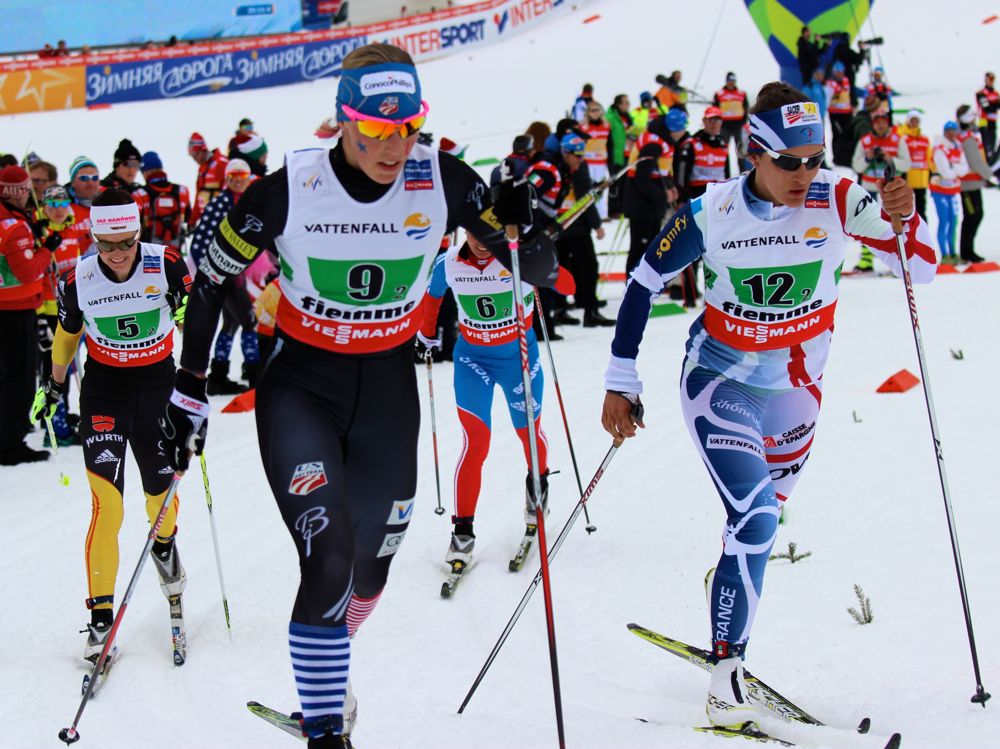
Kikkan Randall leaves the stadium with France and Germany on the second leg of the relay.
The second leg, as Randall willingly acknowledged afterward, was perhaps the Americans’ weakest. She left the stadium on the tails of Finland and felt “comfortable” making up ground to a small pack with Germany and Austria on her first loop, but on her second time through the course her legs got “kind of flooded” and she lost ground. By the time she tagged off to Stephen the U.S. had dropped to ninth, though still within striking distance of Germany and Austria.
“It wasn’t the leg I wanted to have today,” Randall said. “It was going pretty well on the first lap but the second lap I just didn’t have anything to go to. It’s frustrating to be so close to a medal today knowing that my leg could have mattered that little extra bit, but I skied with what I had today. The trend of the distance racing isn’t so good right now.”
Though Randall felt at fault for a loss of positioning, Stephen skied the fastest third leg in the entire field to put the team back in the hunt. Demonstrating the same intensity she showed two days prior in the 10 k, she scampered up the climbs to drop her nearest competitors and catapult the U.S. from ninth to fourth. When she gave Diggins the tag they were 25 seconds behind Finland in third and eight seconds ahead of Russia.
“I don’t like clingers, I don’t want people on my tail, I don’t like to be on people’s tails,” Stephen said of her skiing. “I just like to go out as hard as I can and drop people, because in a sprint I will lose every time… I pretty much just always want to go by, and I had no idea how much space I had between the next girl. I didn’t look back and I just went, so no strategy at all, I guess.”
Diggins had her work cut out for her on the last leg to hold the position. With Finland so far in ahead and a strong Tchekaleva closing in from behind she was forced to do the work to close in on third while attempting to keep Russia at bay. But Tchekaleva, the bronze-medalist from the 10 k, proved too much for her on this particular day and passed the young American on the first lap.
“I didn’t have any possibility to reach her for a long time, but I saw her just on the length of my hand,” Tchekaleva said through a translator. “So first I tried to reach [Diggins] and then I saw the Finnish girl.”
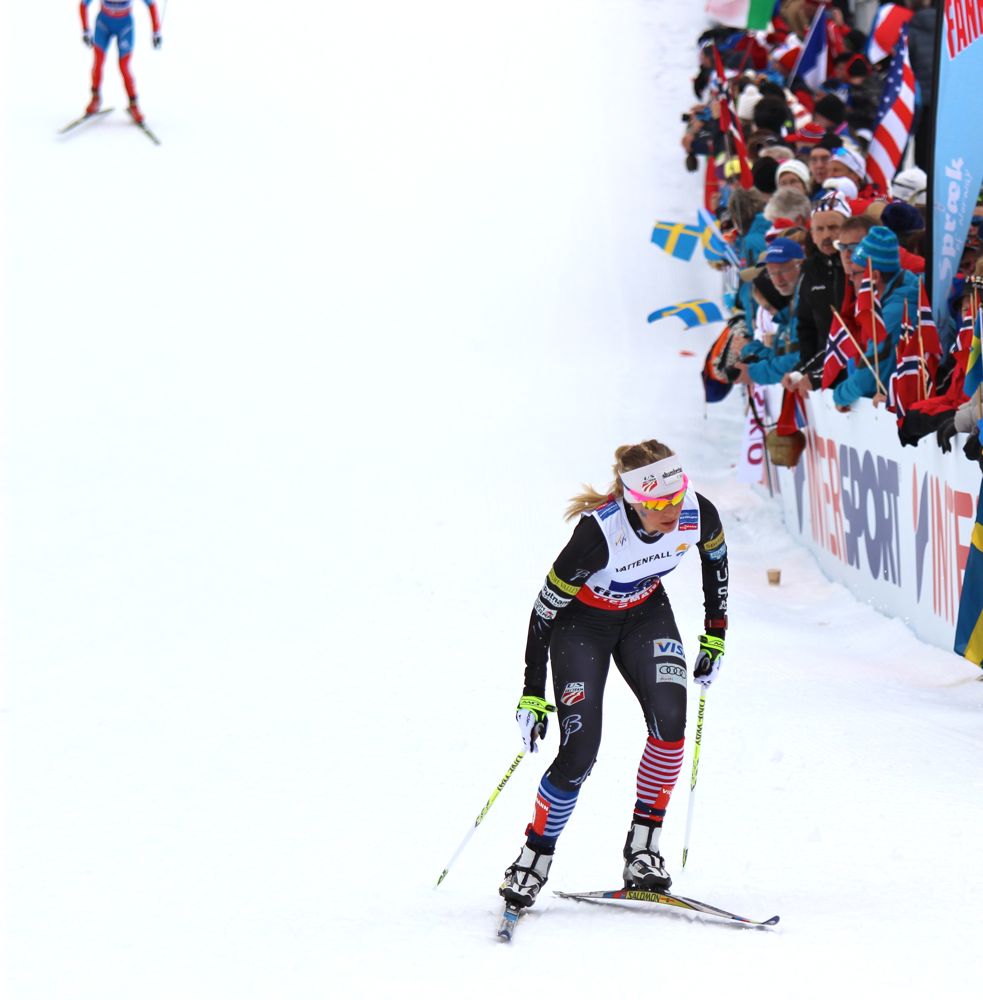
Jessie Diggins begins the anchor leg with Russia in hot pursuit.
When Russia passed her, Diggins avoided getting discouraged with the help of teammates telling her from the sidelines that Finland’s Riikka Sarasoja-Lilja was losing steam.
“It was hard,” Diggins said. “Russia had passed me and I was like, “Aw man, hang on, hang on, hang on.’ You never know what happens, maybe she’ll trip or something, you can’t give up. And coaches kept telling me ‘Finland’s dying, hang on!’ But it’s so hard to keep pushing when you’re just skiing by yourself. But I could hear the coaches yelling and my teammates were so awesome cheering.”
Diggins caught and passed Finland near the top of the last climb on the last lap of the course.
“She was fading and I was trying so hard to just not lose us a place,” she said.
Those that watched the race from the top of the course could see that Diggins completely redlined in the last few minutes.
“Jessie caught Finland on the last climb and just switched on all her anaerobic fibers,” Whitcomb said. “I mean, she was yelling over the top of the last hill she was so exhausted. Just like, ‘Ahhh!’ And absolutely put Finland well behind her so she could ski into fourth.”
Diggins collapsed after the finish and Finland came through 11.4 seconds later. After being initially disappointed with missing the podium, she reasoned that cutting their ninth-place finish from Oslo two years ago by over half was a positive day.
“If we keep on that trajectory it’s looking pretty good [for next time],” Diggins concluded.
It’s worth mentioning that the women’s team’s lineup was a tough decision for coaches to make. Ida Sargent and Holly Brooks were alternates, but Whitcomb believes either of them would have made excellent replacements.
“It’s much easier when you have only four candidates, but we have six,” he said. “We’ve had several instances this year we’ve had to make some very tough calls. All six women have outgrown our World Cup start quota and that’s particularly the case at World Championships, where you can only start four. So it’s a great problem to have, but not an easy one to have.”
On the whole, the fact that the team was encouraged but not unequivocally happy with the best relay finish the U.S. has ever had says a lot about where the team expects itself to be competitively.
“We know for sure [a medal] is possible now,” Randall said. “When we all put together solid legs, we’re right in the fight and we were so close today. Sadie skied great, she skied right where she needed to, I was in there until 2 k to go, and Liz and Jessie obviously skied fantastic. We’re so close to being medal-worthy. Yeah, I’m personally disappointed to be the one that was kind of at fault today, but I think a year from now at the Olympics it could be a really exciting event for us to look forward to.”
Whitcomb concurred.
“I’m really happy with today,” he said. “We had four girls that skied our hearts out and we have two more sitting in reserve that could have also skied their hearts out and served as legitimate substitutions. I’m more encouraged than I ever have been, as we head to the end of these championships and start focusing towards Sochi, on our prospects for winning a relay medal. Fourth place is always difficult, but we definitely don’t see that. We see one of the best results we’ve ever had as a team that is coming together more and more every day that passes. There’s no team here today in the world that is more hungry for Sochi now, to repeat this race.”