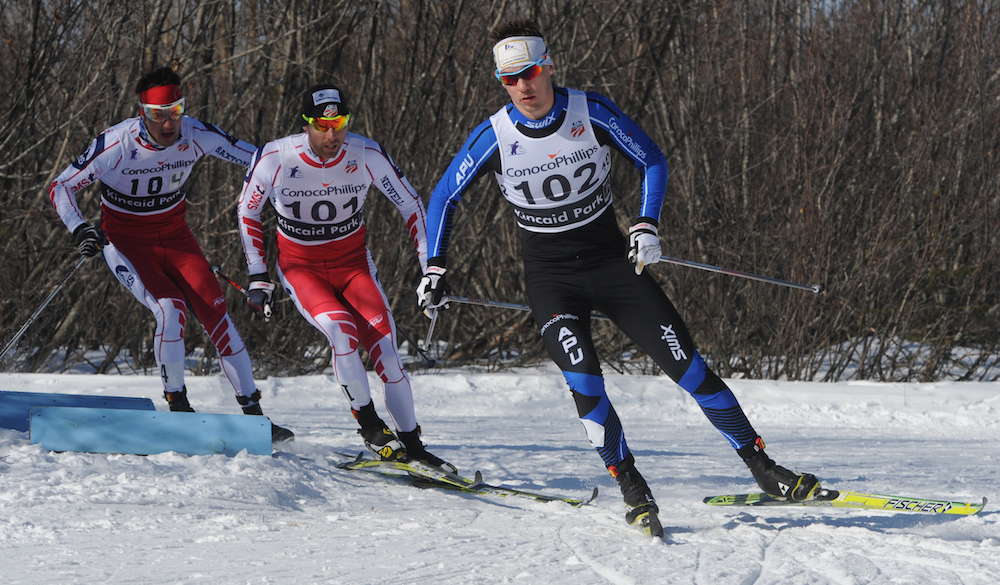
Alaska Pacific University’s Reese Hanneman (r) leads Andrew Newell (c), of the Stratton Mountain School (SMS) T2 and U.S. Ski teams, and Benjamin Saxton (SMS), in the men’s classic-sprint final at the Super Tour Finals at Kincaid Park on Sunday in Anchorage, Alaska. The three went on to finish in the top 3, with Newell first, Hanneman second and Saxton third, but Newell was relegated for obstructing Hanneman and listed as sixth. (Photo: Bill Roth/Anchorage Daily News)
ANCHORAGE, Alaska — Andy Newell’s victory was over almost as soon as he’d finished. The U.S. Ski Team member’s lane switch in the last 80 or so meters before the finish of the men’s 1.4-kilometer classic sprint final at SuperTour Finals on Sunday prompted several jury members to convene once he finished first.
In the second lane from the right out of four lanes to the finish, Reese Hanneman of Alaska Pacific University (APU) had been trailing Newell slightly, who was farthest right, before Newell decided to shift left to the inside of a slight lefthand curve before the final straightway.
He had to accelerate to do so and needed to leave enough room between him and Hanneman before jumping across his lane, two tracks to the left. Hanneman, who’s lived and trained in Anchorage for the last five seasons and is originally from Fairbanks, later said he had to stand up for a second and the move cost him a chance at winning. Newell claimed he had the space and went for the opening.
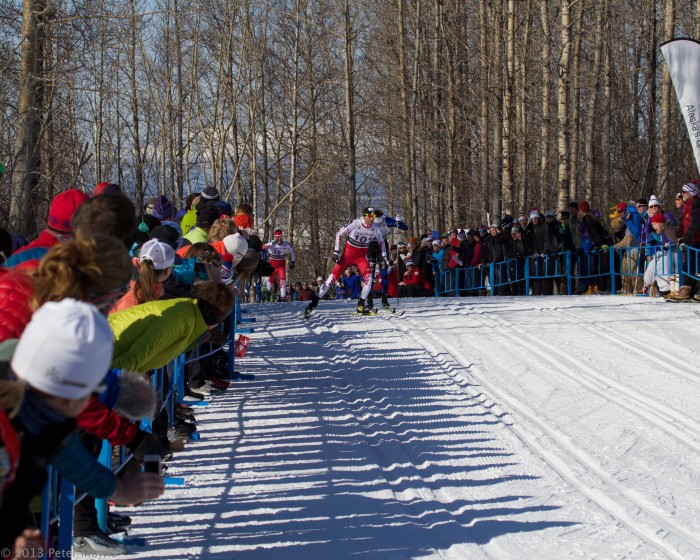
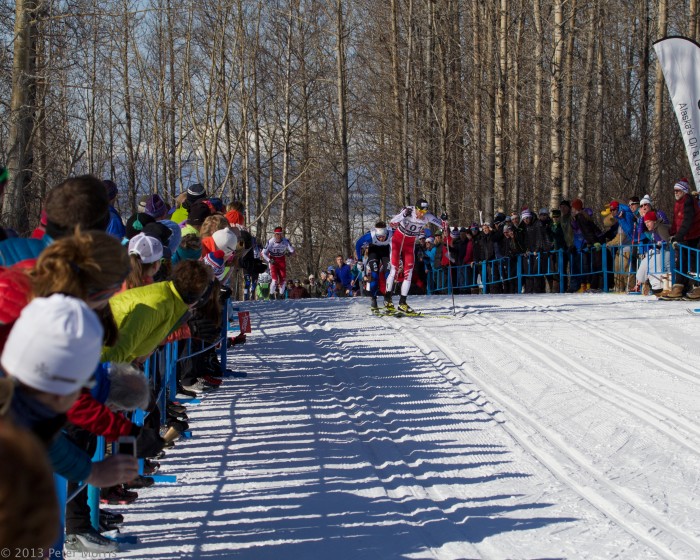
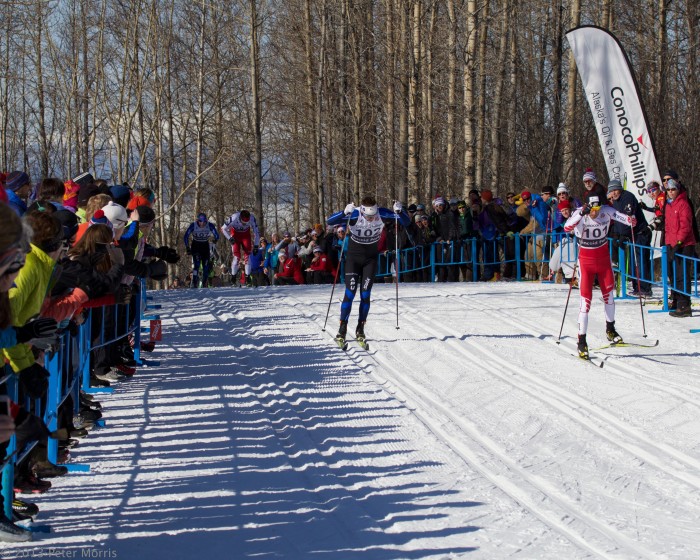
Andy Newell (SMST2/USST) changing lanes 80 meters before the finish of Sunday’s classic sprint final at SuperTour Finals in Anchorage, Alaska. (Photo: Peter Morris)
Andy Newell (SMST2/USST) changing lanes 80 meters before the finish of Sunday’s classic sprint final at SuperTour Finals in Anchorage, Alaska. (Photo: Peter Morris)
Andy Newell (SMST2/USST) changing lanes 80 meters before the finish of Sunday’s classic sprint final at SuperTour Finals in Anchorage, Alaska. (Photo: Peter Morris)
The two double poled to the line, where Newell stayed ahead of Hanneman by several meters through the finish. Hanneman tossed his head back in disappointment — it was the one low point of an otherwise picture-perfect day. Warm sun, consistent conditions, and for Hanneman, a win in each of the preceding heats with the exception of the qualifier, in which he placed second to Newell by 2.6 seconds.
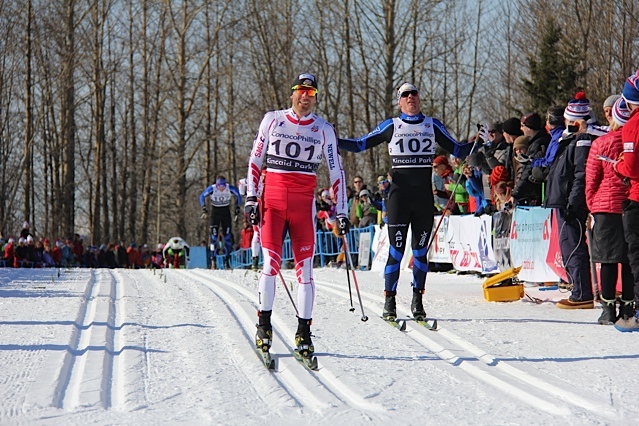
Andy Newell (101) beat Reese Hanneman (102) to the finish of Sunday’s 1.4 k classic sprint final, but was later relegated to sixth in the heat for obstructing Hanneman about 80 meters before the finish. (Photo: Rob Whitney)
In the final, Hanneman had to come to grips with losing to Newell in the end-all race of the day. In first for much of the 1.4 k loop, which included a gradual downhill into a tight right corner and long descent before the big climb back up, Hanneman initially attacked at the bottom of the final hill known as Elliott’s Climb and led halfway up.
Newell followed him closely and pulled up alongside Hanneman some 200 meters before the finish, then the two raced side by side over the top. Skiing in the same suit for the same team as Newell, Ben Saxton of the Stratton Mountain School (SMS) was the next closest competitor a few seconds back.
Just after the crest before the flat to the finish, that’s where the moment in question went down. That’s what sent APU head coach Erik Flora running to the finish to meet with jury members after the two finished. According to Hanneman, the jury was already aware of the incident and in the process of discussing whether to deny Newell of the victory because of obstruction.
About an hour and 45 minutes later, the announcement was made: unofficially, Hanneman had won, and everyone else in the final had moved up one place — Saxton to second, Tyler Kornfield (APU) in third, Pat O’Brien (Craftsbury Green Racing Project) in fourth, and Dakota Blackhorse-von Jess (Bend Endurance Academy) in fifth. Newell was relegated to sixth with a competition suspension.
A 15-minute protest period allowed Stratton coaches to file the first official protest of the day, in which they opposed the decision to penalize Newell. Twenty-five minutes later, the jury arrived at their decision: Hanneman would remain the classic-sprint champion and Newell was sixth.
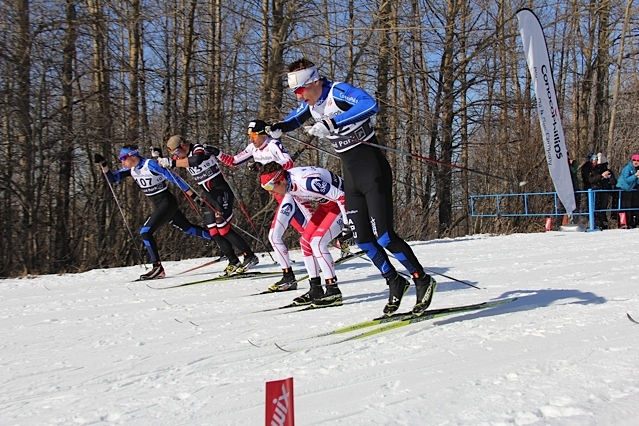
Start of the men’s final at the SuperTour Finals classic sprint on Sunday at Kincaid Park in Anchorage, Alaska. (Photo: Rob Whitney)
It wasn’t the way anyone wanted it to happen.
“I would rather win without all that shenanigans, but that was one of the few times I’ve actually felt like a move really kind of did affect the race,” the 24-year-old Hanneman said. “So that’s why I wanted to stand behind that.”
As the jury informed both men of their decision inside the timing trailer the finish, Hanneman sat on a table looking down and Newell stood up, smiling. He wasn’t happy. If anything, he was in awe.
“I don’t see how that’s possible. … I don’t really now what they’re thinking,” Newell said. “I think they’re kind of beginners in there.”
For someone who laughed as he said he’s “been to a lot of TD meetings in my life,” Newell’s frustrations were easily understood. Hanneman got it and initially didn’t want to rock the boat. Second was a great result, but he stood behind his coaches’ decision to follow up with the jury. Hanneman is known as one of the most social guys on the circuit, amiable and friends with a lot of people. Newell’s also highly respected at the domestic and international levels.
“That’s what I want it to be. I have nothing against anybody, I don’t want anyone having anything against me,” Hanneman said. “But I don’t want people to abuse that and ski all over me because I’m a nice guy.”
As for the official decision, technical delegate Bill Rogers said Newell was issued a competition suspension for obstruction, something that wouldn’t affect other races this week.
“Basically we had the jury made a decision based on evidence, Andy Newell protested that and so we did have a closed jury meeting, which involves interviewing both the athletes and then separately meeting to go over the evidence,” Rogers said.
The process itself involved calling the athletes and their coaches to the table, which convened outside then moved into a private meeting inside the timing trailer, to review video and photos. Hanneman argued that Newell skied over his skis: “They have pictures of video of him just mobbing all over my gear,” he said.
Newell couldn’t say whether there was contact or not, but said he made a point to get far enough ahead of Hanneman to make his lane change.
“I also changed two tracks over instead of one so I wouldn’t block him,” Newell said. “I guess according to the video he stands up a little bit, but I am barely even going near the tips of his skis, if they did at all.”
The process itself, according to Newell, involves the jury asking each skier involved “was is it intentional or not, is the first question … and it was obviously not intentional,” he said. “And then, was there an advantage or not? And that’s kind of the shady area. It’s not like Reese lost much time, he did maybe stand up for a second and so if you call that an advantage or not, I don’t know because it didn’t really affect the outcome of the race.”
Hanneman said the jury asked about contact first, to which he said, “Absolutely. Was it intentional? That’s more up to [Newell], I have no clue. But to say you accidentally switched tracks? That doesn’t happen. … I felt like once he made that move that kind of decided the race. It seems like they made the right decision even though I wish they didn’t have to make that decision at all.”
Newell knew that because his previous infraction at World Cup Finals last weekend was a technical warning, equivalent to a yellow card on the World Cup (for skating while changing lanes in a classic sprint), it wouldn’t affect anything at SuperTour Finals. Plus, the season was over after these races in Anchorage.
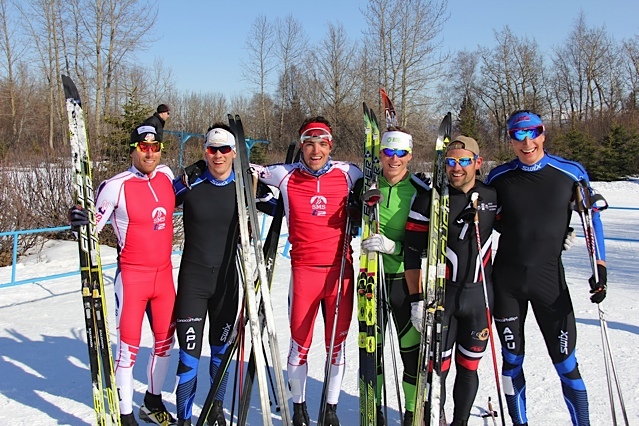
Friends ’til the end: the men’s final, all of which placed in the top sixth (from left to right) Andy Newell, Reese Hanneman, Ben Saxton, Pat O’Brien, Dakota Blackhorse-von Jess, and Tyler Kornfield. (Photo: Rob Whitney)
The penalty cost Newell $650 dollars in prize money, plus the $100 he and his coaches had to put forward to protest. At the end of the day, he made $100 for sixth place, which the protest fee negated.
On the flip side, Hanneman took home an extra $250 dollars for the win ($750 for first as opposed to $500 for second). It was the SuperTour leader’s second victory in national-caliber classic sprints this season after he won his first national title at U.S. Cross Country Championships in the classic sprint in January.
But he also knew what the other side of a jury decision felt like. In December, Hanneman was disqualified for skating in a Besh Cup classic sprint — which he initially won.
“I know that it’s not fun but when you do something that’s questionable, like when I skated in Besh Cup, I was like, well, I shouldn’t have done that and know I know,” he said. “You need that to reinforce … Andy needs to know that he can’t make a move like that because it’s not fair racing. You have to some checks like that to keep people in line.”
According to Rogers, “Unfortunately, obstruction in sprints is common. I think it’s very normal.” He declined to explain how the jury made their final decision and the evidence they considered in the process.
At the end of the day, Hanneman was a champion and the 20-year-old Saxton had one of the best races of his career in second — up there with his runner-up finish in the skate sprint at 2014 nationals. He finished 4.74 seconds behind Hanneman (who ultimately won in 3:25.56) and held off Kornfield by 1.49 seconds.
For Kornfield, the 2012 national classic-sprint champion, third stood as his best race of the season. He finished 4 seconds ahead of O’Brien, who ended up fourth, and 13 seconds ahead of Blackhorse-von Jess in fifth.
Saxton said Hanneman and Newell took off toward the bottom of the hill, over the first roller on the way up to the finish. He was caught in the far left lane in fourth and unable to go with them. Despite the fact that he thought he could’ve stuck with them to the finish, Saxton said he was happy with his result — even if it was third at first.
“I haven’t felt this good all year. This was an incredible feeling,” Saxton said.
“Andy and Reese threw down World Cup qualifiers today so that’s pretty awesome,” he added, referring to Newell’s top time of 3:19.52. Hanneman was 2.6 seconds back in second and Blackhorse-von Jess advanced to the heats 4.09 seconds behind Newell in third. Saxton qualified fourth (+7.4).
Saxton went on to win his quarterfinal (as did Newell), as well as the first semifinal by 0.24 seconds over Newell.
“It’s pretty cool for me to get to race against Andy [and] experience that for the first time,” Saxton said. “[Watching him in the quarterfinals] it was incredible dichotomy between him and the other skiers. He’s so relaxed. It’s not that there technique is bad, but it’s just this innate tightness. There’s a laboredness in their movements.”
So to beat him in the semifinal was fun.
“In my semi, we went side by side up the hill, so it was cool to feel that pace and feel the turn of pace,” Saxton said. “It was exciting.”
Hanneman bested O’Brien in the second semifinal by 0.83 seconds. O’Brien and Simi Hamilton (SMST2/USST) also won their quarterfinals, but Hamilton placed fourth in the second semifinal, 2.6 seconds behind Blackhorse-von Jess in third, and did not make the final.
“Reese is skiing incredible,” said Saxton, Hanneman’s roommate in Europe last year, shortly after the finish. “I could not be happier for that guy.”
Alex Kochon (alexkochon@gmail.com) is a former FasterSkier editor and roving reporter who never really lost touch with the nordic scene. A freelance writer, editor, and outdoor-loving mom of two, she lives in northeastern New York and enjoys adventuring in the Adirondacks. She shares her passion for sports and recreation as the co-founder of "Ride On! Mountain Bike Trail Guide" and a sales and content contributor at Curated.com. When she's not skiing or chasing her kids around, Alex assists authors as a production and marketing coordinator for iPub Global Connection.