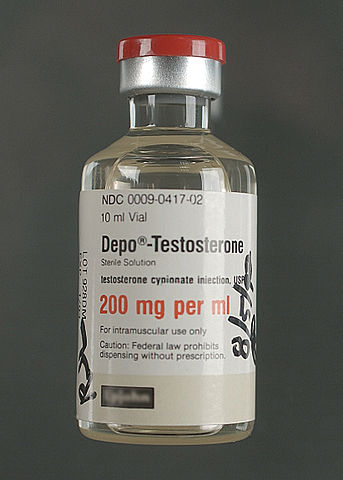
Oslo researchers Dr. Ingrid Egner, Dr. Jo Bruusgaard, Dr. Einar Efterstøl, and Dr. Kristian Gundersen found last year in mice that a 14-day dose of testosterone had notable effects on muscle cells long after they had stopped administering the drug.
How this works in humans isn’t a completely straightforward conclusion, but Dr. Gundersen said in a University of Oslo press release at the time that testosterone and other anabolic steroids could easily have effects for a decade or longer after drug use had ceased.
“The specific time aspect is of course challenging to extrapolate from mice with a lifespan of two years to humans who live for 80 years,” he said. “However, the cell nuclei in humans are known to be very stable. If the muscle memory mechanism in humans is similar to what we observe in mice we could be talking about several decades of advantageous effects.”
The specific mechanism for the long-lasting effects appears to be a proliferation of nuclei in muscle cells. There is yet to be a testosterone scandal in nordic sports, but this opens the door to the idea that other performance-enhancing substances which induce hypertrophy, or the enlargement of muscles, may have similarly long-lasting effects.
As explained in The Journal of Physiology, both testosterone propionate (administered by a pellet inserted under the skin) and overload exercise (simulated by shortening the muscle itself) caused an increase in the cross-sectional area of muscle fibers. The increase in muscle size were greater with testosterone than with overload training. Similarly, both treatments increased the number of myonuclei in muscle cells.
The difference between training and drug use emerged later. After giving the mice a 14-day dose of testosterone, the researchers then waited three months, during which both the drugged mice and the control group received no treatment. After that rest period, there were still 42% more mynuclei in the muscle cells of the drugged mice than in the control group. The cross-sectional area, meanwhile, was indistinguishable between the two groups.
So why do nuclei matter? Each nucleus has associated structures which can synthesize the proteins the cell needs. This could help with muscle repair after damage, for instance.
The study proved a long-standing scientific hypothesis: that there is some sort of “muscle memory” that allows muscles that have previously been trained to more easily regain mass if they are trained again later. No other researchers had ever found the mechanism for this, but it appears to be the myonuclei.
The researchers pointed out that this finding may have many beneficial applications – for instance, in helping reduce frailty in an aging population. If hard exercise and/or drug application can produce long-lasting effects, then we might develop public health strategies that could reduce injuries to octogenarians.
But the implications for sport are not as positive.
“Our data demonstrate that in least in mice, an episode of testosterone use may recruit a long lasting pool of excess myonuclei, and a persistent increased ability to regain muscle mass by resistance exercise in the absence of further steroid exposure,” the authors concluded. “Thus, the benefits of even episodic drug abuse might be long lasting, if not permanent, in athletes. Our data suggest that the World Anti-Doping Code calling for only 2 years of ineligibility after a conviction for steroid use (WADA, 2009) should be reconsidered.”
Furthermore, while the study only addressed testosterone, an anabolic steroid, the effect may be similar for other performance-enhancing substances currently banned by WADA.
Insulin-Like Growth Factor I (IGF-I) has long been banned in sport and recently came to the fore when it was mentioned in the records of a South Florida clinic providing performance-enhancing drugs to baseball players.
While there is yet to be any work done specifically examining whether IGF-I increases the number of myonuclei, it does contribute to the proliferation and differentiation of muscle cells – and many researchers (for example, here) have concluded that this by definition means increasing the myonuclei.
Furthermore, human growth hormone (HGH) increases the circulating levels of IGF-I, leading to the same effects. Thus doping with HGH or IGF-I could, potentially, also have very long-lasting effects.
One thing that might be comforting to nordic fans? Because erythropoietin (EPO) is not associated with muscle hypertrophy, there are unlikely to be long-lasting effects of previous EPO doping – at least through this mechanism. On the other hand, proof of the existence of a long-term cell memory mechanism suggests that other such mechanisms are not out of the realm of possibility.
Chelsea Little is FasterSkier's Editor-At-Large. A former racer at Ford Sayre, Dartmouth College and the Craftsbury Green Racing Project, she is a PhD candidate in aquatic ecology in the @Altermatt_lab at Eawag, the Swiss Federal Institute of Aquatic Science and Technology in Zurich, Switzerland. You can follow her on twitter @ChelskiLittle.