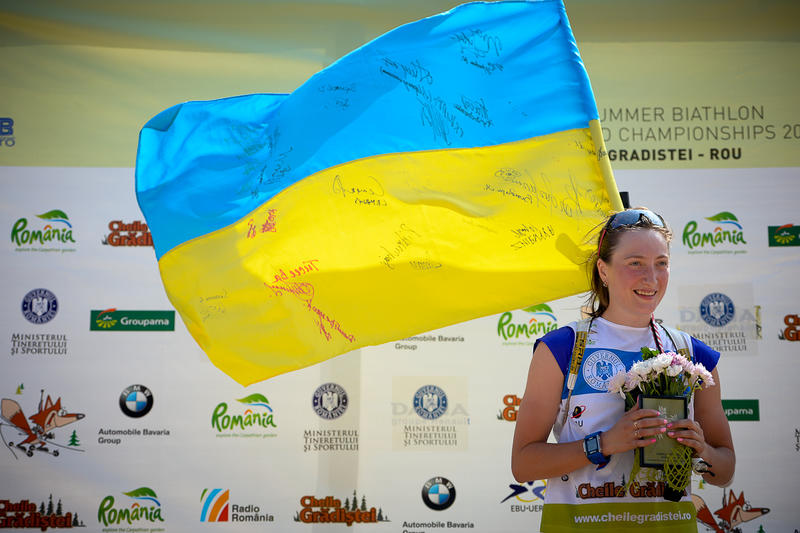
Olga Abramova after winning gold in the pursuit competition at Summer Biathlon World Championships in Romania in August 2015. She had also won the sprint. (Photo: IBU/Evgeny Tumashov)
Olga Abramova, a Ukrainian World Cup biathlete whose “A” sample from a January competition tested positive for the banned hormone mildronate, has waived her right to have the “B” sample examined.
That means that her case will proceed immediately to an International Biathlon Union (IBU) Anti-Doping Hearing Panel, which will decide whether and how to discipline the athlete.
Mildronate was added to the World Anti-Doping Agency’s Prohibited List effective January 1st, and Abramova’s sample was collected just ten days later. Originally designed as a growth-promoting hormone for livestock, mildronate is widely acknowledged to be performance-enhancing and is even advertised as such.
In the press release announcing the advancement of the Abramova case, the IBU also revealed that a second athlete had tested positive for the same substance at an IBU Cup competition in January. As the IBU Cup is a second-tier circuit, it is assumed that this means it is not a star athlete, but the IBU has not revealed the athlete’s name.
“The idea is to protect the right of the athlete until they either declare that they are indeed positive, or a B sample confirms this,” IBU Vice President for Medical Issues Dr. Jim Carrabre wrote in an email to FasterSkier. “Once this occurs then we truly have a positive finding. If we announce the athlete’s personal information before this and they deny the medication and the B sample does not confirm that we have a case, then we have a personal privacy violation.”
Meanwhile, Carrabre told Norwegian broadcaster NRK that he wanted to re-examine anti-doping samples from the 2014 Olympic Games in Sochi, Russia, given ongoing investigations into doping in the country and a WADA investigation which alleged Russian state security interference in the Sochi laboratory. The Russian Anti-Doping Agency, RUSADA, is currently not in compliance with WADA and testing has been outsourced to the United Kingdom.
“My point to NRK was that I would like to overview the tests that were done, the results of those tests, and integrate this as a total picture of things going on around the time of Sochi,” Carrabre explained in an email. “We would be remiss not to do this especially in light of the [WADA] Independent Commission’s findings and recommendations. As you know, there are many issues with Sochi including test sample destruction.”
“I must say that I’ll be very surprised if one laboratory managed to cheat,” Besseberg said.
Carrabre reportedly met with WADA officials to exchange information, however several in the biathlon community are questioning whether the IBU has any jurisdiction to do such an analysis since the International Olympic Committee (IOC) is responsible for testing at all Olympic Games.
Russia is also pushing back on the allegations.
“The International Olympic Committee has previously made a statement that they have no doubts about the transparency of the Olympic Games in Sochi in terms of doping,” Natalia Zhelanova, Advisor to the Russian Minister of Sports, told R-Sport News, according to a translation. “At the Games for anti-doping it should not be RUSADA and our laboratory- doping control was by the IOC.. This occurs at any Olympic games and only the IOC may decide to conduct further analysis of doping tests.”
The former Russian Biathlon Union director Sergey Kuschenko further asserted that his athletes had been clean.
“These charges are baseless,” he told R-Sport. “As for the Russian national team, at the time of the Olympic Games, we were confident that our athletes have no such problems.”
Chelsea Little is FasterSkier's Editor-At-Large. A former racer at Ford Sayre, Dartmouth College and the Craftsbury Green Racing Project, she is a PhD candidate in aquatic ecology in the @Altermatt_lab at Eawag, the Swiss Federal Institute of Aquatic Science and Technology in Zurich, Switzerland. You can follow her on twitter @ChelskiLittle.