“Play True” is the World Anti-Doping Agency’s (WADA) outward appeal to athletes, coaches, doctors, a myriad of handlers and advisers, and, ironically, anti-doping labs to keep sport clean.
On one hand, “Play True” could be interpreted as a baseline demand, something educators might instill in elementary students. But it also reads like a plea; for fans of the sport and most importantly participant athletes themselves, there’s a lot to lose when athletes “Play False”.
The sharpened teeth behind words like “Play True” are the tests administered to detect doping and potential bans for positive tests, although WADA’s anti-doping arsenal also includes a confidential digital hotline for individuals to file claims of suspected doping.
On Oct. 25, WADA released its annual testing numbers in a massive document titled “2016 Anti-Doping Testing Figures.” The report itemizes every sample tested by the 34 WADA-accredited labs in 2016 and uploaded into WADA’s Anti-Doping Administration and Management System (ADAMS). The information includes all in- and out-of-competition tests on both athlete urine and blood, and results for Athlete Biological Passport (ABP) blood analysis.
The 2016 report does not include data or discussion of Anti-Doping Rule Violations (ADRVs). A discussion of 2016 ADRVs is expected sometime in 2018. The report does include the number of Adverse Analytical Findings (AAF) and Atypical Findings (ATF).
Here’s the simple appetizer before the full course: an AAF occurs when a sample contains a prohibited substance. An ATF, according to WADA, indicates that “while there may not be an adverse analytical finding, there may be some suspicion according to the results and that further analysis or investigation should be conducted.” After an ATF is investigated, it could lead to a negative result (the suspicion was not warranted), an AAF (something was found), or it may be canceled.
WADA stresses that in reading and interpreting 2016 Anti-Doping testing Figures report, “one single result does not necessarily correspond to one athlete. Results may correspond to multiple findings regarding the same athlete or measurements performed on the same athlete; such as, in the case of longitudinal studies of testosterone.”
Also, the number of AAFs in the 2016 testing report will not correlate directly to the number of ADRVs in 2016. Among other reasons, that is because some AAFs end up being explained by the athlete having a Therapeutic Use Exemption (TUE).
The Report’s Findings
Samples Analyzed and Reported by Accredited Laboratories in ADAMS)
It’s worth mentioning again the length and comprehensiveness of this report. FasterSkier created a Google spreadsheet to better understand testing results in three sports we cover: biathlon, cross-country skiing and nordic combined. This process simply allowed FasterSkier to compare testing analysis in these sports more efficiently, and you can see the spreadsheet yourself at the link above.
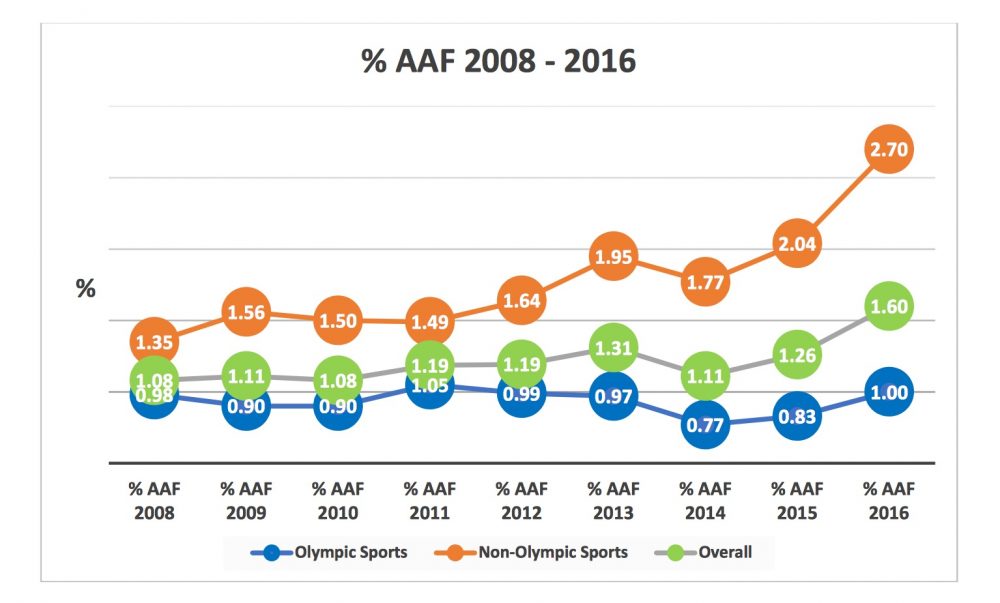
WADA articulated what it felt were the report’s highlights. The anti-doping watchdog advertised what it called a “noteworthy” development: that the total number of AAFs increased from 1.2 percent in 2015 to 1.6 percent in 2016. WADA also qualifies the total increase in positive tests as “partly related” to AAFs attributed to Meldonium — that drug was placed on the prohibited list in January 2016 without much consideration of how long it might stay in athletes’ bodies, or whether athletes had enough advance warning to stop taking the drug.
At the same time, WADA noted that the total number of samples tested decreased from 303,369 to 300,565 from 2015 to 2016. WADA claimed that despite the downturn in the total number of tests, the administration and efficacy of its tests contributed to the higher AAFs total in 2016 compared to 2015.
Totals
Starting with biathlon, there were 1688 total samples tested: 671 were in-competition urine samples, 39 in-competition blood samples, 859 out-of-competition urine samples, and 119 out-of-competition blood samples. Of those 1688 samples, 16, or 0.9 percent of the total, were considered AAFs (seven in-competition AAFs and nine out-of-competition AAFs, all from urine samples).
Terms and Abbreviations
(as referenced in FS spreadsheet)
IC: In‐Competition
OOC: Out‐of‐Competition
Sample: Any biological material collected for the purposes of Doping Control* Adverse Analytical Finding
AAF: Adverse Analytical Finding
ARF: Atypical Finding
GC/C/IRMS: Gas Chromatograph/Carbon/Isotope Ratio Mass Spectrometry (e.g.”IRMS”)
ESA: Erythropoiesis Stimulating Agent**
hGH Isoforms: Human Growth Hormone Isoform Differential Immunoassay
hGH Biomarkers: Human Growth Hormone Biomarkers
GHRF (GHS/GHRP): Growth Hormone Releasing Factors (Growth Hormone Secretagogues/GH‐Releasing Peptides)
GHRF (GHRH): Growth Hormone Releasing Factors (Growth Hormone Releasing Hormone)
GnRH: Gonadotrophin Releasing Hormones
HBT: Homologous Blood Transfusion
HBOC: Haemaglobin Based Oxygen Carrier
IGF-I: Insulin‐like Growth Factor‐I (and its analogs) Athlete Biological Passport
ABP: Athlete Biological Passport
IOC: International Olympic Committee
AIOWF: Association of International Olympic Winter Sports Federations
ASOIF: Association of Summer Olympic International Sports Federations
ADAMS: Anti‐Doping Administration and Management System
TUE: Therapeutic Use Exemption
Cross-country skiing accounted for 2135 total samples tested. 623 were in-competition urine tests, while 19 were in-competition blood tests. 1163 were out-of-competition urine tests, 330 out-of-competition blood tests. The sport had a single in-competition AAF and eight out-of-competition AAFs — again, all derived from urine samples. Out of all the cross-country samples tested, 0.4 percent were AAFs.
Nordic combined had 393 total tests. Eighty-eight of those were in-competition urine tests, six were in-competition blood tests. According to the WADA report, out-of-competition urine tests accounted for the majority of samples taken; 245 urine samples were analyzed and 54 out-of-competition blood tests were recorded. Nordic combined had two confirmed AAFs — both from in-competition urine tests. Of all the nordic-combined tests, 0.5 percent were AAFs.
How exactly should we read these tea leaves? It has been well-documented in the mainstream media, as well as in documentaries like Icarus, that historically, the anti-doping system can be gamed. Methods other than drug testing have shown that between 15 and 40 percent of elite athletes have intentionally doped at some point. With the low rate of AAFs in the three sports highlighted by FasterSkier, biathlon, cross-country and nordic combined, a few basic conclusions can be made.
With the low rate of AAFs in the three sports highlighted by FasterSkier, biathlon, cross-country and nordic combined, a few basic conclusions can be made: the possibility of doping and skiing undetected remains, but if the “Play Fair” mantra works, the majority of athletes are training and racing clean.
Tests for Blood Doping
Of importance to policing endurance sports like biathlon, cross-country and nordic combined is increased implementation of WADA’s Technical Document for Sport Specific Analysis (TDSSA). The TDSSA demands that certain sports conduct a mandatory minimum of tests to screen for specific drugs.
For both biathlon and cross-country, the TDSSA calls for enhanced testing for Erythropoiesis Stimulating Agents (ESAs) — think EPO. There’s also a required testing minimum for Growth Hormone (GH) and Growth Hormone Releasing Factors (GHRFs). As of January 2017, the current TDSSA calls for 60 percent of all samples in biathlon and cross-country to be tested for ESAs and 10 percent for GH and GHRF’s respectively.