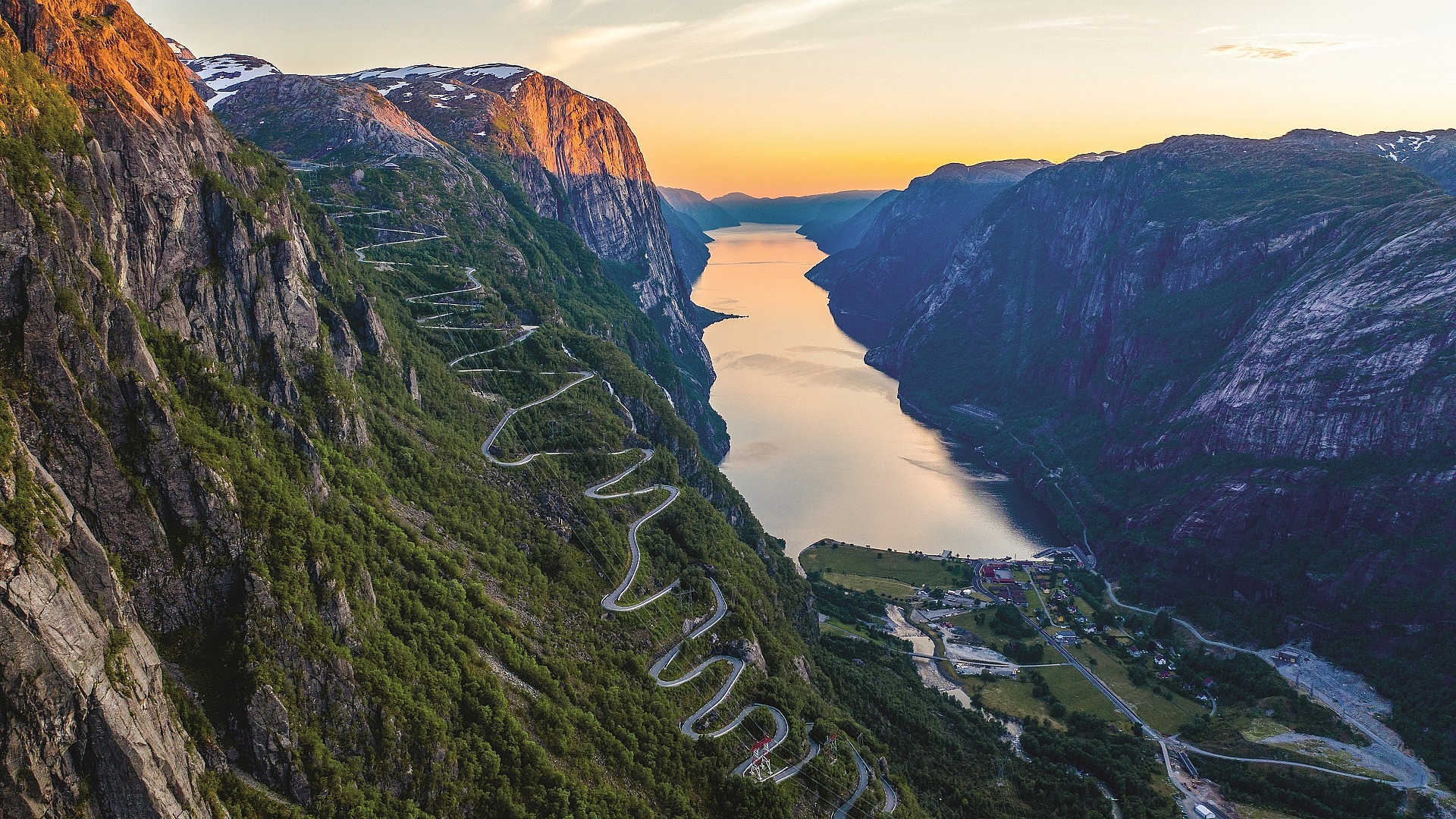
It’s the kind of event that explains Norwegian’s love for cross country skiing – it represents all they want to represent about themselves, and nothing else. In the humid, green summer, some of the world’s best winter athletes come to the coastal town of Sandnes in the country’s south for four days of roller skiing racing – the Blink Festival – in which spectators will pack nearly every inch of town center, mountainside, or arena that the course passes. On the first day, they literally climb up a straight up a fjord – the Lysevegen road, in the Lysebotn Opp, a 7.5 k climb featuring 27 hairpins that stagger when viewed from the air (see below). It’s the essential challenge of the festival. Taking a national obsession and turning it into an event that makes a display of why the country of Norway loves it. It thumbs its nose at the notion of challenge, of not being able to hold onto winter in the summer, and frankly, the limits of what a human should be able to do on skis.
Since its first running in 2006, the Lysebotn Opp has been an indicator of what’s to come not only the next winter, but longer down the road at the World Cup-level of skiing. Therese Johaug, and Charlotte Kalla both bolstered their dominant place in the women’s field over the years. The arrival of the United States Women as top-level contenders was also made apparent when Liz Stephen podiumed in 2012, and then won the climb in 2014.
Stephen’s win in 2014 was remarkable then, and is remarkable now. She was the only American to have taken the marquee event in Norway’s summer rollerski festival. That was until Wednesday, when Sophia Laukli won the Lysebotn Opp and introduced the whole of Norway (a country she’s a dual-citizen of with the United States) to another generation of American women capable of conquering the hardest skiing challenges that can be thrown at them.
The mass start 7.5 km freestyle climb began on the flat roads leading out of the tiny village of Lysebotn. On the start-line, Bib 1 belonged to Heidi Weng, who highlighted a field full of up-and-coming Norwegians and some of Europe’s best pros. Delphine Claudel and Flora Dolci from France were in the field, as was Nadine Fähndrich from Switzerland. Laukli wore bib 11. The course conditions were, as is expected and almost necessary in a fjord in Norway in the summer, rainy.
As the field rolled out, Sophia Laukli initially tucked well within the field, coming away from each split in the field in the leaders group. Those splits came mostly as a result of Heidi Weng (NOR) who controlled the front of the field on the lower part of the climb. Split after split occurred through the field, until a group of about ten skiers was left going into a tunnel about 2 km into the stage. The final break in the leaders occurred in the tunnel, and as the skiers came out of the tunnel on the course, three skiers – Weng, Dolci (FRA), and Laukli – made up the lead group, while Claudel (FRA) led the chase group, with Rahnihild Glørsen Haga (NOR) on her wheels.
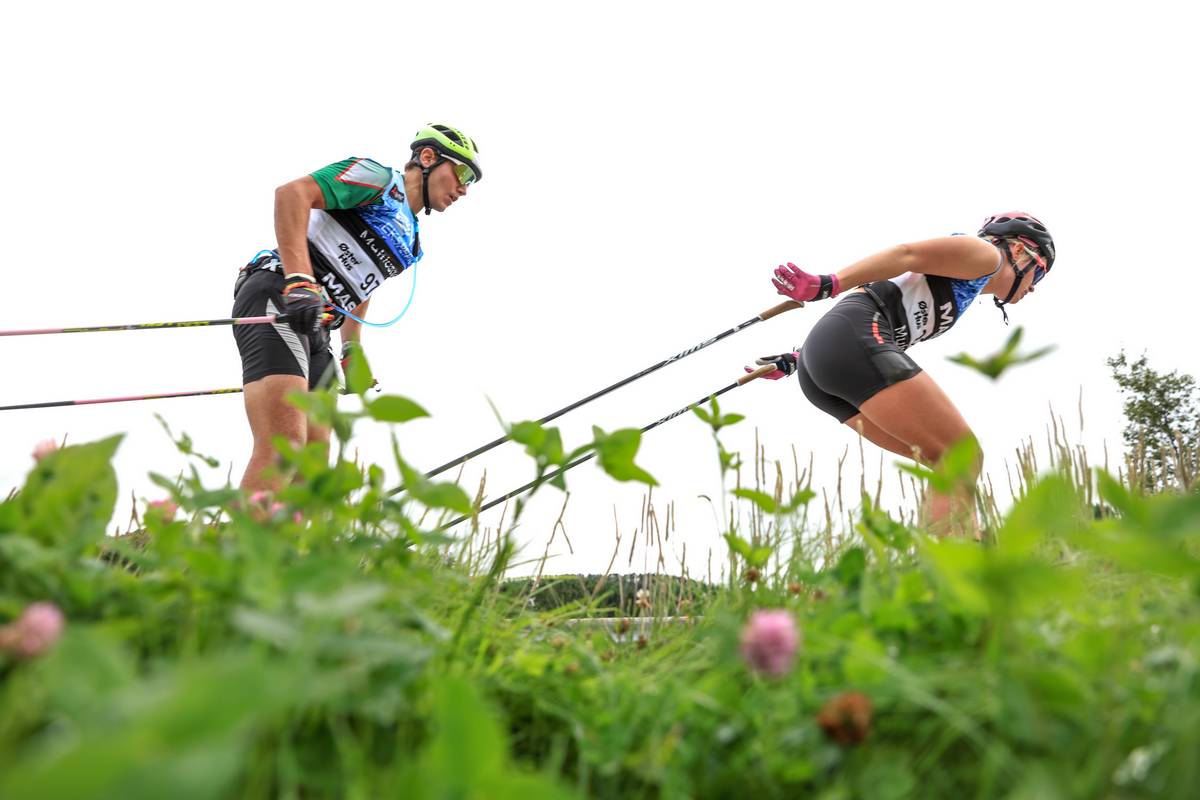
The trio of Weng, Dolci, and Laukli then set into taking turns on the front pace-making. It looked like something out of a Tour de France Mountain Stage broadcast, only that in the sport of skiing, there was more than just reading faces to aid in telling the viewer who was tired. As Dolci started to mix in V1 strokes alongside her upright V2, Laukli kept a steady V2 the entire way up, with powerful pushes holding a high tempo the whole way. The same principle at play in your local 10 k played out on the toughest rollerski climb in the world. Start to V1, and you might just be tired.
Dolci peeled off from doing her turn at the front soon after, which is when Laukli’s high-tempo V2 gained a telling bit of power. It was the moment she seemed to sense that what had been an unknowable challenge – you don’t often climb up fjords in a race setting – might just be her domain. It didn’t take a look or a pause, just a little pick-up.
As they rounded a corner and Laukli moved ahead, Weng matched her stroke-for-stroke. Then in an effort to regain the ability to do the pace-setting before the pace became too much, Weng put a burst in to get ahead of Laukli. It was too late. Laukli had already internalized that rare and thrilling feeling in ski racing where she sensed that she could keep going when others could not.