
 This coverage is made possible through the generous support of Marty and Kathy Hall and A Hall Mark of Excellence Award. To learn more about A Hall Mark of Excellence Award, or to learn how you can support FasterSkier’s coverage, please contact info@fasterskier.com.
It was a day for hard-working backup players to show what they can do . . .
A few weeks from now, the World Championships in Trondheim, Norway will include a Team Sprint, an event typically included on the roster at both World Championship and Olympic events. Today’s races in Cogne, Italy were scheduled to offer a dress rehearsal, of sorts, for teams likely to compete in Trondheim. But the best-laid plans of FIS officials are often undone by the many complications of the World Cup season, the complex and opportunistic fight for overall points, the aspirations of athletes trying to qualify for their national teams, and the injuries and illnesses that tend to plague winter endurance athletes. Cogne may have offered an opportunity for athletes and teams to practice the skills needed to excel in a World Championship event, but precious few nations fielded the actual teams that are likely to contend in Trondheim. No Johannes Hoesflot Klaebo (NOR) in today’s field, no Linn Svahn (SWE), no Jessie Diggins (USA). Nonetheless, the competition was hotly contested, and the victories well-earned.
The World Cup schedule did seem to recognize the iniquity this race might pose in calculating points standings; therefore, this Team Sprint offered no individual World Cup points. Racers would compete for prize money ($15,000 Swiss Francs for the victory), for Nations Cup points, and for the opportunity to claim the sport-immortality that comes with World Cup podium performances.

Team Sprint
The Aosta valley around Cogne has played host to World Cup Sprint events in the past, most recently as the site that celebrated the 1-2 finish of Federico Pellegrino and Francesco deFabiani in a Freestyle Sprint in 2019. In 2025, Italian hopes were again high, as indicated by the non-stop din of revving chainsaws and novelty AaaahOooga! car-horns that seem to accompany most Nordic ski races on the European continent. While the great victories of 2019 would not be repeated for the Italians, the racing was still fast and furious.
Ironically, the most successful Team Sprint teams are rarely made up of two pure “sprinters.” The event is simply too long: both team members end up skiing a 1.3 kilometer qualifying lap, AND three 1.3 kilometer race legs. For any sprinter, that’s a long day of racing, one favoring athletes who possess an ability to recover between highly intense Sprint legs (a quality more commonly found in all ’round skiers rather than in pure sprinters).
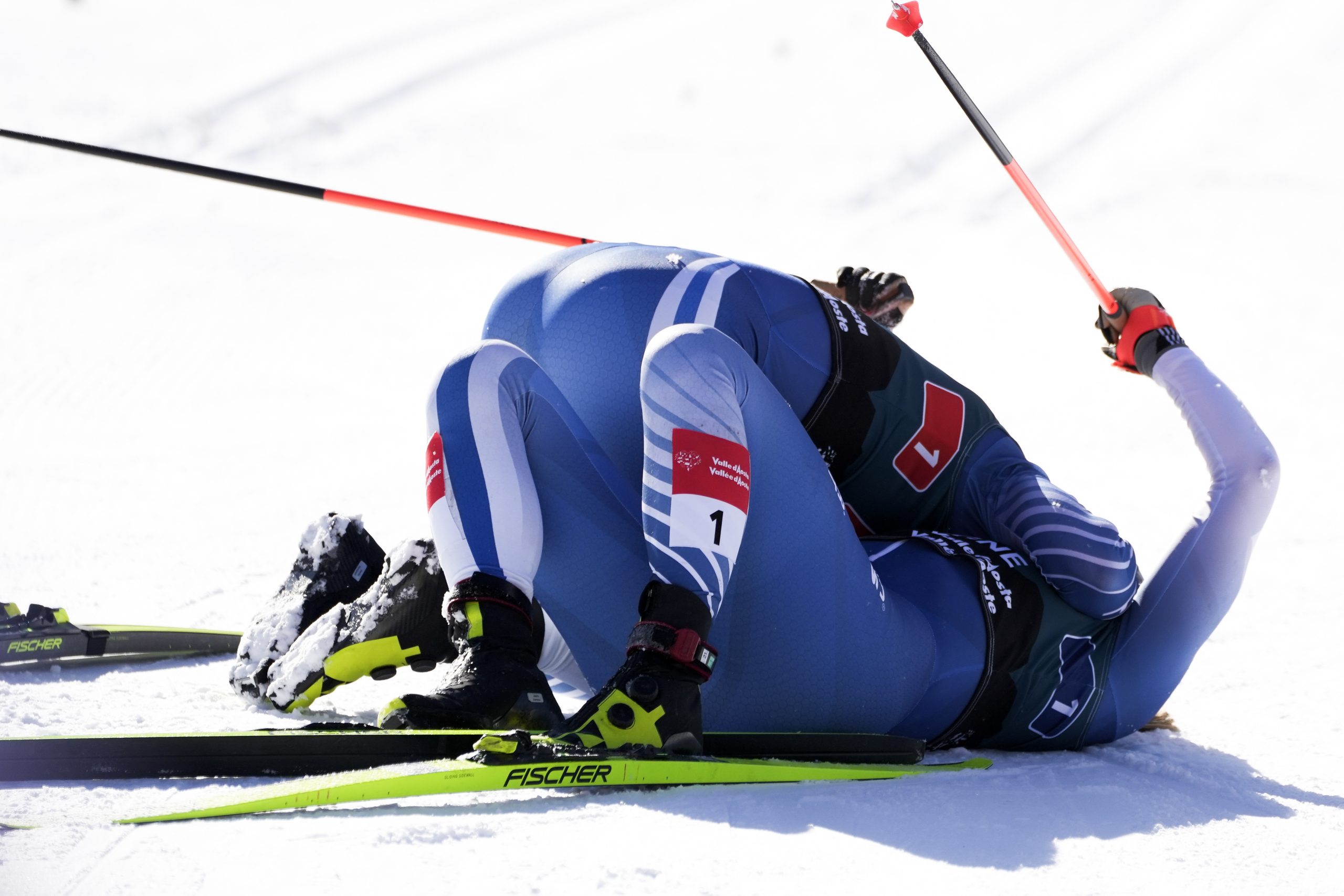
On the Women’s side of World Cup Team Sprinting, it’s been a few years of dominance for Sweden who has triumphed in every Team Sprint since 2021 (five straight events). But in Cogne, Sweden was pushed by both teams from Finland—with penultimate legs skied by Niskanen (Finland I) and Parmakoski (Finland II)—who pushed the pace. Even so, the lead at the final exchange belonged to Germany I as Laura Gimmler (part of an Olympic Championship duo with Victoria Carl in 2022) had surged to a decisive lead. The final leg would be up to Gimmler’s teammate, Coletta Rydzek. But again it was Finland who animated the race as Rydzek was caught mid-way through the final lap by Jasmi Joensu (Finland I). While Joensu stayed away to capture the win, Rydzek was overtaken in the final meters by Maja Dahlqvist (Sweden I) who made up four places in the final lap, capturing second place (with teammate Johanna Hagstroem).


