The five minutes Beckie Scott spent at the finish line in Soldier Hollow on February 15, 2002, lasted longer than most things in her career. She had crossed the line in what felt like third place. She thought she had a medal. She did not yet know.
“It was actually a photo finish,” Scott said. “There were about five full minutes where we didn’t know. And then it was announced.”
Her teammates, her coaches, and the wax technicians were already gathered in the pit, standing in the cold. The result came over the loudspeaker. Bronze. Canada. Beckie Scott.
“We went ballistic,” she said. “It was magic. By that point, a lot of the coaches and wax technicians had made their way down to the pit. We were sort of standing there all waiting, and then when it was announced, it was just chaos. But in the best possible way.”
The Canadian flag went up the pole in third position. The bronze, in the moment, was a win.
“There was no disappointment. We celebrated that medal like it was platinum. This was the first medal for Canada. It was a long shot. It was absolutely incredible and powerful to stand on. In that moment, I got to celebrate that and have that day, and that feeling, and all the joy that comes with it.”
What happened next is now part of cross-country skiing’s history. The two Russian skiers who finished ahead of her were caught for doping. The bronze turned to silver, then to gold. The flag that had risen for her in third place was wrong, but only because the truth had not yet caught up to the racing.
It would catch up eventually, though, and so would Scott, now an Olympic champion.
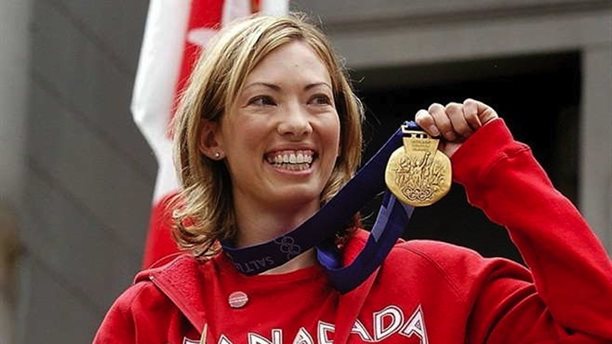
Beckie Scott with the gold medal she was awarded at a ceremony in Vancouver in June 2004. A former Canadian cross-country skier, Scott finished third in the 5 k pursuit at the 2002 Olympics but was later awarded gold when the two women ahead of her were disqualified for using performance-enhancing drugs. (Photo: Cross-Country Canada)
Scott grew up in Vermilion, Alberta, a rural community in the province’s northeastern region. Her parents were avid cross-country skiers and members of the local club. The trails started at the back of their property and ran into the provincial park. She could ski out the back door.
When the Jackrabbit program — the Canadian equivalent of the Bill Koch Youth Ski League in the United States — rolled out across Canada in the early 1980s, her mother adopted it in Vermilion and Scott came up through it.
“I developed just a real affinity and love for the sport, right from the start,” she said. “I was very inspired by the community. I really loved the community. I loved competing, and I just loved the idea that the harder you worked at something, the better you could do. So as a kid, it was all very exciting, and a lot of fun.”
The Vermilion club is now more than 50 years old. The trails are well used. It remains a rare facility for a rural Alberta town.
What was not rare, in the late 1990s, was the experience of a North American woman struggling on the World Cup. Scott was at the front of a group that did not yet exist. She was the best of her cohort, which was a difficult thing to be.
“Even when we started on the World Cup, when I was there, the results were abysmal. It was very, very poor performances. The results were nowhere near successful, that’s for sure.”
She remembers it now with a kind of dry humor. “I think it’s good that we had a good sense of humor, because there were a lot of days, if we weren’t laughing, we would have been crying. I do remember being completely devastated, often. Not just by being so far down the list, but by how far behind I was. That, to me, just seemed almost impossible. To see the gaps that I was seeing when I first started, in the era, I think we all know why the Russian women were skiing as fast as many of the men.”
She did not know that at the time. She thought she was just a weak competitor.
The way through, she said, started with a single word.
“The first step was approaching it as a professional. Leveling up the approach to my career as a cross-country skier, as a professional. I don’t think I was doing that in the early days, and I didn’t even understand what that meant, necessarily. So that was a big shift. And then it was increasing training hours, getting serious about strength training, and technique. Taking every single piece of what a performance needs and addressing it separately, and eventually collectively. But the biggest shift for me was the mental, socio-emotional approach. Shifting the paradigm to being a professional.”
She offers this as the lesson she most wants to pass on. The hardest part, she said, was maintaining belief.
“In the early days, I just didn’t know at first if this was even possible, or what it was going to take, or how to get there. I had this incredibly aspirational ideal of what I wanted to be, and I was so far from that when I first started.”
The first glimmer of light came at a World Cup in Val di Fiemme, Italy. She does not remember the exact year when we spoke, but it was in December of 1997. After seasons of trying to crack the top 30, she finished eighth.
“That was it. That was the moment. It’s like, okay, 100 percent this can be done. And this isn’t going to be a one-off. It was totally exciting and inspiring, and I just wanted more.”
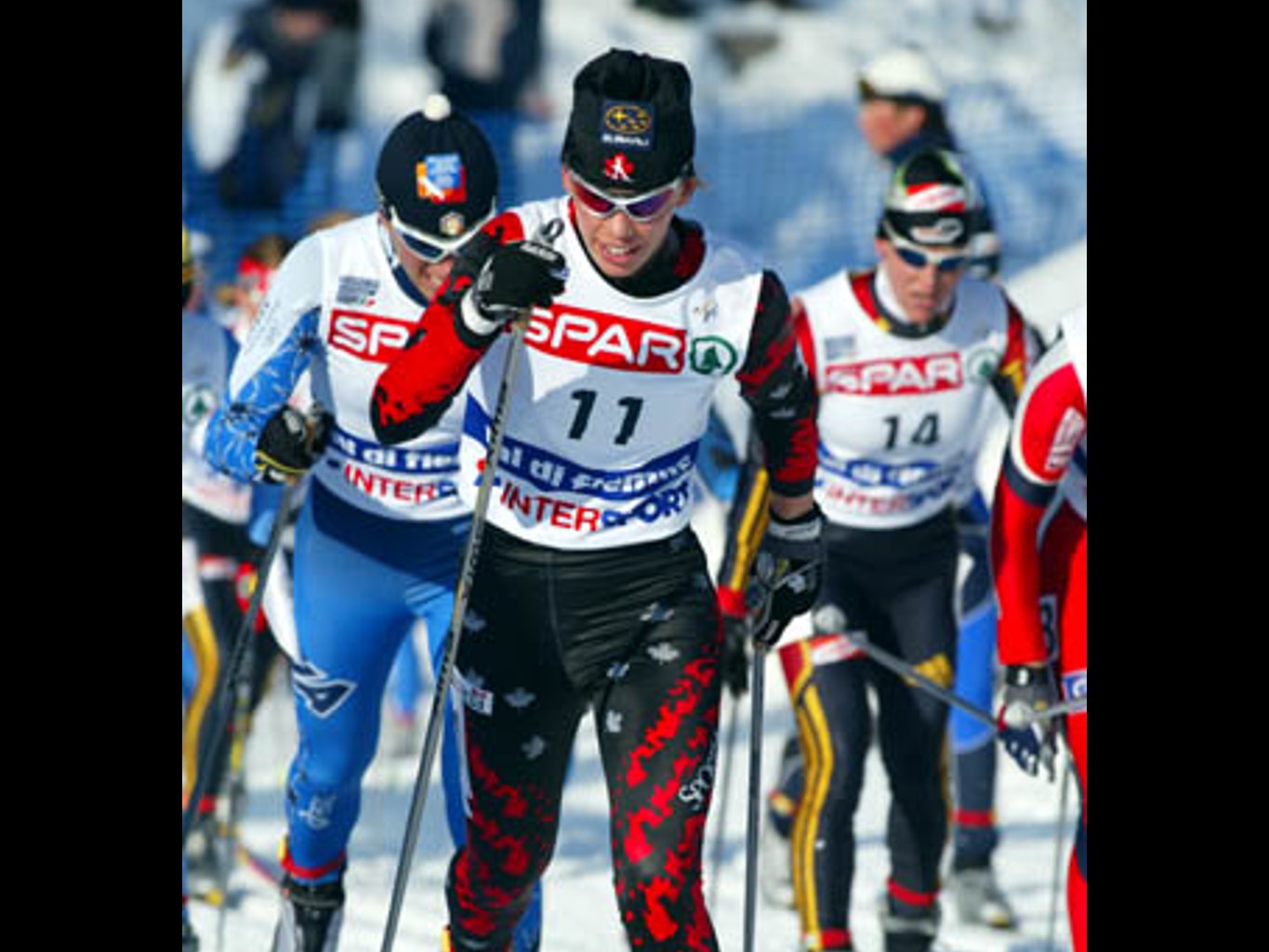
Beckie Scott racing in Val di Fiemme (courtesy photo)
By Salt Lake City, she was a contender. Not a sure thing, but a contender.
“We had the belief, even years leading into Salt Lake City, that this was a golden opportunity that we shouldn’t and couldn’t pass up. We had spent our years living and training in Europe, constantly dealing with jet lag, living in hotels, foreign language, foreign food. And this was a magical opportunity on our doorstep to effectively race at home.”
The 2002 women’s pursuit was a five-kilometer classic followed an hour and a half later by a five-kilometer skate. The format played to her strengths.
“I could do both techniques well. There’s this powerful energy that’s created when you have a home crowd behind you. It really does change things for athletes in a way that’s hard to describe. There’s an uplift that’s just incredibly powerful. I felt it. I remember it to this day, twenty years later.”
Then came the five minutes of waiting, and the chaos in the pit, and the medal that was, eventually, the right color.
The irony of becoming the public face of clean sport in cross-country skiing was not lost on her. She had been vocal before Salt Lake, after most of the Finnish team was caught for doping at the 2001 World Championships in Lahti.
“It was deeply frustrating to know that we were doing everything we could do to compete at the highest level in this sport, and we were constantly being thwarted by athletes who were using performance-enhancing drugs. That was incredibly aggravating. And it was shared. Not just by me, but my coaches, technicians, fellow teammates. This was not just unique to me.”
When the Russians were caught in Salt Lake, her first reaction was surprise.
“It was an open secret how much performance-enhancing drug use was going on in our sport, in particular by the Russian team. I was surprised because I did not have much belief, faith, or confidence in the anti-doping systems at that time. When I learned later about what actually happened at Salt Lake City to have those tests revealed as positive during those games, it was a remarkable series of events.”
That path eventually led her to the World Anti-Doping Agency and a long career in sport integrity work.
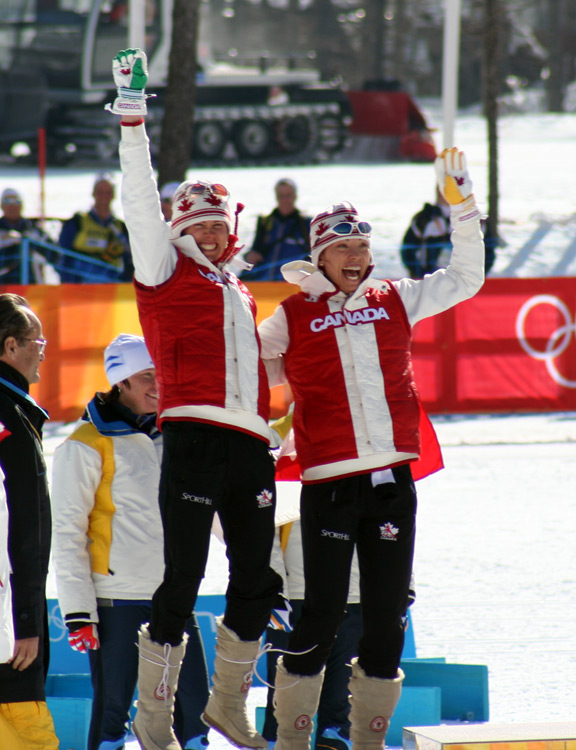
Canada’s Beckie Scott (right) and Sara Rennner receiving their silver medal in the team sprint at the 2006 Olympics in Torino, Italy. That was two years after Scott belatedly received the gold medal she won at the 2002 Olympics, after fighting long and hard to earn it when the first two finishers were found to be doping. (Photo: courtesy photo)
In 2006, in Turin, she won another medal. This one is remembered less for who lost it and more for who gave it.
In the women’s team sprint, her teammate Sara Renner broke a pole. A Norwegian coach, Bjørnar Håkensmoen, standing on the side of the course handed Renner one. Renner finished the leg. Canada finished second. Norway dropped to fourth.
“It really lived long in the hearts of people, I think, because of the sportsmanship element,” Scott said. “The Norwegian coach giving her the pole, which moved the Norwegians back to fourth and gave us the opportunity to have a silver that day. That piece was so encouraging and heartening, and really in the spirit of what we like to think the Olympics should be about.”
The other piece, for her, was personal. The team sprint silver was the last medal of her career, won with Renner, with whom she had been racing for eleven years.
“That was the culmination of 11 years of traveling and racing World Cups, World Championships, and Olympic Games together. And then we could stand on the podium together, in what would be the last year of my career. As teammates, but also very good friends, lifelong friends. We’re friends today. There was a dual component to that experience. It was, I think, lovely and inspiring in a lot of different ways.”
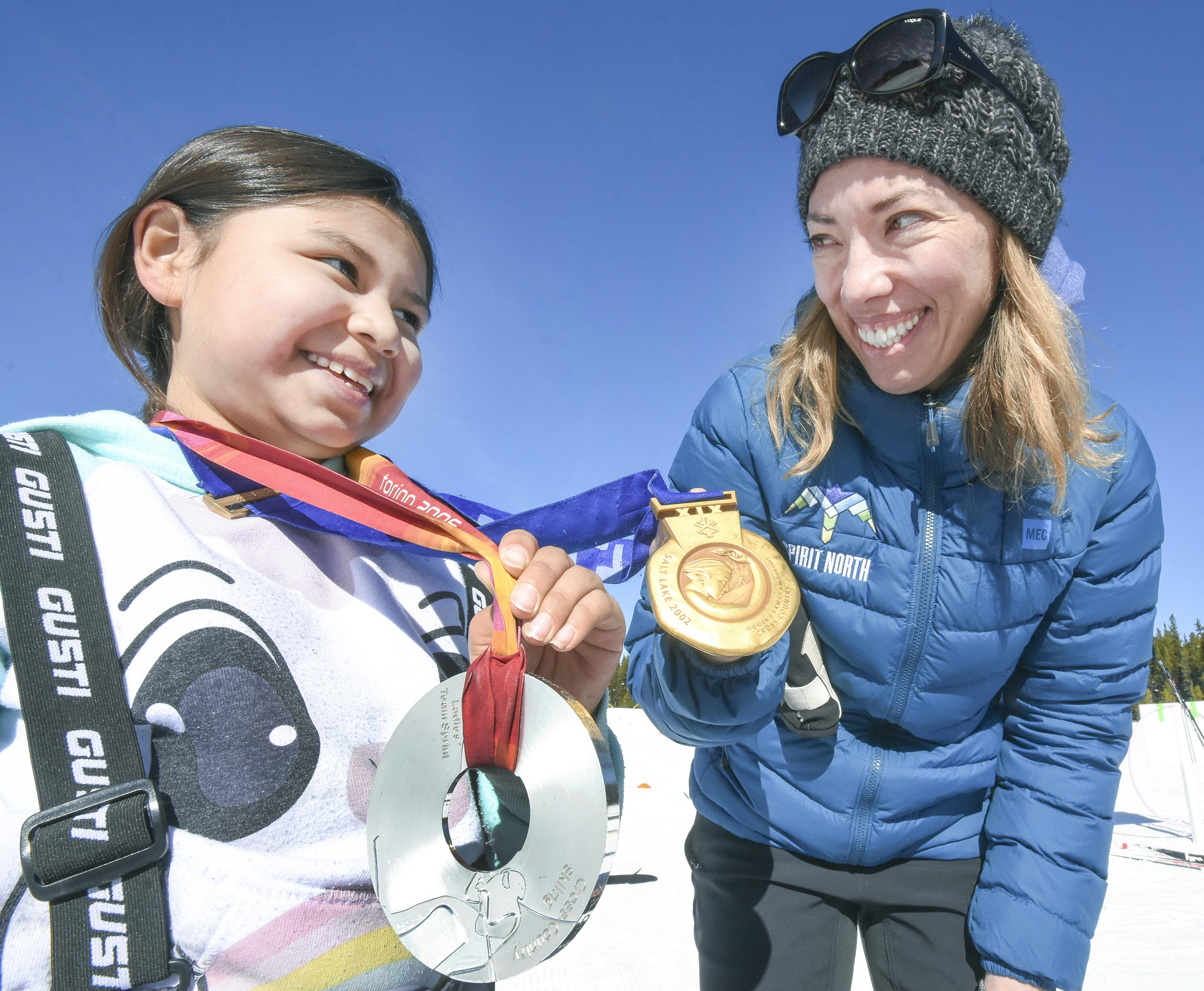
Beckie Scott shares her silver and gold Olympic medals with a Spirit North participant. (Photo: Spirit North)
When she retired from racing, she was invited to be an ambassador for a Learn to Ski program sponsored by an oil and gas company in northern Alberta. The program ran in indigenous communities. She would visit a community five or ten times a year, ski with the kids, show the medals, give a talk, then go home.
She kept going home, and she kept thinking about what she had seen.
“I began to notice many things. First, the disparity in the socioeconomic conditions of how indigenous people in this country live versus non-indigenous people. The lack of opportunity that kids were really able to access for sport and play. And then just the paradox of my own life and the opportunities that I had through sport, and my own kids were having through sport.”
It struck her, she said, as deeply unfair.
“An entire population of people was effectively kept out of that arena, and for no valid reason that I could see or think of.”
The Truth and Reconciliation Commission published its final report in 2015. Among its 94 calls to action were several related to sport. Scott read the report. She had, she said, a hard time just letting things be.
“I have a hard time just turning away and saying, not my problem. So I started a nonprofit.”
She started with four communities in northern Alberta. The organization, Spirit North, is now national. It operates in 160 communities across Canada. It serves roughly 20,000 kids a year. It is among the largest sport for development organizations in the country.
“The lesson there is that you can make a difference. I didn’t know anything about starting a nonprofit. I didn’t even really know much about indigenous culture and ways of being and knowing. But being open to learning, being super curious, and being driven by a vision of what change could look like, and meaningful action. That resulted in that organization.”
Beckie Scott gives a speech while she served as the Chair of the World Anti-Doping Agency (WADA) Athlete Committee. She also served on the Compliance Review Committee. (Photo: courtesy photo)
In March of 2025, Scott started a new job as CEO of Nordiq Canada. The skills, she said, transfer. Spirit North was a nonprofit. So is Nordiq Canada. There is a board, staff management, fundraising, finance, HR, and strategy.
“A big part of our job at Spirit North was setting the strategy. A big part of our work here at Nordiq Canada is setting the strategy. Putting the activities together. How are we going to get to where we want to go. Many, many parallels.”
The job she walked into was harder than the parallels suggest. The federal government had frozen its core contributions to National Sport Organizations for 20 years. The core funding that Nordiq Canada received from Sport Canada when she started last year was the same dollar figure as when she was racing two decades earlier.
“Think about that in terms of the cost of living, inflation, and the rising demands on an NSO. It really crippled the organization in terms of capacity and what it was able to deliver.”
She brought her CFO, Sian Bolton, from Spirit North with her. They streamlined operations. She went out and raised money.
“I just started knocking on doors and pounding the pavement, trying to raise money for the organization. The response in the community has been encouraging. We signed on a number of new donors and had some major gift contributions. People recognize that we have a lot of talent right now in our programs in this moment. And if we don’t get behind them, we’re going to lose them. People heard that message loud and clear.”
Then, after Milano, the federal government announced a $755 million investment in sport over the next five years.
“It’s transformational. We are going to benefit from that. I am very optimistic about our future financial state because of the government’s recent announcement and because of our fundraising success.”
The total budget at Nordiq Canada now sits just under $5 million, covering both the Olympic and Paralympic programs. About $2 million of that is core federal funding. Scott would like to add another $1.5 to $2 million.
She conducted a ‘listening tour’ after taking the role. The thing she heard most often from athletes was a lack of trust in the high-performance system.
“As an athlete, you want to believe more than anything that your NSO has got their act together and knows what they’re doing when it comes to high performance. That was one of the biggest areas that needed to be addressed.”
She restructured the leadership team quickly. “It was time to make a fresh start. The organization needed to be right-sized for the budget and the financial situation we were in. But we also needed the right skill sets and the right roles.”
She has, she said, four near-term goals. Podium results. Financial stability. Restoring trust and credibility. Unifying the community.
“It’s a bit fractured,” she said of Canadian skiing now. “I think we can do a much better job of pulling together, remembering why we’re all here. Unifying as a nation behind our athletes and our programs and our development and our organization.”
The fifth goal, on a longer arc, is coaching development.
“I see a huge opportunity for closing the gap in coaching in this country. I look to the U.S. and what the U.S. has done to generate so many really highly qualified coaches, and not bringing them over from Europe all the time. For me, for the next four to five years, coaching development is going to be a big focus.”
Beckie Scott and Justin Wadsworth pose with their family. (Photo: courtesy photo)
Scott is married to Justin Wadsworth, who spent six years as head coach and high-performance director for Biathlon Canada and is now consulting for U.S. Biathlon. They try not to talk about work over dinner.
“It’s hard. We’re living it every day, and our kids are both in it. But dinners are generally pretty lighthearted. We don’t avoid talking about work, but we certainly don’t do it all the time.”
She is writing her report for the upcoming Nordiq Canada AGM. When she looks back on her first year, she said, it has been a remarkable one.
“It was a lot of transformational change. New leadership in finance, high performance, events, athlete support. But at the same time, we managed to do that without destabilizing our teams. Our athlete performances continued to rise at the Olympic Games, at the Paralympic Games, at the World Juniors. We have so much to celebrate and be proud of when we think about this last year in terms of performance. The organization is on solid ground, and it’s really full steam ahead.”
It could seem strange that the woman who became the first North American to win an Olympic gold medal in cross-country skiing now spends her days raising money, restructuring boards, and writing AGM reports. Alternatively, maybe the trail Scott got on out of her backyard in Vermilion had been leading her all along to this moment, and she has proven she is ready for it.
Help Support Our Coverage!
If you value the thoughtful work and access FasterSkier provides, please consider becoming a Voluntary Subscriber. Your support directly fuels our work to cover the people, places, and moments that make our sport special.
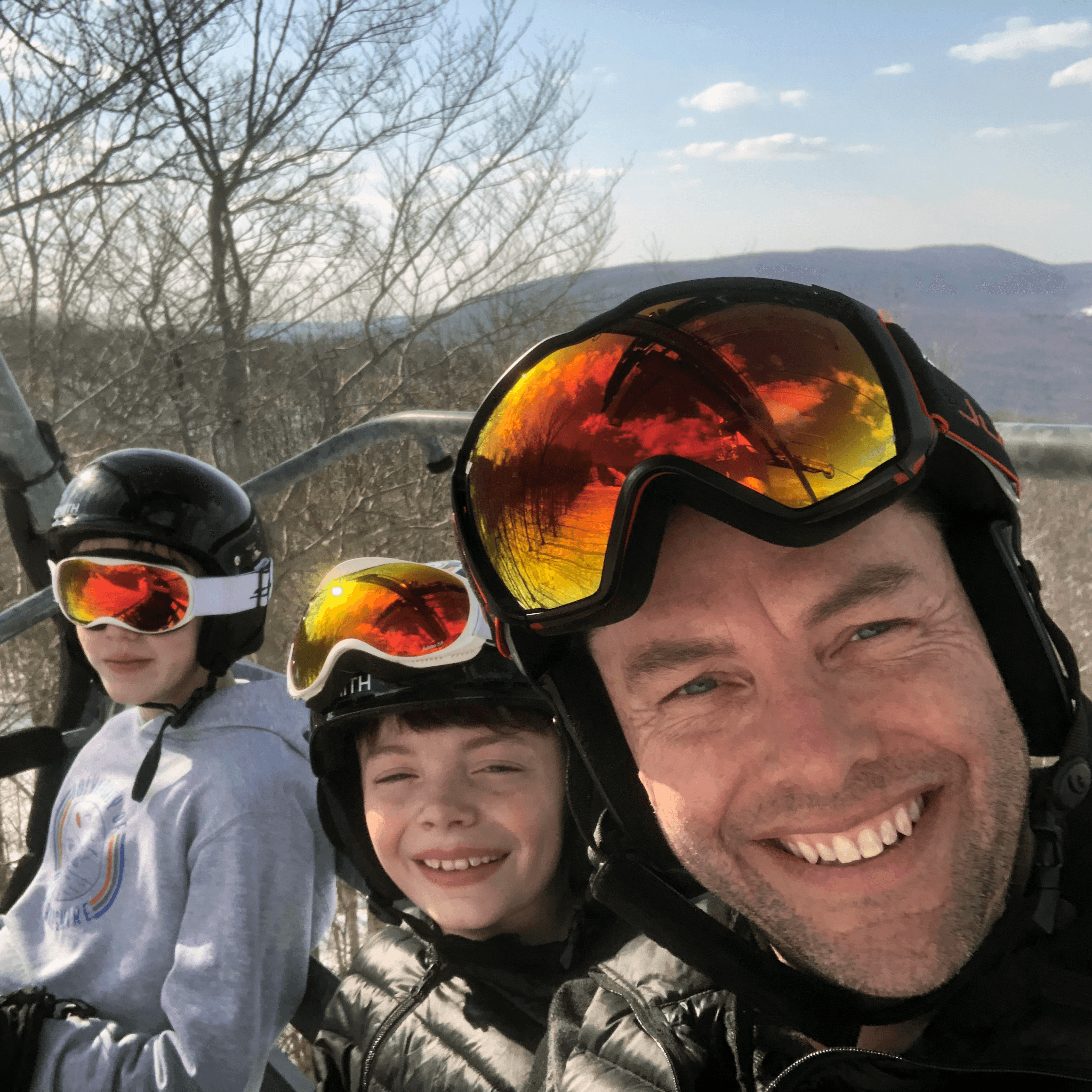
As owner and publisher of FasterSkier, Matthew Voisin manages the day-to-day operations, content, and partnerships that keep the site gliding smoothly. Away from the desk, he’s doing his best to keep pace with his two energetic sons.


Comments
Commenting policyJoin the conversation. Comment and react with your Endurance ID — one account across the whole network.
Loading comments…