
This article was made possible through the generous support of our voluntary subscribers. If you value coverage like this, please support FasterSkier with a voluntary subscription.
A new study landed in my feed last week, and I will admit the algorithm has my number. It steered me toward a question I have chewed on more than once here at FasterSkier: when it comes to low-intensity training, are you better off concentrating volume into one big week, or spreading the same volume evenly across several weeks? The easy move is to enjoy a paper that agrees with you and click away. I try not to do that. A study only earns its keep if I am willing to read the ones that argue against me with the same care I give the ones that pat me on the back. This one sits close to my own view, which is exactly why I want to handle it carefully.
What the researchers tested
Walther and colleagues, writing in the International Journal of Sports Physiology and Performance, set out to test whether concentrating low-intensity training into a high-volume block produces any adaptation that even distribution does not. They worked with 20 well-trained junior cross-country skiers in a crossover design, so every athlete completed both approaches and served as their own comparison. Total training volume was matched across the two protocols. Before and after each intervention, the researchers ran a battery of tests: VO2max, peak velocity at VO2max, lactate responses, submaximal economy markers, and subjective measures of recovery and fatigue.
The two protocols differed only in shape:
- BLOCK: one week at 160 percent of normal endurance volume, followed by three reduced-volume weeks.
- EVEN: the same total volume spread evenly across four weeks.
The point worth holding onto is that the totals were identical. Only the organization of the four weeks changed.

The performance results
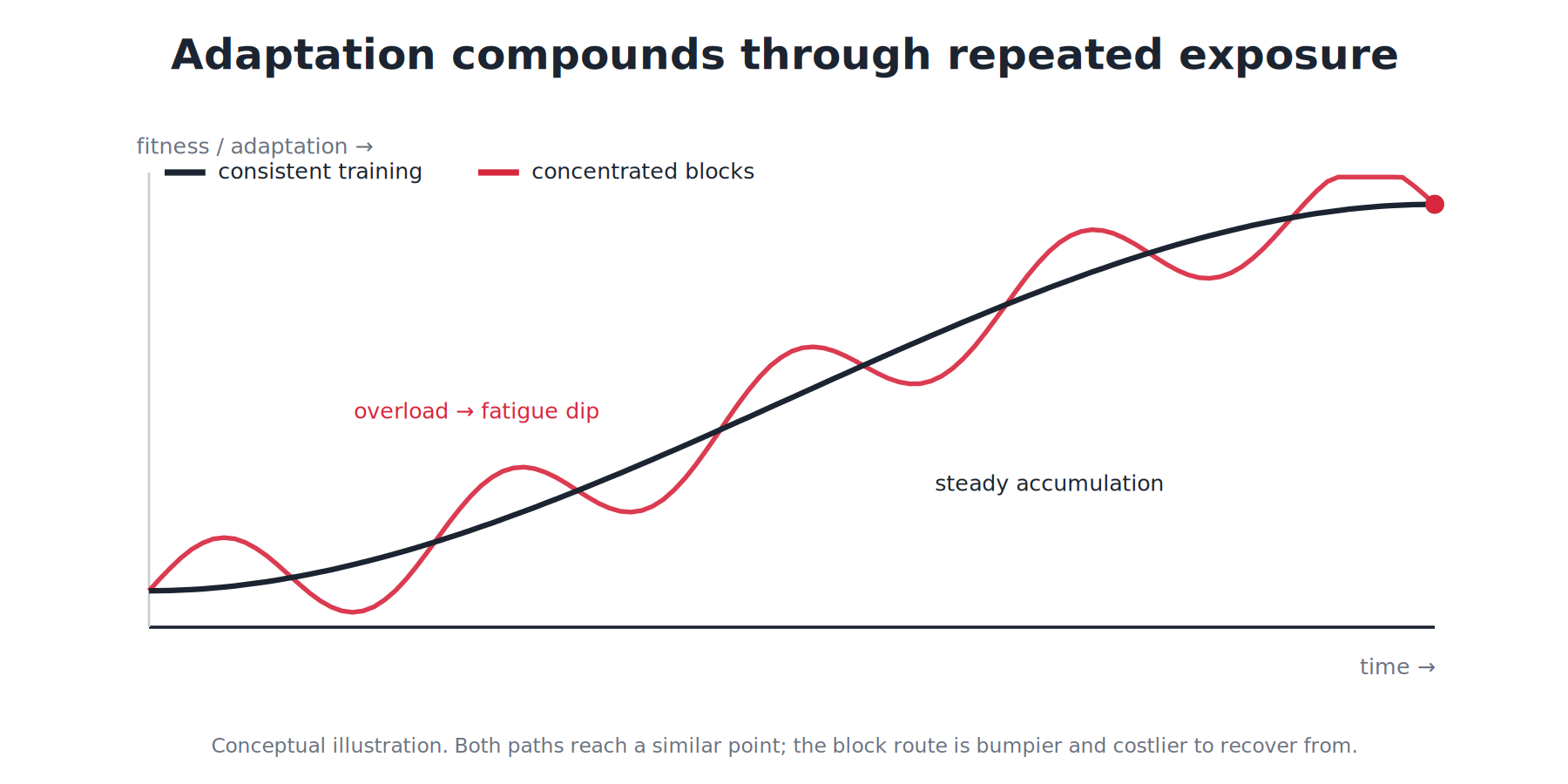
Concentrating the volume into a block had no effect on performance. Both protocols nudged some variables in the right direction, and the improvements were statistically similar. VO2max, maximal aerobic speed, and lactate-threshold measures all moved to a comparable degree whether the work was stacked into a block or laid out evenly. That matters because block periodization is so often assumed to be the stronger option. Here, concentrating on a low-intensity load produced no extra adaptation beyond what consistent training already delivered.
The two approaches did not feel the same, though. During the high-volume week and the recovery week that followed, the BLOCK group reported lower mood, reduced feelings of recovery, and greater fatigue. The athletes tolerated the work, and there was no indication of increased injury or illness risk, though four weeks is a short window in which to base that claim. The concentrated approach simply costs more on the recovery side without being repaid in results. I would have liked to see heart rate variability tracked across both protocols. Autonomic data might have put real numbers to that recovery cost, rather than leaving it to a subjective report.

Why this matches what I have seen
This lines up with something I have watched play out across endurance sport for years. Adaptation comes from repeated exposure, not from the occasional enormous week that flattens recovery and chips away at the very adaptation you are chasing. A training model deserves to be judged on more than whether it works. Time to adaptation matters. So does recovery cost, psychological and autonomic strain, and whether an athlete can actually keep the thing going for months and years. The block protocol led to greater fatigue and poorer perceived recovery without a better outcome. From a coaching chair, that is not a small detail, and it weighs even heavier with junior athletes.
Comments
Commenting policyJoin the conversation. Comment and react with your Endurance ID — one account across the whole network.
Loading comments…