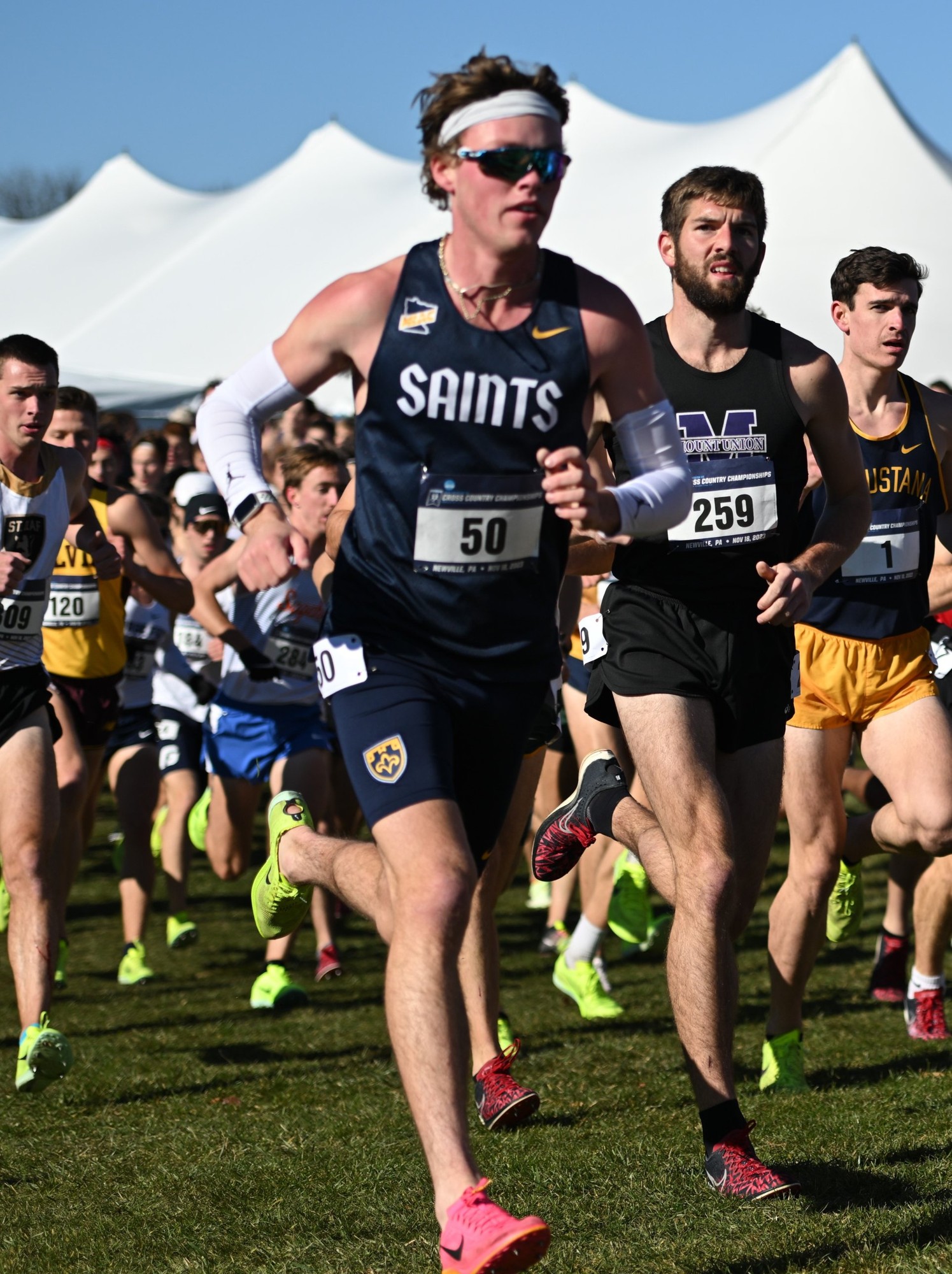
Lars Dewall (50) races for St. Scholastica at the 2023 NCAA Division III Cross Country Championships in Newville, Pennsylvania. (Courtesy photo)
Lars Dewall has run four marathons and he has never run a slow one.
The debut was Grandma’s in June of last year, 2:22:57. Then California International in December, 2:14:15. Then Boston in April, 2:12:30. Then Berlin in September, 2:12:13, third American across the line. Four races, four personal bests, each one faster than the last, which is not how marathon careers usually go.
Dewall came out of Division III. He ran at the College of St. Scholastica in Duluth and was an All-American there in 2023, one of the first two the cross-country program ever produced. He now teaches middle school social studies in San Diego. The man who still writes his training is Chad Salmela, who coaches cross-country at St. Scholastica, called the women’s team sprint in PyeongChang for NBC, and spent eight years on the US biathlon team before either of those things.
Salmela has a theory about why Dewall keeps getting faster, and it is not a comfortable one for American distance running. He has been making the argument for most of two decades, in a sport that was not his first one, and until recently he did not have a runner fast enough to make anybody listen.
“He’s like my living thesis right now,” Salmela said. “He’s actually texting me as we’re talking.”
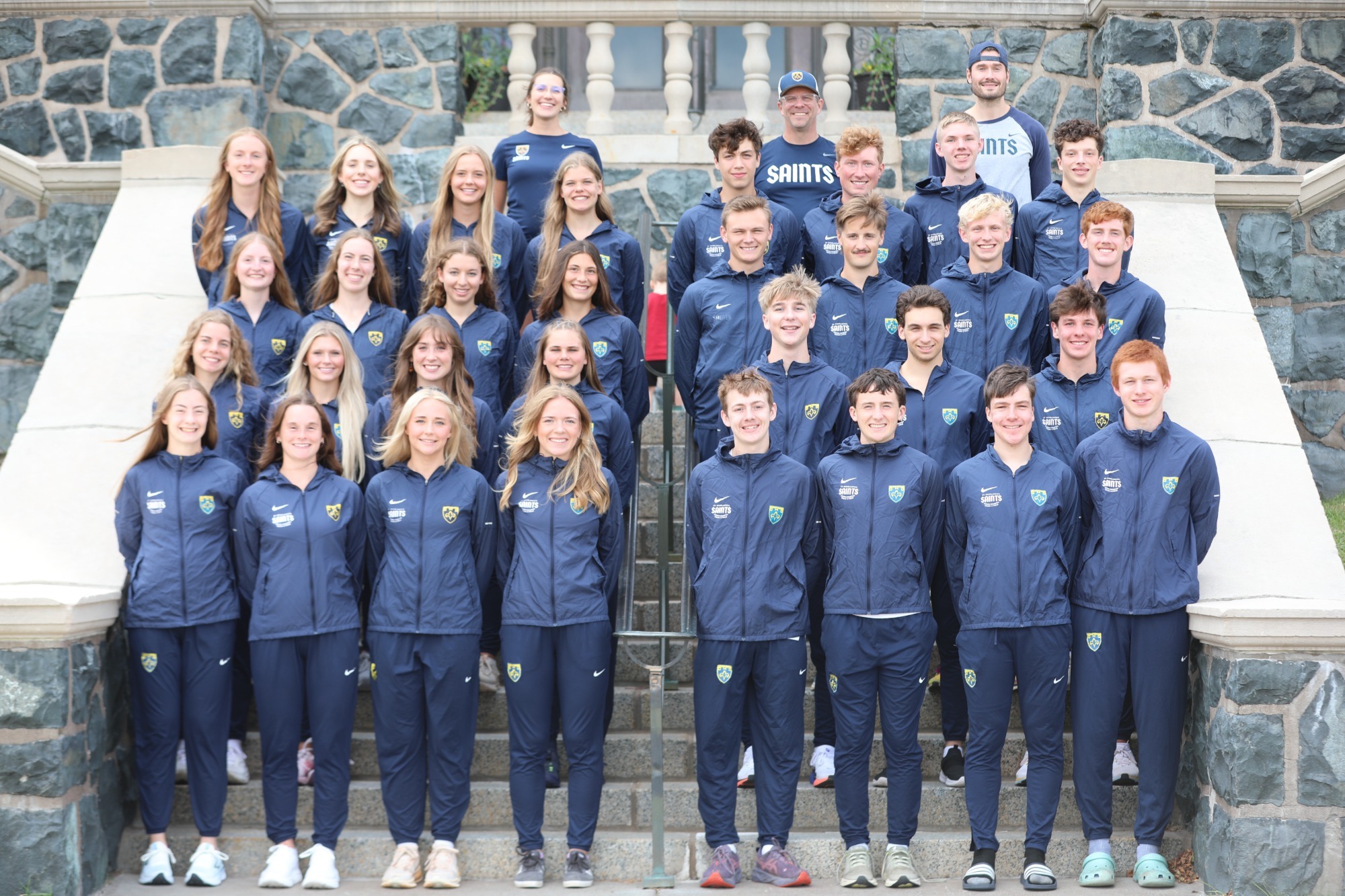
Chad Salmela, back row center, with the 2026 College of St. Scholastica cross country team. In more recent years, Salmela has given up the nordic coaching role to concentrate on broadcasting during the ski season, which we will cover soon in part two of this series. (Courtesy photo)
Mileage is a distance, not a volume
The sentence above is his, written rather than spoken. It appears in the letter he sends to recruits, which is less a sales pitch than a seven-paragraph argument about exercise physiology, and it is the cleanest statement of the thing he believes.
“Mileage tells you how far you’re running,” he said. “It doesn’t break down what you did in that distance.”
He has been resisting the number for years and he still resists it.
“You can have a huge mileage week on threshold. You can have a small mileage week on relatively aerobic,” he said. “Two to three two-hour-plus workouts, that’s going to be fewer miles than three threshold workouts. So that mileage metric, I feel like it kind of misshapes things in people’s minds.”
Ninety-mile weeks are not the problem, in other words. What is in them is.
“Ninety-mile weeks at a lactate of 2.5 as opposed to a lactate of 1 is going to have a way bigger consequence down the road,” he said.
This is where the skiing comes in, and it is worth being precise about the lineage, because Salmela is. The interval sessions he leans on are not his. The one he uses the day before a race, a minute on and thirty seconds off, he calls “a complete ripoff from the Ingebrigtsens,” though the session appears in Marius Bakken’s own published account of the Norwegian model, as does the 45-seconds-on, 15-off session Salmela started using this autumn. Bakken, a Norwegian physician and former 13:06 5,000-meter runner, built the method out of more than 5,500 lactate measurements and mentored Gjert Ingebrigtsen (Jakob’s father) directly between 2011 and 2013. The family made it famous. Bakken wrote it down first.
What Salmela did was carry it sideways, out of a sport where lactate testing has been routine for forty years into one where it mostly has not. He is blunt in the recruiting letter about why that gap exists and what it costs: the discovery was “established decades ago in the early 1980s, and has been adjusted in many other endurance sports, yet somehow continues to evade American distance running.”
His own estimate of what the ceiling looks like is deliberately large.
“If you can train as a runner seven or eight hundred hours of aerobic training, it doesn’t have to all be running; you can improve way more than you think as a runner,” he said. “But how do you get those 800 hours? You can’t do it running. You’re probably going to start having a limitation there.”
That is a skier’s number, and he knows it. It is also the number he says Dewall has been running at for two years.
St. Scholastica’s Paul Schommer, foreground, and Joe Dubay bounding up Spirit Mountain in Duluth, Minnesota, in the fall of 2014. (Photo: Chad Salmela)
Injury is not the cost of doing business
The recruiting letter contains three words in capitals: “Injury is NOT necessary.” He gets more animated about this than anything else in our ninety-minute conversation.
“The first thing that always drove me nuts as a skier coming into the running world, before I even started coaching, was just the acceptance of injury as part of the deal,” he said.
He is careful to say he might be wrong, and then says why he does not think he is.
“Anytime you’re asking your body to do something it’s not able to do, you’re doing something wrong,” he said. “I think that’s a very important thing to remember. If you build the strength and you build the motor to handle it, you can pretty much avoid injury.”
Then the qualifier, offered without being asked for, which is the mark of someone who has actually thought about the limits of his own claim: “maybe I’ve just never taken anybody to their very maximal capacities so far, and that could be it.”
The mechanism he proposes is fuel. His argument is that a runner who has never taught their body to burn fat at easy intensities is spending glycogen on workouts that were supposed to be building aerobic efficiency, and that the bill arrives later.
“You’ve got to define where your aerobic threshold is running, and you have to make sure that you’re burning fat there,” he said.
He has a blunt way of describing the high school runner doing it wrong.
“You can’t be running 6.5-minute miles and you got a PR at 15:30. That doesn’t even compute. It’s not easy enough,” he said. “You’re still going to have better immediate success. But somewhere down the road, if you don’t learn how to burn fat, you’re going to probably get hurt.”
The same protectiveness shows up somewhere less expected, which is how he handles a team that is getting sick. Two weeks before we spoke, a freshman turned up to a threshold session with a sore throat and told nobody until afterwards. Three of the four men in his suite went down. By Thursday the squad was, in Salmela’s description, a shell of itself, and on Saturday fourteen of thirty made the workout.
The athlete who did not get sick was the fittest one in the room, and Salmela pulled him out of the hard session anyway.
“I’m not putting you through a level four workout right now when you’re rooming with three guys who probably are carrying the bug, because you’ll be sick by Saturday if we do it,” he said. “He was pissed, but I didn’t let him do it.”
The rule for everyone else is not negotiable and the arithmetic behind it is simple.
“If you’re sick today, you’re not training tomorrow,” he said. “The best case scenario is you catch it, you stop, and you have four days that you’re not training. That’s going to be the minimum.”
Against that he sets what a season costs. His athletes are chasing a minute off an 8k, and he does not think a sick athlete who races anyway gets it.
“They’re not running a minute faster in 8k this year, and they will not do it if they get sick,” he said. “They won’t do it.”
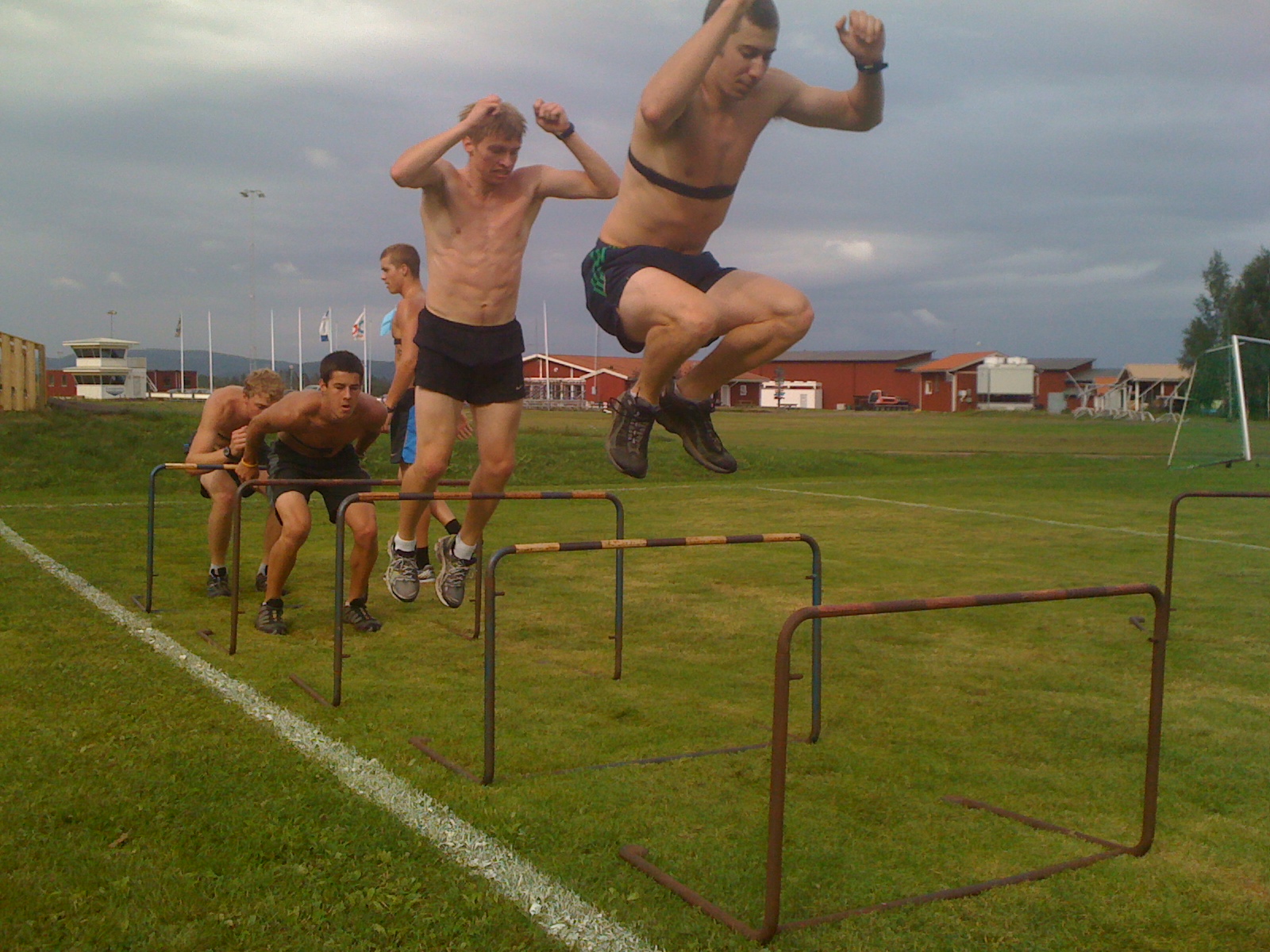
Hurdle bounding at a St. Scholastica dryland session. Salmela believes in the work and is his own cautionary tale about too much of it; a winter of jumps in his last season as a biathlete left him convinced he had compartment syndrome. (Photo: Chad Salmela)
What he got wrong first
Salmela is a strength evangelist who will tell you, unprompted, about the year he ruined a team with it.
“I loaded too much strength on some of my early teams coaching, and they got flat,” he said. “They got super slow, didn’t stay quick.”
What he settled on instead is periodized and, more importantly, individual. December is a strength block for everybody. In season it drops to maintenance and bodyweight work. Beyond that he decides person by person, and he is explicit that the people who say runners need strength and the people who say they do not are both partly right.
“You need a minimal amount of strength just to stay healthy,” he said. “And then some people need strength to be stronger, to be faster as a runner. They actually need strength to be a part of the catalyst that makes you your best.”
He has a sophomore who worked this out for herself before he did. She ran in high school, never lifted, went through the Air Force, got strong there, and arrived at the conclusion that the strength was the thing she had been missing all along. She now does three sessions a week on her own, more than Salmela gives anyone else on the roster.
Plyometrics get the same treatment, and the same warning, which comes from his own body. In his last season as a biathlete he loaded up on jumps and spent January and February convinced he had compartment syndrome.
“Really what it was is I had incredible anaerobic power and the racing season just kind of started having catabolic reactions in my shins,” he said. He credits Dave Bacharach, the exercise physiologist at St. Cloud State, with talking him out of the diagnosis: a lot of type 2 fibre, suddenly drowning in lactate every weekend.
“You have to be careful with plyos for aerobic sports because it’s anaerobic work, and it’s going to steal some of it,” he said.
The archaic notion
Ask him about tapering and he does not hedge.
“I think the taper is an archaic notion,” he said. “I think some people need a taper. You have to find the person who needs a taper. And there are some people out there, but I’d say they’re the minority.”
His team runs six to nine hours a week regardless of where the season is. The reasoning is that fitness is the thing being protected, and that the races themselves do the damage a taper is usually blamed on.
“Great races kick your ass, man,” he said. “They are hard to recover from. So if you want to have two or three great races in a row, you better watch that.”
When he does drop volume it is recovery, not peaking, and he says so. The most persuasive evidence came from a senior who diagnosed her own pattern and brought it to him: three straight years of running a personal best at conference and then one of her worst races of the season at regionals a week later.
“She goes, can we fix that? And I’m like, yeah,” he said. “We’re going to keep the volume high. We’re not going to taper.”
What replaces the taper is a race week with a shape to it, and this is the most directly usable thing he says all afternoon. A maximal effort five days out, long enough to spend real time at max heart rate. Then the Bakken session the day before.
“The reason I think you need that is because your heart will not be ready to respond to the work if you don’t do that,” he said of the hard day. “And if you do it any closer to the race, you’ll still be trying to recover from it.”
The day before, he keeps it short: five to eight repetitions of a minute on, thirty seconds off, in the tempo zone, perhaps five minutes of actual work.
“It’s the best pre-race workout I’ve ever found. Works almost universally,” he said. “Up until that point, I had found some workouts that work for some people and not for others.”
He does not prescribe the number. He hands the athlete a rule instead, and it is a small masterpiece of coaching.
“As long as the one you did last feels better than the one you just did before that, do the next one,” he said. “As soon as you feel like you’re working at all, you’re done.”
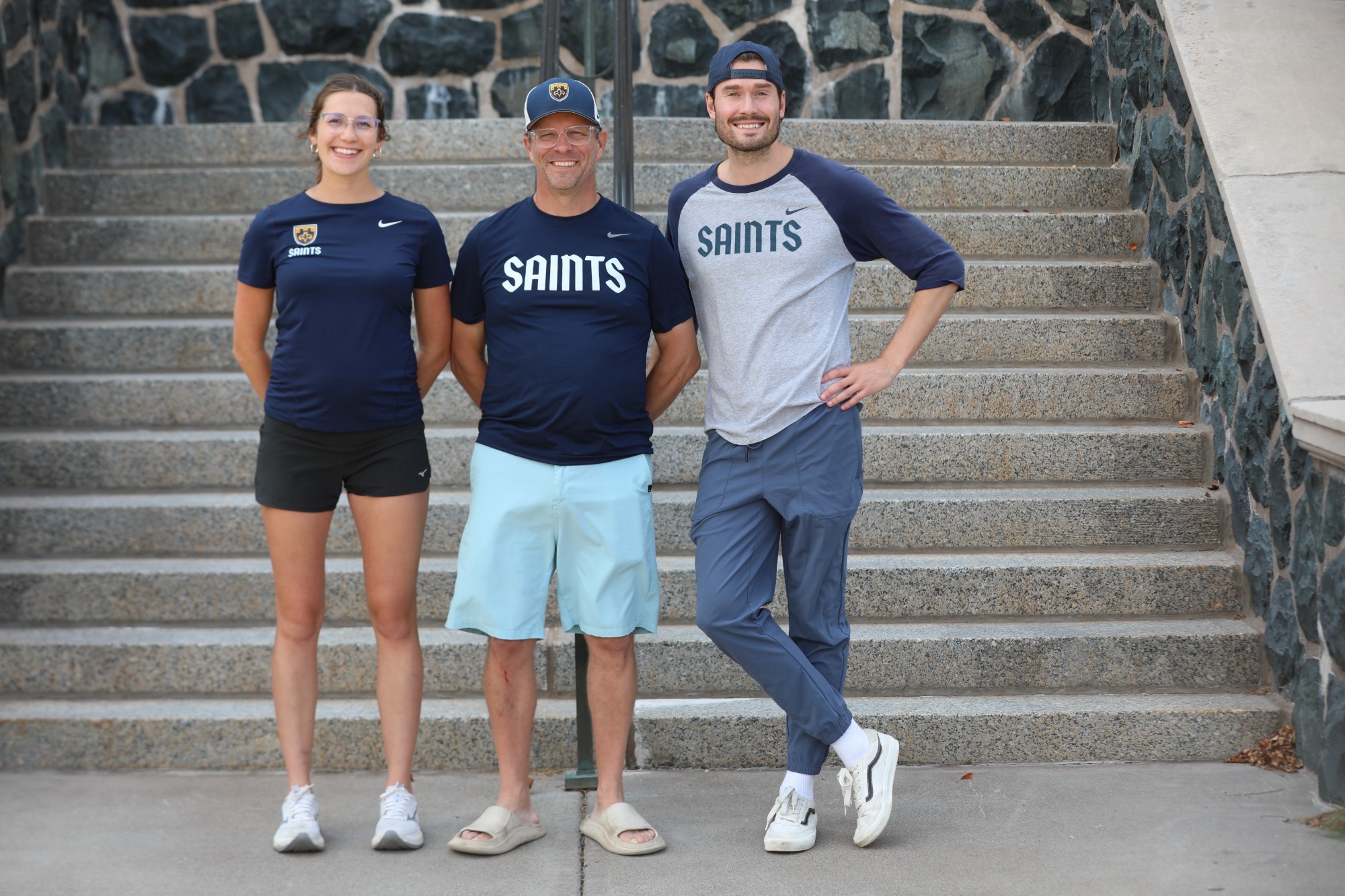
Salmela, center, with his St. Scholastica cross country coaching staff in August 2026. (Courtesy photo)
Leave the gait alone
There is one more piece, and it runs against most of what a modern running program sells.
“Meddling with natural biomechanics is kind of a no-no in my book,” Salmela said.
His most successful runner, he said, had a gait nobody admired and plenty of people wanted to correct. She was never injured until she stopped doing strength work.
“Her gait wasn’t pretty, but it worked, you know, and I recognized that,” he said.
His evidence for leaving well alone is a runner who arrived last year from a small high school program, had not scored for his team, and spent his first season trying to prove he belonged by going too hard at everything. It did not work. Salmela sent him away for a summer with an instruction to run more, at the intensity he was told and no harder.
“He comes in here, he looks so good. All the coaches are like, man, his running has improved a ton,” he said. “He had clodhopper feet last year, because he wasn’t a real runner. He hadn’t run enough yet. Comes in this year and he just comes off the ground, he looks natural, he looks like a runner now.”
Then the part he seems to enjoy most.
“And I did nothing,” he said. “I didn’t have to tell him anything other than follow the right intent.”
Dewall early in the race at the 2023 NCAA Division III Cross Country Championships, the fall he became one of the first two cross country All-Americans in St. Scholastica history. (Courtesy photo)
Which is more or less the argument in miniature. Dewall ran 110 to 130 miles a week building for Berlin, more than he had ever run, a third of it on soft surfaces, the intensity governed by lactate rather than by what the paces are supposed to look like. He got support from Puma’s PROJECT 3 program for the race. He went 2:12:13 and took seventeen seconds off a personal best he had set five months earlier in Boston.
Salmela has been saying for years that nordic volume would do this to a distance runner if anyone ran it properly. It took him until his fifties to find the runner who would.
Help Support Our Coverage!
If you value the thoughtful work and access FasterSkier provides, please consider becoming a Voluntary Subscriber. Your support directly fuels our work to cover the people, places, and moments that make our sport special.
A path to the Gulf of Bothnia near the Salmela family farm in Finland. The training ideas he has spent most of two decades carrying into American running came out of that part of the world. (Photo: Chad Salmela)
As owner and publisher of FasterSkier, Matthew Voisin manages the day-to-day operations, content, and partnerships that keep the site gliding smoothly. Away from the desk, he’s doing his best to keep pace with his two energetic sons.




Comments
Commenting policyJoin the conversation. Comment and react with your Endurance ID — one account across the whole network.
Loading comments…