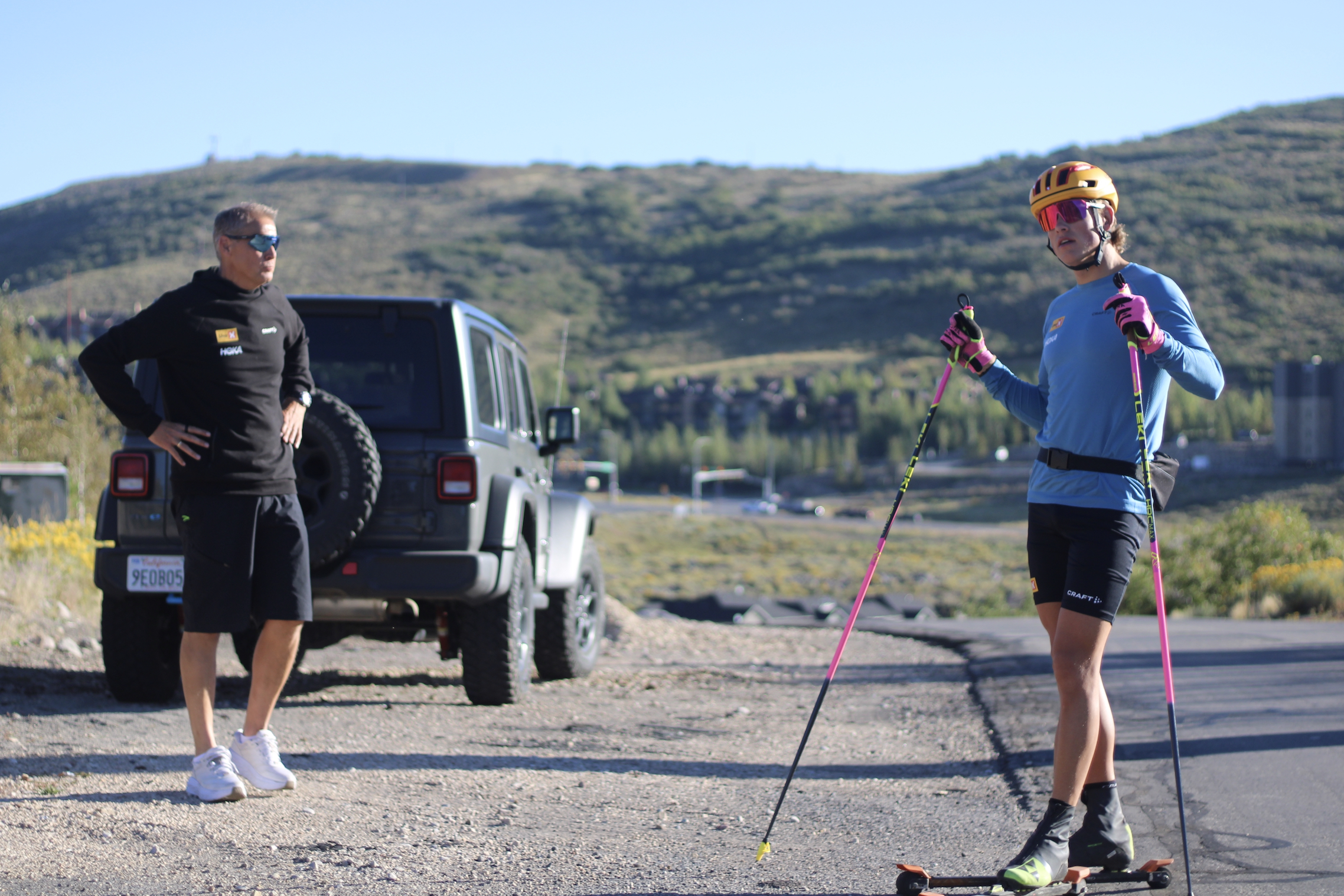
Johannes Høsflot Klæbo and his father, Haakon, during a water break on a rollerski workout in Park City, Utah, in September 2023. (Photo: Nathaniel Herz)
After more than 50 years in endurance sports as an athlete and coach, I recognize many of today’s training debates. We were asking versions of the same questions decades ago: How much training is enough? How hard should it be? When should we increase the load, and when should we allow more recovery? My answers have changed. The biggest change has been how much authority I give the training plan compared with the athlete’s response to it. I still believe in consistent work, appropriate volume, controlled intensity, and patience. But I have become much more willing to change the prescription as I learn how the athlete responds.
I believe it is important for coaches and athletes to build the training process on their own experience. Too many follow current trends, which in the last decade or two have shifted more than they did in the previous 30 years. That deserves recognition and some thought. Modifying what an athlete has done successfully over a few years is a fine and reasonable way to go. Wholesale changes create unknowns that make it impossible to assess what has worked.
What we know to be true, and what experience has demonstrated, should remain the foundation of how athletes train. Consistency is key, training at an appropriate volume load is critical, good control of training intensity should be a primary focus, and being patient and allowing the athlete time and room to adapt is most important.
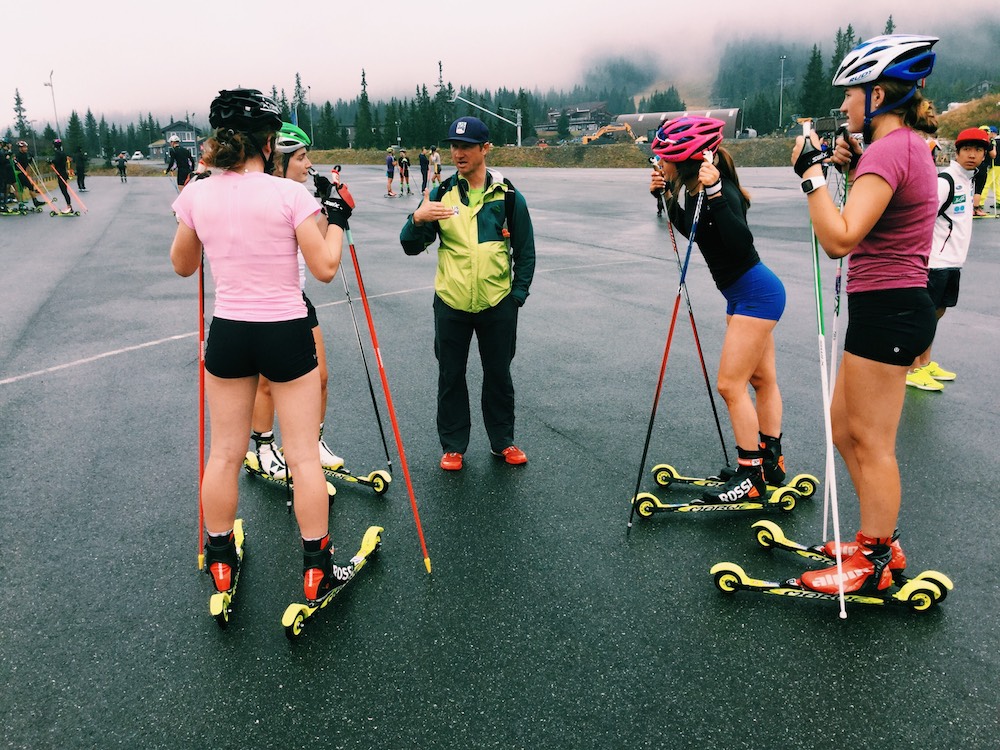
Coach Bryan Fish, in the yellow jacket, works with American athletes at the International Junior Camp in Sjusjøen, Norway, in 2018. How an athlete arrives on a given day can matter more than what the plan says. (Photo: Maria Stuber)
Twenty Years of HRV
Perhaps the most important change I have considered and implemented for anyone I coach is not being a slave to the training plan. I was one of the early adopters of heart rate variability (HRV), some 20 years ago. HRV is a tool I find most valuable in guiding training and in giving athletes the time and space to recover and adapt to it. Of course, following experience and science, I have modified how I analyze HRV over two decades, but the core value is still there. In my experience, HRV helps us refine training so we can give athletes what they need on a given day or week.
Maybe in another decade something better will come along to help with this assessment, and we should be open to that. But we should not throw out something that has demonstrable value.
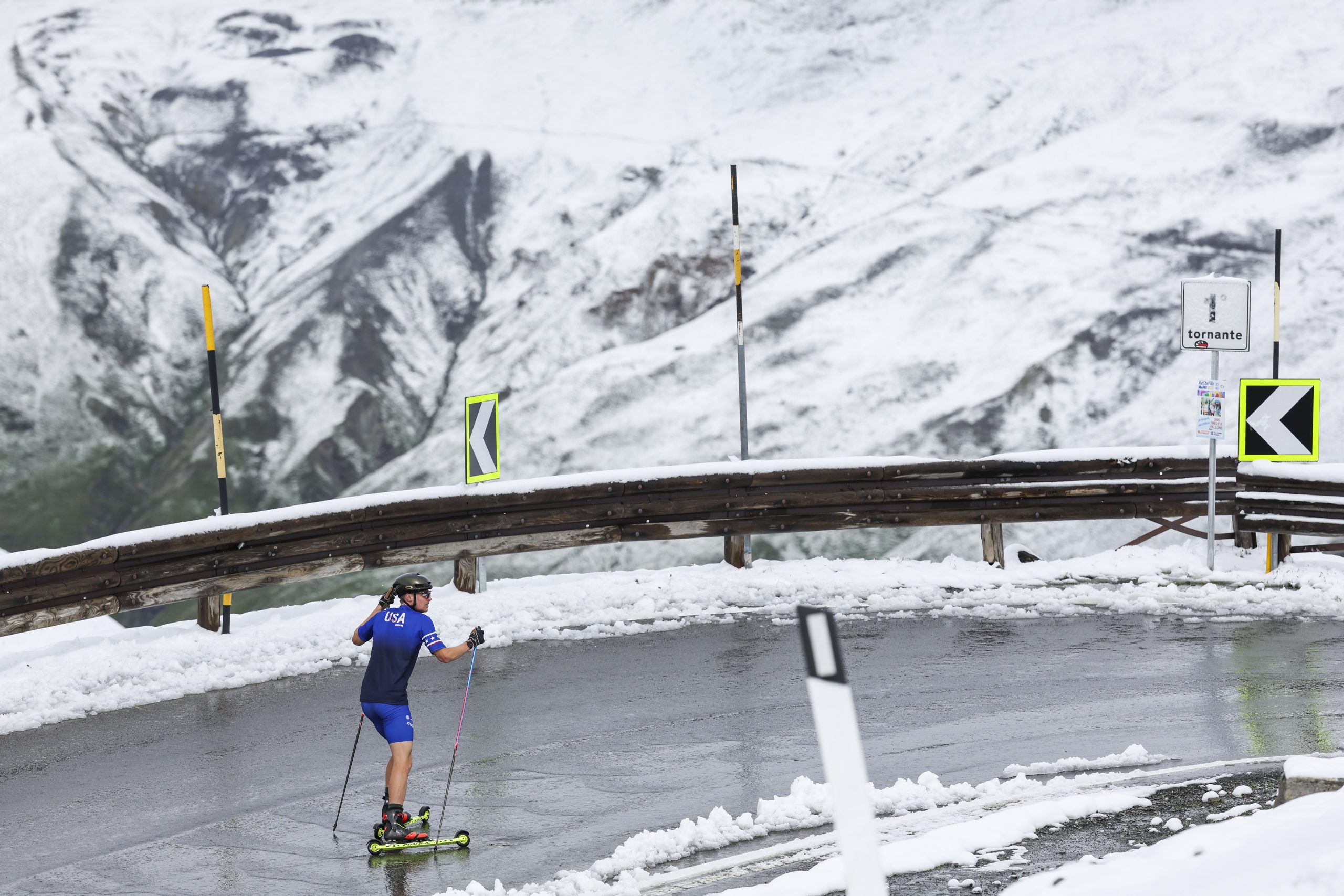
U.S. biathlete Campbell Wright climbs the Stelvio Pass during a summer training block based in Livigno, Italy, in July 2025, with fresh snow along the road. (Photo: NordicFocus)
A Flatter Ramp
Another big change I have made over the past 10 to 15 years is to the periodized training models we follow. When I was competing, we started the year in May at, say, 50 hours, and we progressively built that load month over month to 100 to 120 hours in November. During the later years of my career and into my early coaching years, I remember talking with coaches, physiologists and other athletes about this process. I simply did not see how 50 hours created adaptation that allowed for 60 hours, and how that training load allowed for 70 hours, and so on. It just did not make sense to me. Of course, it took some years to break out of that cultural mode and truly shift how we plan and implement training.
Now I fully believe in a far less aggressive ramp rate: starting the year at higher volume and staying consistent week to week and month to month. Over the course of the year, we can actually do more training with less shock and stress to the system, and with more consistent development. The theory that we need to increase the load week to week and month to month to add stress so we can adapt is, frankly, BS as I see it now. Training compounds week to week, month to month and year to year with consistency.
Simply put, under any model we should strive for consistent implementation, and we should not increase the load until, and only until, we have plateaued and fully adapted to the current load. Being consistent at the correct loads will let us do more training over a year, or over multiple years, than striving for a month-over-month increase.
It is easy to admire a big week or block of training and be impressed. But one big week or block tells us little more than what the athlete did. It does not tell us whether that training was sustainable, consistent, or actually created beneficial adaptation. The athlete who trains consistently day after day, week after week, month over month and year over year receives far less attention, but is the one building a sustainable base of fitness and performance.
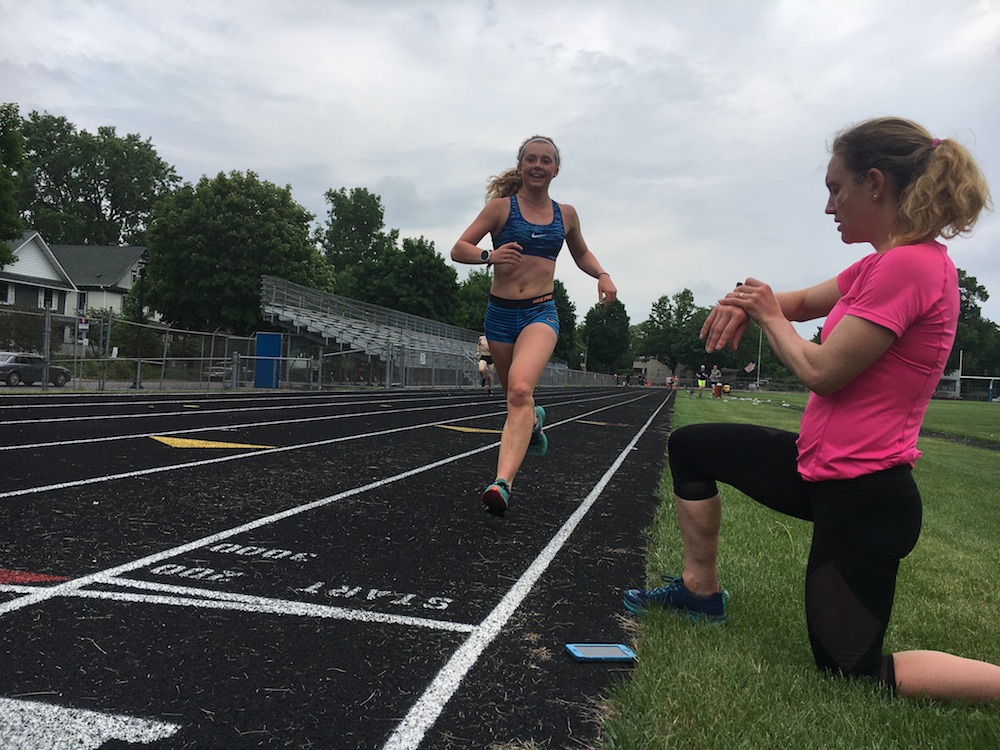
Coach Caitlin Gregg times Loppet Nordic Racing junior Sarah Olsen during a track time trial in the spring of 2018. (Courtesy photo)
The Questions I Ask
So both how I assess training load and recovery with HRV, and how I plan training around consistent loads, have completely changed how I evaluate training decisions. Sometimes the right decision is to add more training load. Often it is not. Other times it is to repeat a sustainable load so the athlete can stay consistent and adapt to it.
I always ask the question: If we do workout X today, or load X this week, how will it affect the athlete next week or next month? We also need to ask what we are trying to improve, what dose we need to improve it, and how we will know if it improved.
Ian Torchia leads L3 intervals with the Stratton Mountain School team in June 2018, with U.S. Ski Team head coach, Matt Whitcomb, following on a bike. (Photo: Pat O’Brien)
Old Becomes New Again
Then we must address the recent trends, and perhaps not so recent, in high-intensity training. In the mid-to-late ’80s and into the ’90s, high doses of threshold training were the “thing.” Then, in the late ’90s and early 2000s, VO2max blocks became the next “thing,” and after that it was back to VO2max workouts in a somewhat more controlled fashion. Now, over the last five or so years, based on the training of a speed skater and some Norwegian triathletes, we are back to so-called threshold and subthreshold training.
In essence, all things old become new again. What is missing from the trends is not the actual training; for some athletes it may well be the correct pathway. What is missing is an assessment of what limits the athlete’s performance. Without judging the merits of either high-intensity methodology, some athletes may need more focus on VO2max work, and others may well benefit from threshold-type workouts. In the simplest terms, an athlete with a very high fractional utilization may benefit more from a higher volume of threshold work, while those who do not have a well-developed aerobic capacity may benefit more from VO2max-type work. For elite athletes with a very high fractional utilization, threshold-type training probably also creates a signal to improve VO2max, or the speed at VO2max, because the intensity is relatively in the same zone.
Regardless of the type of high-intensity training an athlete is doing, we should be most focused on assessing and measuring how efficiently they are moving, their speed, and their durability to sustain that speed. Because no matter what the training methodology is, if you are not consistently improving performance, the training is not working.
U.S. Ski Team coaches Jason Cork and Chris Grover go over the details for a distance time trial at Soldier Hollow in Midway, Utah, in 2017. (Photo: Pat O’Brien)
The Plan Is a Snapshot
The most basic element, and the one most coaches spend hours and hours on, is the training plan. We plan periodized models of increasing training volume, and when and how to implement high-intensity training. We plan when to do races or time trials, when to focus on speed training, and how to fit in strength training and other aspects of performance. Yeah, that is all well and good, but it is mostly an exercise in futility. In my opinion, the training plan was valuable on the day it was written, based on where the athlete was at that snapshot in time. Once a plan is in place, there is a temptation, if not a certainty, that the athlete will do everything in their control to carry it out regardless of how they are feeling or what they need right now.
I did this for years. I spent hours developing an individual plan and expected the athlete to carry it out as some kind of infallible document. That is not how the body works. Nowadays I still write year plans, but with far less detail on hours and specifics, and more explanation of what we want to accomplish in each period rather than details of volume and periodization. I want the plan to create an environment with flexibility, where we use the data, and how the athletes are feeling and adapting, to adjust the day-to-day training.
After more than 50 years, I still believe in the value of consistent training, appropriate volume, controlled intensity, and patience. What has changed is how I decide what an athlete needs and how willing I am to revise that decision.
I once spent more time asking whether the athlete had completed the plan. Today, I spend more time asking whether the training is producing the response we intended, whether the athlete is absorbing it, and what that tells us about the next step.
I expect some of my thinking will continue to change. Experience gives me a foundation, but it also gives me reasons to keep asking questions. The responsibility I have as a coach is to pay attention, assess honestly, and act on what I learn, even when that means changing a plan I believed in when I wrote it.
Help Support Our Coverage!
If you value the thoughtful work and access FasterSkier provides, please consider becoming a Voluntary Subscriber. Your support directly fuels our work to cover the people, places, and moments that make our sport special.
Coach, competitor, correspondent, commentator—Jim Galanes has spent a lifetime on cross country skis, always serving as a keen observer of our sport. A three-time Olympian in both Cross-Country and Nordic Combined, Jim has tested the theories, initiated the instruction, assessed the results. Now, FasterSkier is thrilled to announce that Jim joins our staff of writers and contributors, adding his unique and time-tested insights to the editorial offerings of this publication.




Comments
Commenting policyJoin the conversation. Comment and react with your Endurance ID — one account across the whole network.
Loading comments…