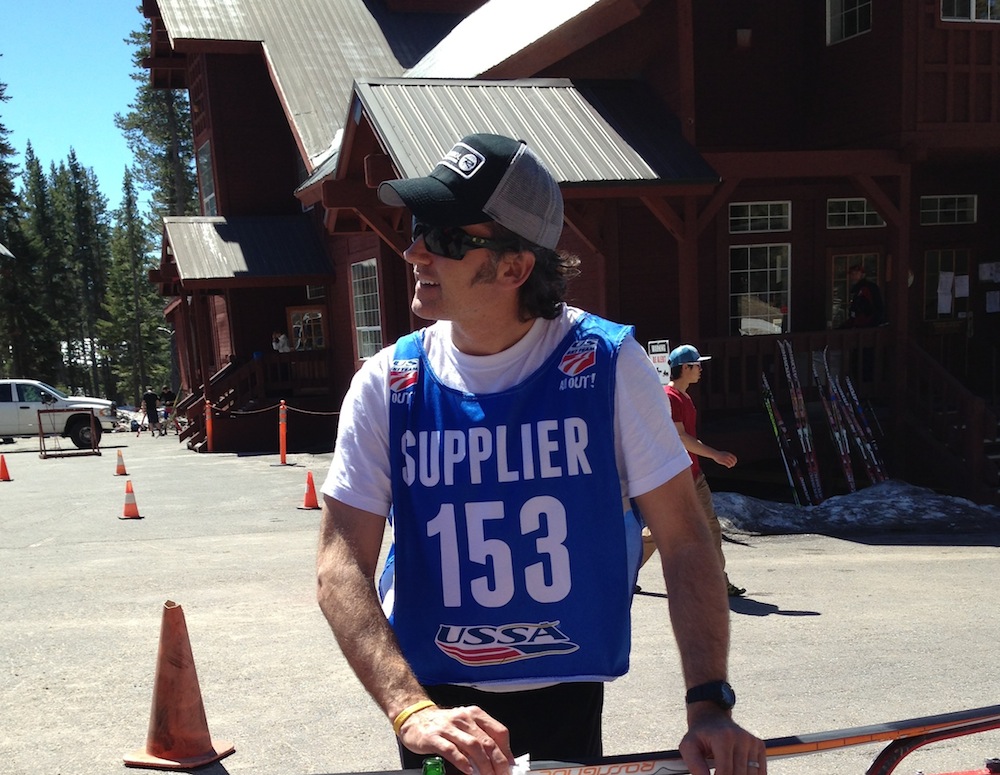
Randy Gibbs at the 2013 U.S. Distance Nationals in California, where he waxed the skis Liz Stephen rode to the 30 k title. (Courtesy photo)
Randy Gibbs was about 10 years old when his father turned the basement into a wax room.
It was 1980, give or take, in Minneapolis. His dad and his uncles raced the American Birkebeiner every February and made a big deal of it every year, and now there was pine tar in the house.
“I was like, what is going on here?” Gibbs said. “This is crazy. You can put this on different ways and it will do different things. Like sometimes it’ll be too sticky or too slippery.”
He has been chasing that problem ever since. Gibbs spent eight seasons as a service technician for the U.S. Ski Team, waxed at the Vancouver and Sochi Olympics, and was one of the techs who got the skis right in Val di Fiemme, Italy, the day Kikkan Randall and Jessie Diggins won the team sprint at the 2013 World Championships. This fall he is the High Performance Coach and Head of Service at Snø Racing, the Minneapolis professional team that most of the sport still calls Team Birkie.
What he wants to build there goes back further than any of those wax rooms. It goes back to a teenager at Wayzata High School who never had enough skis.
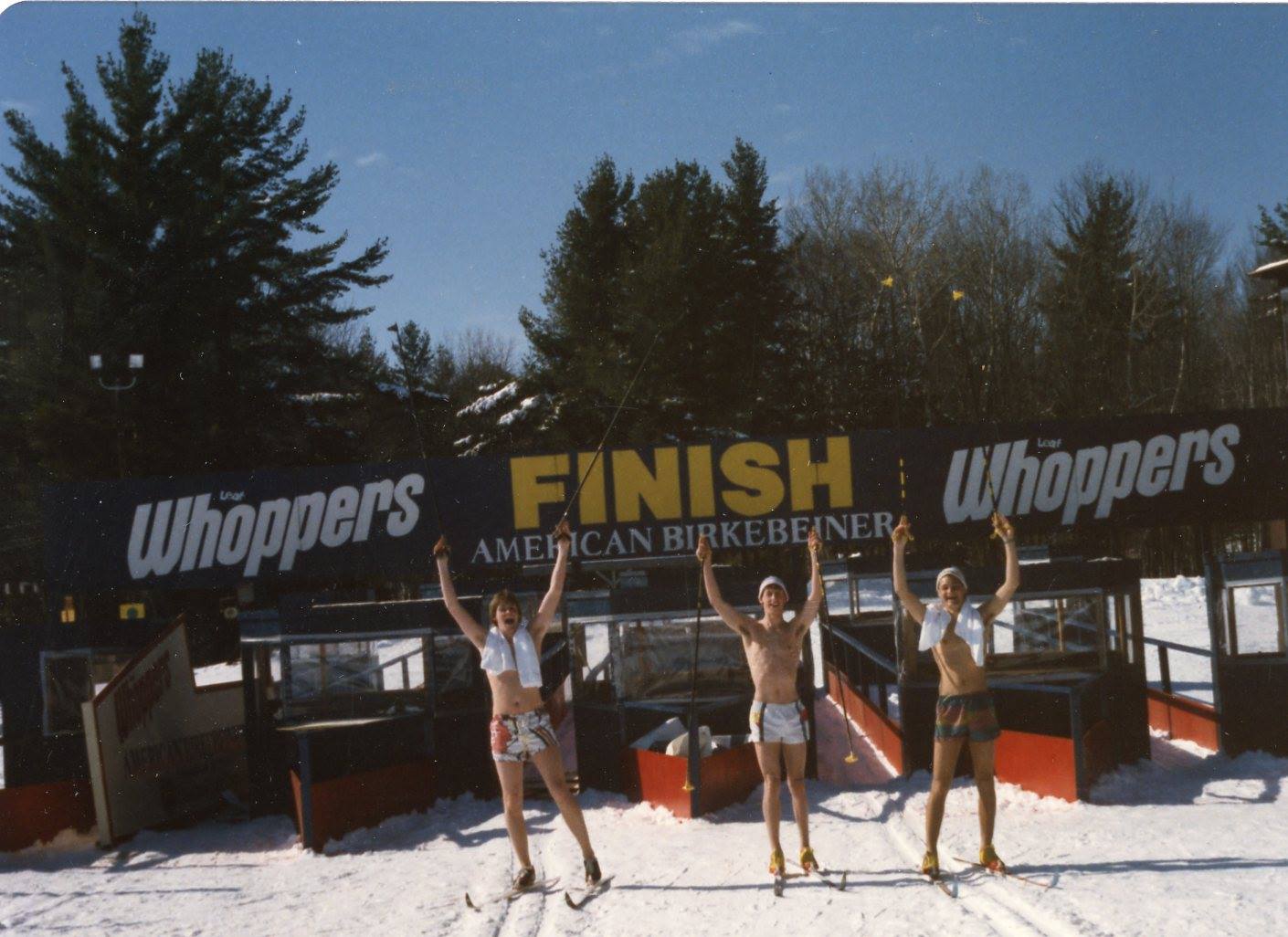
Finishers celebrate under the American Birkebeiner finish banner at Telemark in 1991. Gibbs grew up watching the race end here. (Photo: Ted Theyerl)
A Lodge With a Fireplace
Gibbs was on skis at the Birkie before he could really ski.
“There’s pictures at the Birkie, staying in those little lodges there,” he said. “When I was just like one year old or two years old, walking around with skis on, and all my uncles and my dad racing and making a big deal about it every year.”
When he was in sixth or seventh grade, his parents bought a small resort on a lake near Delta, Wisconsin, about 30 miles north of Cable. It had its own trails and a little snowcat, and Gibbs got to groom with it. He groomed, he skied, he ran his own time trials. And in February he went down to watch the finish of America’s most celebrated ski race.
“It used to finish at Telemark at the time,” he said. “It felt like I was at the Olympics, you know, like all these people. And I remember the Telemark Lodge with the fireplace, and they used to have this Coliseum with the tennis courts, and there was a fudge shop and all this stuff in between. Now it’s all torn down and all gone.”
“But all that back then got me really burning fire to really want to be in the sport,” he said, “and just keep in the sport and keep around people in the sport.”
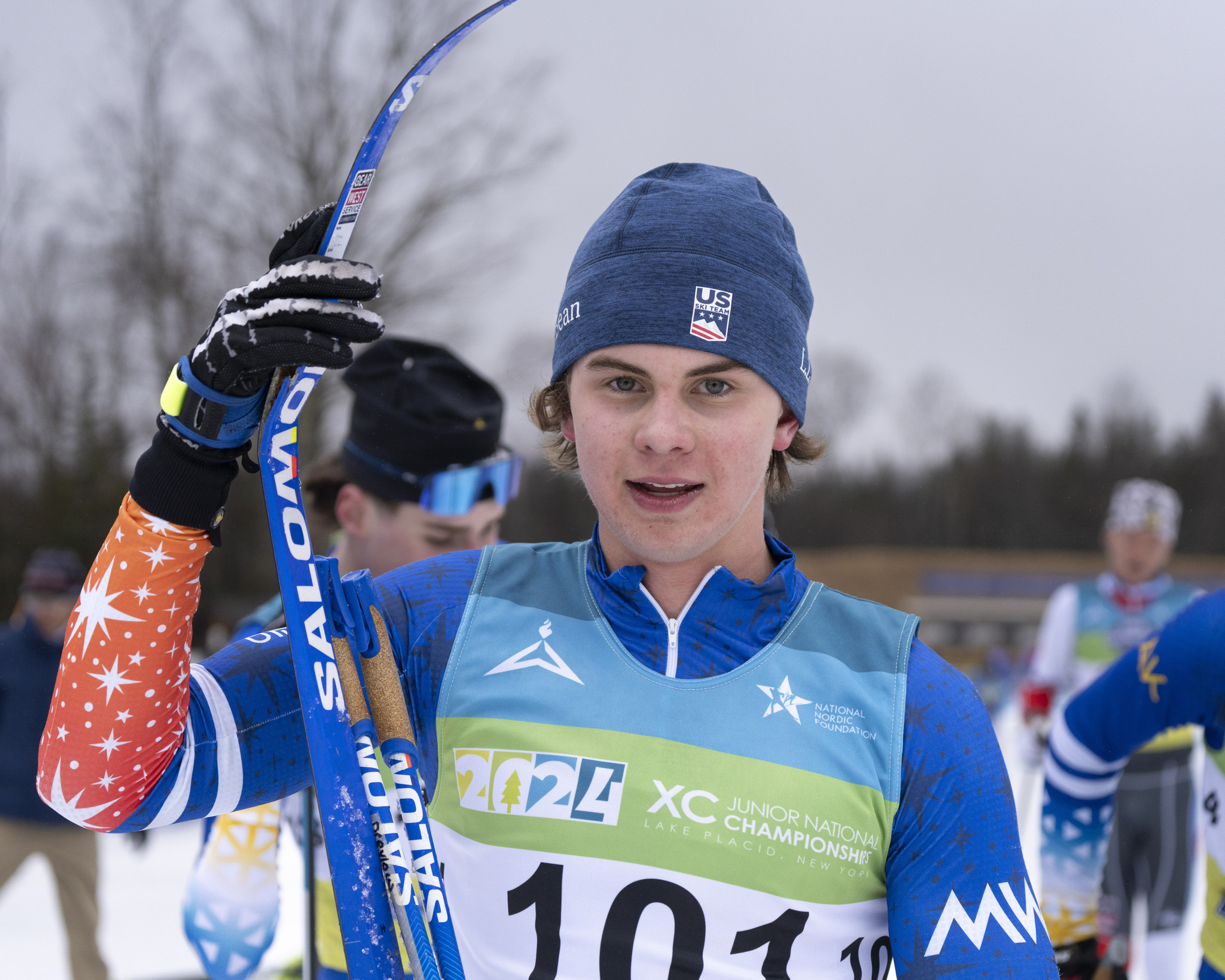
Logan Drevlow of Loppet Nordic Racing and the Midwest team at the 2024 Junior Nationals in Lake Placid, where he snapped a ski in a fall and still won every U16 boys’ race of the week. (Photo: Phillip Belena/Lake Placid Organizing Committee)
One Pair of Skis
Wanting it did not make him fast enough. Gibbs never made the Minnesota state meet and never made a Junior National team.
“I had great people as coaches, but I just didn’t really have the support,” he said. “I know a lot of people are in my same boat, where they just were kind of on their own, trying to, with one pair of skis, do everything. Using old equipment, old boots and poles, and just trying to make it happen.”
He remembers the moment he understood what he was up against.
“I remember the first time I saw these guys pull up these ski bags with like four or five pairs of skis,” he said. “And I’m like, oh man. Those are just for klister.”
“But what that did do is it made me want to coach,” Gibbs said. “I started thinking, you know what, I want to be a coach. I want to help some athletes reach their full potential and be able to not have these things happen to them.”
He was 21 and a student at the University of Minnesota when he started as an assistant coach at Wayzata around 1991. A couple of years later he was the head coach. In 1993 he went to his first Junior Nationals as a coach and service lead for the Midwest team, at Giants Ridge in Biwabik, and he kept going back. He would end up on 13 of those Midwest staffs.
After a couple of years in Madison he came back to Minneapolis and coached at Hopkins, where his father had taught. The girls’ team was loaded. Hopkins won the 2002 state team title, and one of the skiers who spent her summers rollerskiing with Gibbs was a Hopkins junior named Courtney Dauwalter, who won the individual pursuit title that year, long before the rest of the world learned her name as an ultrarunner.
What Gibbs remembers most about those years is the parents.
“More importantly, really, the parents being able to trust me,” he said, “and be able to pay for these guys to get to places, to races, big races, and also equipment, and keeping up with all of that. Having all these skis, and being able to take these trips out east and going to nationals and up to Alaska. And they all did it.”
Most of those girls skied in college. Some of them coach now. They still keep in touch.
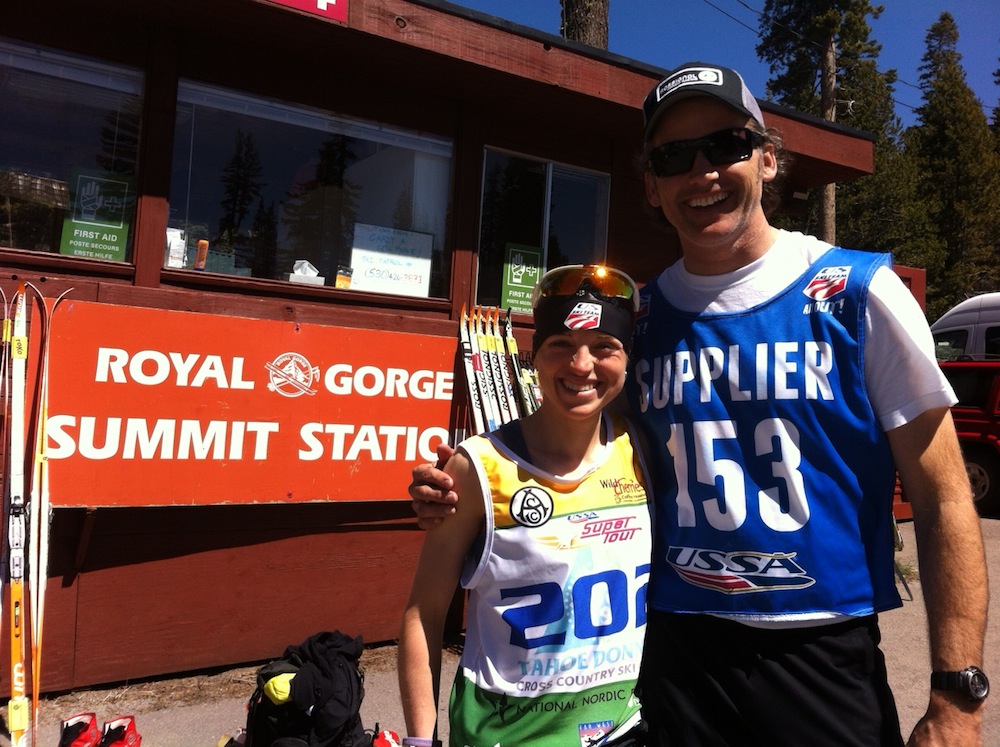
Gibbs with Liz Stephen at Royal Gorge in California during the 2013 spring series. He spent eight seasons as a U.S. Ski Team technician. (Courtesy photo)
The Big Show
In 2006 Gibbs joined the U.S. Ski Team’s new development group, working alongside Pat Casey and a young coach named Matt Whitcomb. The athletes were names like Liz Stephen, Morgan Arritola and Tazlina Mannix, chasing OPA Cups and SuperTours and spending part of each winter in Europe.
Before long they were crossing paths with the World Cup team, which on the women’s side was mostly Kikkan Randall, alone. Gibbs remembers the first time the younger women started a World Cup relay with her, in Davos, around 2008.
“To get those guys seeing what the big show is like,” he said, “… and have Kikkan have some more people on the team. More women on the team, so she’s not always the only girl there. That was really fun.”
The job grew into a full-time spot on the World Cup service crew. He waxed at the 2010 Olympics in Vancouver and the 2014 Games in Sochi. But the race he brings up first is the team sprint in Val di Fiemme, when Randall and Diggins skied into American history.
“To win the team sprint at World Championships for the U.S. was crazy to think about when I first started, even in 2006,” Gibbs said. “And to see that happen in 2013, we knew at the time it was like, okay, this is the very beginning. To really start being able to get on the podium and make it more of a normal thing, and not a weird thing, when the U.S. team puts these athletes out there.”
Then his daughter was born, and the 100-plus-night seasons stopped making sense.
“I had to kind of step back because I couldn’t be gone all the time,” he said. “And so I had to leave the team after Sochi.”
The Australian team called almost immediately. For several seasons Gibbs ran two or three trips a winter for them, through world championships and the 2018 Olympics in PyeongChang, as both the coach and the wax tech for a squad of four or five.
“It was a different kind of pressure,” he said. “It wasn’t a pressure of winning medals or getting on the podium. It was just like, let’s try to have our best races we’ve ever had, and let’s try to keep improving every day.”
Then COVID came and he drifted out of the sport for a while. He got his fix traveling to nationals and Silver Star with Will Sweetser’s Nordic team at Sugar Bowl Academy, and last winter he went to Junior Nationals in Cable with the Far West team. That trip is where the conversations with Yuriy Gusev started about what Team Birkie could become.
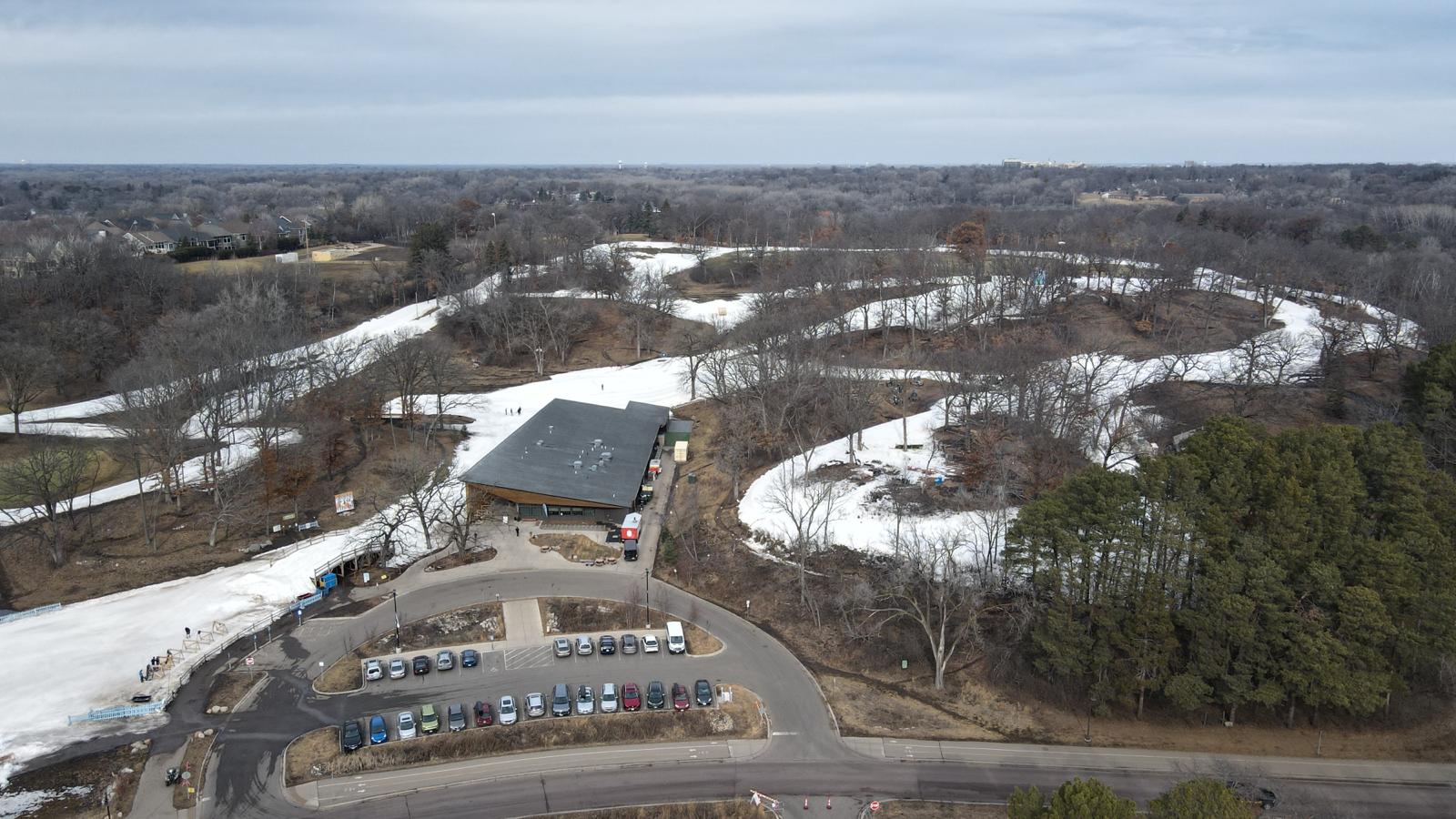
The Trailhead at Theodore Wirth Park in Minneapolis, where about seven kilometers of trail are covered by snowmaking. The Legacy Relay kicked off with a reunion here on Oct. 23. (Photo: Loppet Foundation)
“Who Are You Guys Now?”
In June, Team Birkie became Snø Racing. The team is a nonprofit formed through a collaboration of the American Birkebeiner Ski Foundation, the Loppet Foundation and Central Cross Country Skiing (CXC), with YMCA of the Rockies Snow Mountain Ranch signed on this fall as its presenting sponsor. Gibbs has spent the summer finding out how few people noticed.
“I’d say most people, probably 80 or 90 percent of the ski world, still doesn’t really know what Snø Racing is, and that there’s no longer a Team Birkie,” he said. “And that we’re actually Team Birkie with a different name.”
The confusion follows the team all the way to Cable.
“Even talking to local skiers in town or on the trail, they’re like, who are you guys now? Where are you based out of?” Gibbs said. “And they live there, and they’ve done 35 Birkies or whatever. They don’t know who we are. They know who Team Birkie is.”
The team has been leaving postcards in coffee shops and ski shops around Hayward and Cable that explain the change. Gibbs figures it will take a full season of Snø Racing showing up on the trails and in the results before it sinks in. Asked why the name changed in the first place, he said he does not know the whole story.
“I don’t know for sure what the inner workings were behind the scenes with the American Birkebeiner Ski Foundation,” he said. “I think they wanted to have separate entities, and try to do our own thing as a nonprofit.”
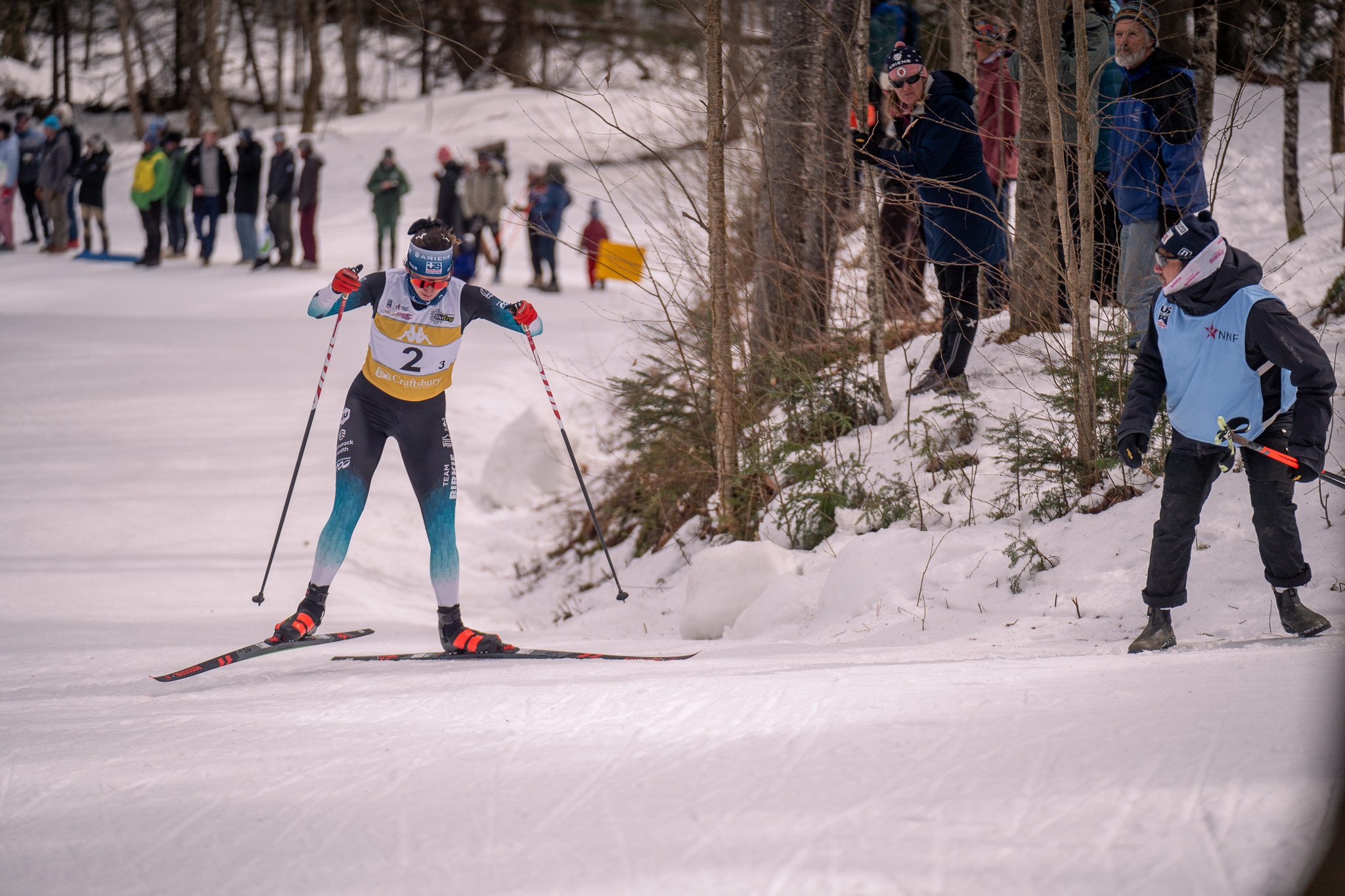
The goal underneath it has not moved: pay enough of the bills that good skiers can train and rest instead of working full time, and get them onto the U.S. Ski Team and the World Cup. The current World Team is Zak Ketterson, Kevin Bolger, Alayna Sonnesyn and Luci Anderson, and they already know how to win together. At SuperTour Finals in Craftsbury last March, those four beat APU’s relay of Olympians by 46 seconds. Head coach Jake Stiele works day to day with about a dozen Continental and Regional team athletes based in Minneapolis.
Gibbs wants more of them, from everywhere, and he has a pitch.
“Minneapolis has more Fortune 500 companies than any other metro area that has groomed ski trails and snowmaking,” he said. “Anywhere, including Oslo. So it’s the epicenter for big companies and skiing in the same place.”
He rattles off General Mills, 3M, UnitedHealthcare, Best Buy and Target, all headquartered within about a 20-minute drive of the Trailhead at Theodore Wirth Park. The team is working on corporate partners who could offer internships, so a post-collegiate skier could keep racing while building a career, and on low-cost housing where parents would feel good about sending a kid for the summer.
“It takes time with those big companies,” Gibbs said. “But if we can get it into the right ears, I think that we can do it.”
Ben Popp, who runs the American Birkebeiner, came at the same idea from the other direction when we spoke in September.
“Why is the Midwest so strong?” Popp said. “Well, Minneapolis and St. Paul get snow. So you have an urban center that gets snow.”
The college summer program, coached this year by 2022 Olympic biathlete Jake Brown, is a big part of the plan. Brown is back in school, and Snø Racing will be looking for a new summer college coach to run the program from June through mid-August, including an altitude camp in Park City or Tahoe. Gibbs is blunt about the other gap.
“We need to get more women in our program also,” he said.
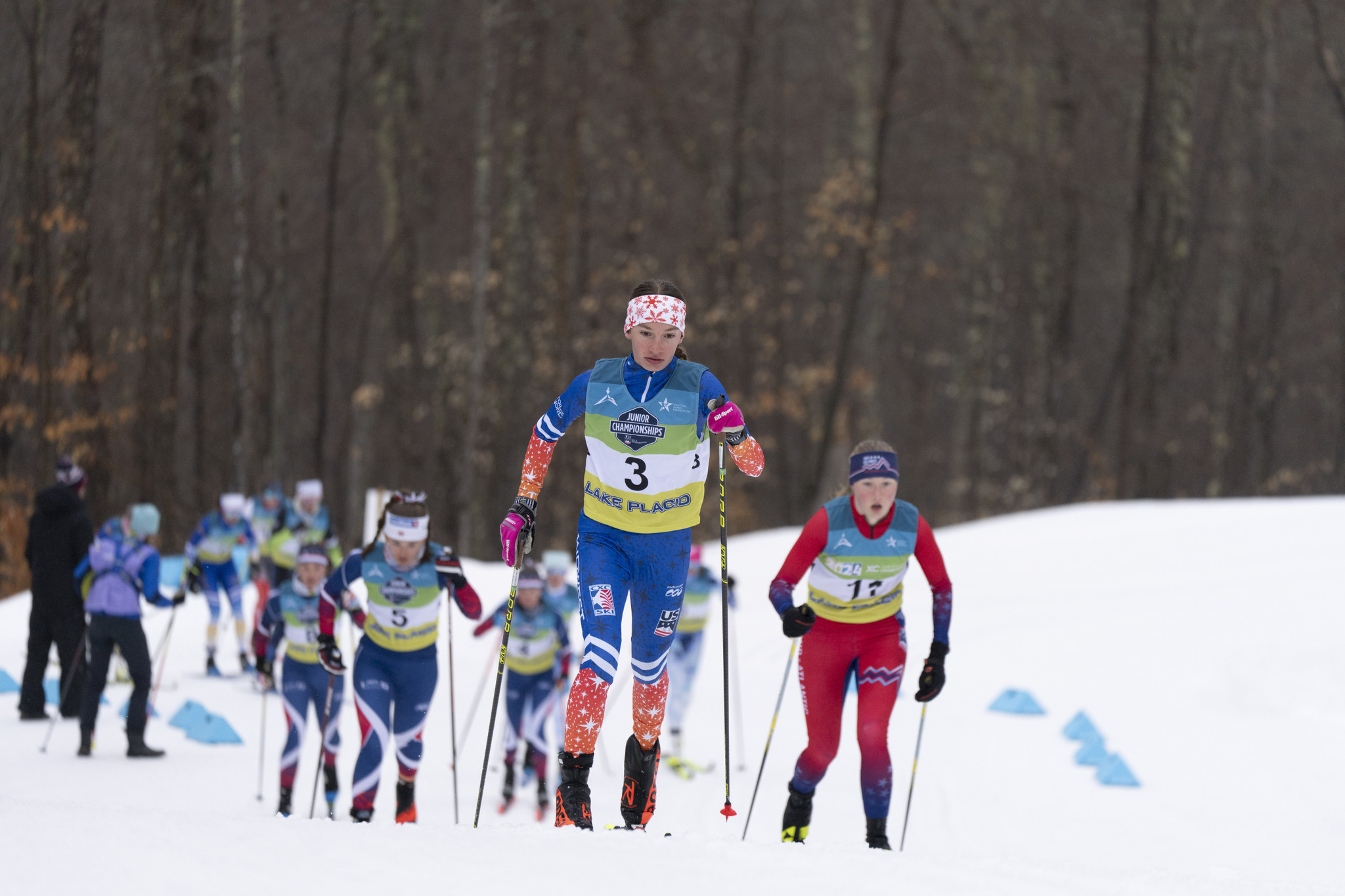
Linnea Ousdigian (Loppet Nordic Racing) leads the U16 girls’ classic at the 2024 Junior Nationals in Lake Placid on her way to the win. (Photo: Phillip Belena/Lake Placid Organizing Committee)
Every Leg Funds the Next One
The project Gibbs most wants to talk about is the one that would have helped the kid with one pair of skis.
It is called the Legacy Relay, and it is a joint effort between Snø Racing and CXC. The idea is to reach everyone who has skied on, coached or cheered for a Midwest (formerly Central) or Great Lakes Junior National team since the first one in 1965. Gibbs figures that is around 3,000 people. Each is asked to give monthly: $5 for current athletes under 30, then $20, $50 and $100. Three quarters of the money goes to Snø Racing’s athletes. The rest goes to grants for Midwest and Great Lakes juniors.
Gibbs knows exactly what those grants are for.
“You can get named to the team, but you still have to pay,” he said. “And then all of a sudden they’re like, well, it’s going to be $3,000, you know, by the time you pay for airfare and everything else. And some families are like, yeah, well, our daughter or son can’t go to that. Sorry.”
“We want your athlete to be able to have those opportunities and not have to pass them up.”
Gusev holds membership card No. 1. Gibbs is No. 2. No. 3 is Luke Bodensteiner, the two-time Olympian, who was billed as the special guest at the program’s kickoff, a reunion of Midwest and Great Lakes Junior National alumni at the Trailhead on Oct. 23. Gibbs raced against him as a teenager in the late 1980s.
“I just remember seeing him in the parking lot knowing, oh man,” Gibbs said. “And then it was just a matter of time till he went by me, and I was like, there goes Luke.”
The money is half the point. The other half is the people.
“Once they are on the team and they’re not juniors anymore, and then they’re done with college and they start their careers, a lot of times you don’t ever see the people again, and they don’t see each other,” Gibbs said. “But they have a lot of wisdom, and they have a lot of contacts.”
Popp, whose organization helped create the team, has thought a lot about why American skiing depends on gifts like these.
“We’re not Norway and Sweden, right? We don’t get the government support, so there’s all this grassroots fundraising,” he said.
That giving, Popp argued, comes from the same place as any other.
“Most people, they give to their church, they give to their college, they give to the hospital. Well, why do they give to those things? Those places completely impacted their life. I would argue that cross-country skiing and outdoor experiences can impact your life in a very similar way.”
Gibbs is just as focused on a quieter problem: the gap between Minnesota’s club coaches and its high school coaches. He wants to get rid of the idea that each side looks down on the other.
“The high school coaches are super important,” he said. “They’re the ones that are with these young kids, seventh and eighth, ninth graders, when they first start skiing. And if they’re not having a good experience, they might quit before they ever even find out anything about their potential.”
A working group of club coaches, high school coaches, U.S. Ski & Snowboard staff and parents has been meeting monthly on Zoom, and Gibbs is trying to get the Minnesota and Wisconsin high school coaches’ associations in the same room. Some of what the schools need is not complicated. An extra bus to get kids from school to Elm Creek or Wirth after class instead of skiing the field behind the building. More wax clinics, which Snø Racing plans to run.
“Try not to go for home runs every time,” he said of what he teaches there. “Have it so if worst case scenario, your skis are still going to be good. But in the best case scenario, you’re going to have lightning-rod skis.”
He points to the Mesabi East Invite at Giants Ridge, which draws 1,300 or 1,400 middle and high school skiers, as proof of what the region has to work with.
“At least half of the ski team should be kids from Minnesota and Wisconsin and Michigan,” Gibbs said. “… It’s like an ocean compared to these little ponds out there.”
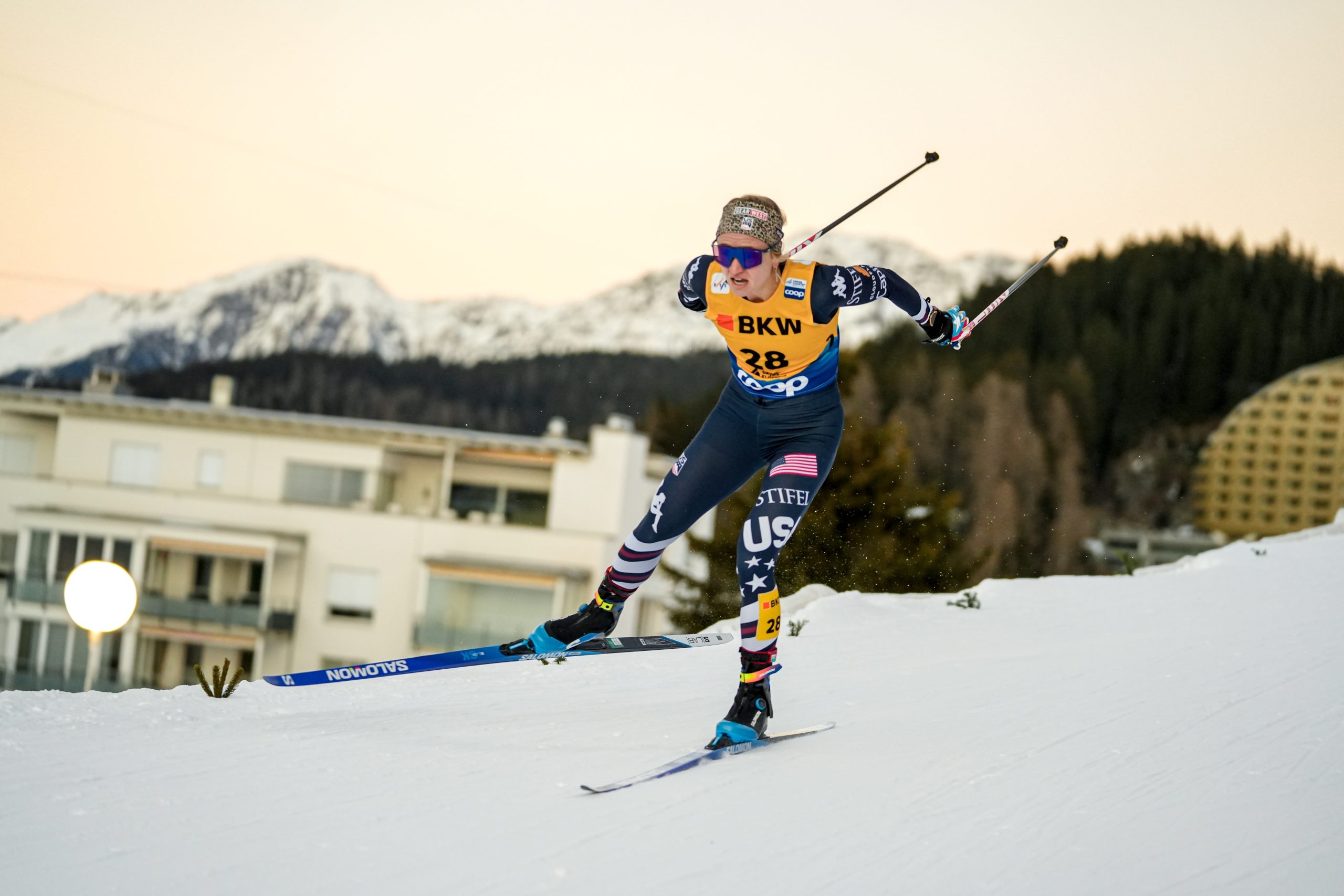
Alayna Sonnesyn skating the individual sprint at the Davos World Cup in December 2025. She will spend part of this winter racing with a Davos-based team. (Photo: Vanzetta/NordicFocus)
A Different Hat
Gibbs lives in El Dorado Hills, California, now, between Sacramento and Lake Tahoe, and commutes to Minneapolis for camps. Earlier this month it hit 102 degrees there. He has fallen for his gravel bike, and he has started rollerskiing again, which draws looks.
“There’s only like me and a couple other people that I’ve ever seen out here rollerskiing,” he said. “You look like a real weirdo out here.”
On Nov. 23 the team heads to Canmore, and his job changes. Stiele will manage the athletes. Gibbs will manage the skis: the fleets, the testing, the products for every venue, through the SuperTour season, U.S. Nationals in Cable and a Birkie that is now part of the SuperTour.
“Then it’s put a different hat on,” he said, “and it’s time to make fast skis.”
Ketterson was named to the U.S. team for the opening World Cup weekends in Ruka and Trondheim, and Bolger, Gibbs said, is going to get opportunities too. Sonnesyn will split her winter between World Cups, Ski Classics marathons with a team based in Davos, Switzerland, and racing at home. Anderson will spend most of it on the IBU World Cup in biathlon. And there are two Twin Cities high schoolers Gibbs cannot stop talking about, Logan Drevlow of Hopkins and Linnea Ousdigian of Mounds View, both Loppet Nordic Racing juniors who could get a few SuperTour starts this winter.
“Generational talents,” Gibbs called them. “It should be pretty fun. Fun for them, not as fun for some of the seniors, I don’t think.”
If one of his athletes makes it to the World Cup for good, he would like to be the one waxing their skis.
“I would love to go do that again,” he said. “These aren’t robots. These are people too that do all the things that other people do, and they have problems and they have issues. So let’s go over there and just … this is a normal race. We’re not going to freak out.”
He wants to bring some calm to it, too. “It’s not all freaking out when Klæbo walks by or whatever,” he said.
He says he needed the years away. He says he has more energy for it now than he did the first time.
“It’s really fun every day when I wake up to work with all of this,” he said. “It doesn’t feel like I’m even working.”
It is still, he admits, mostly a money problem. And a people problem.
“People have to be passionate about it or it’s not going to happen,” Gibbs said. “They have to be willing to do the extra mile all the time.”
Then he corrected himself.
“Or the extra K, I should say.”
How to support Snø Racing
Alumni, coaches and families of Midwest and Great Lakes Junior National teams can join the Legacy Relay here. Anyone can make a one-time gift through Snø Racing’s donation page, and the team’s roster and schedule are at snoracing.org. FasterSkier is glad to back the teams doing this kind of work across North America, and we want to hear about yours.
Help Support Our Coverage!
If you value the thoughtful work and access FasterSkier provides, please consider becoming a Voluntary Subscriber. Your support directly fuels our work to cover the people, places, and moments that make our sport special.
Luci Anderson on her leg of the SuperTour Finals relay in Craftsbury last March, when Team Birkie’s Alayna Sonnesyn, Kevin Bolger, Anderson and Zak Ketterson beat APU’s squad of Olympians by 46 seconds. (Photo: Tryg Solberg/FasterSkier)
As owner and publisher of FasterSkier, Matthew Voisin manages the day-to-day operations, content, and partnerships that keep the site gliding smoothly. Away from the desk, he’s doing his best to keep pace with his two energetic sons.
Comments
Commenting policyJoin the conversation. Comment and react with your Endurance ID — one account across the whole network.
Loading comments…