Gus Schumacher (USA) in the Olympic team sprint in Tesero, Italy, on Feb. 18, the day he and Ben Ogden won silver. (Photo: Vanzetta/NordicFocus)
On Feb. 18, Gus Schumacher anchored the team sprint at the Milano Cortina Olympics and crossed the line 1.4 seconds behind Johannes Høsflot Klæbo, giving him and Ben Ogden the silver medal. That same day he heard from Bill Koch, whose 30 k silver at Innsbruck in 1976 had been the only Olympic cross-country medal won by an American man until Ogden’s sprint silver earlier at those Games.
“I remember Bill Koch was just texting me that day and said, you know, things are going to change, and then kind of doubled down on that,” Schumacher said.
Some things did, he said.
“In general, I think I realized that I didn’t really want things to change that much,” he said. “I’m happy with my life, and I’m just really happy with training and everything.”
Schumacher spoke with FasterSkier on Wednesday from Ruka, Finland, where the World Cup season opens Friday. He is named to all three U.S. starts for the weekend, on new skis, after a summer and fall with more training than last year and no injuries or illness.
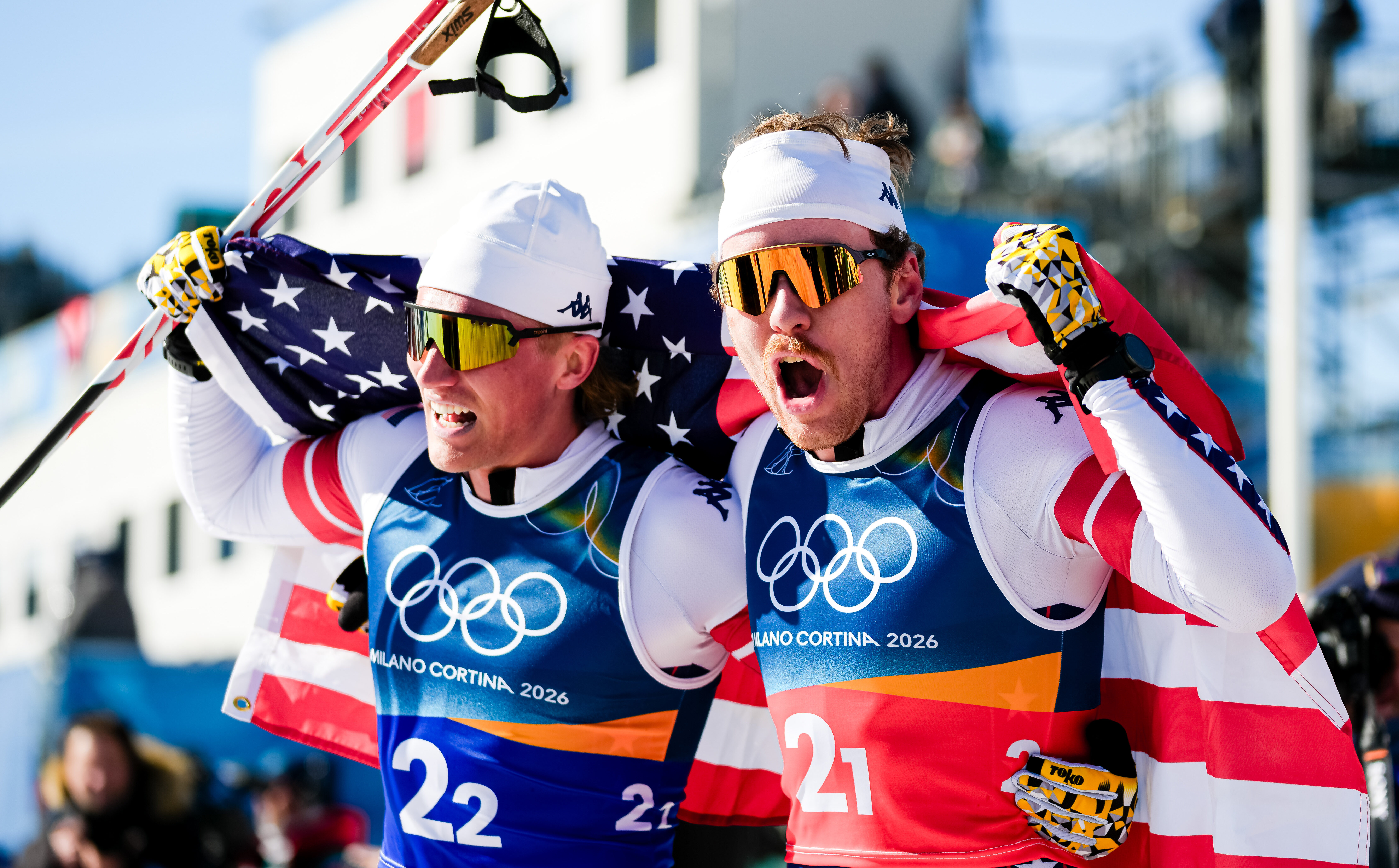
Schumacher, left, and Ben Ogden celebrate their team sprint silver at the Milano Cortina Olympics. (Photo: Vanzetta/NordicFocus)
Same place, same people
He has already written about what the medal changed, he said, in an article for the Anchorage Press. In Anchorage, where he grew up, the difference is mostly how much people notice.
“I think the biggest difference is that the things that I do are more noticed,” he said. “In Anchorage, people have always, or for a long time have sort of looked up to me, and that just solidified it, pushed it forward a little bit.”
He brought the medal home to Anchorage in the spring.
“That was really gratifying, to bring the medal around and have all these people that have seen me grow up skiing kind of get to feel it and feel a piece of it,” he said.
“I’ve had new sponsor stuff come up, and maybe a bump in media obligations and opportunities, stuff like that. But in general, living in the same place, hanging out with the same people, training in the same places, and yeah, I wouldn’t change that.”
The sponsor side was on his mind through the summer, he said.
“For a lot of the summer, I felt like I needed to be trying harder to do that stuff,” he said. “You know, people don’t care about the medal as much a year or two from then.”
“When I thought about it, it’s like, I don’t really want to be doing a ton of extra sponsor stuff just because it’s making money. And I think that those are good. It is nice to make money, but at the end of the day, skiing fast is what’s going to make money long term. And so that’s my main focus.”
The other piece, he said, is visibility for the sport, which is where he looks to Jessie Diggins.
“Jessie obviously did a great job with that,” he said. “So to try to continue that legacy by just taking opportunities when they come up and practicing being well-spoken and just thinking about what I want my impact to be when people look to me.”
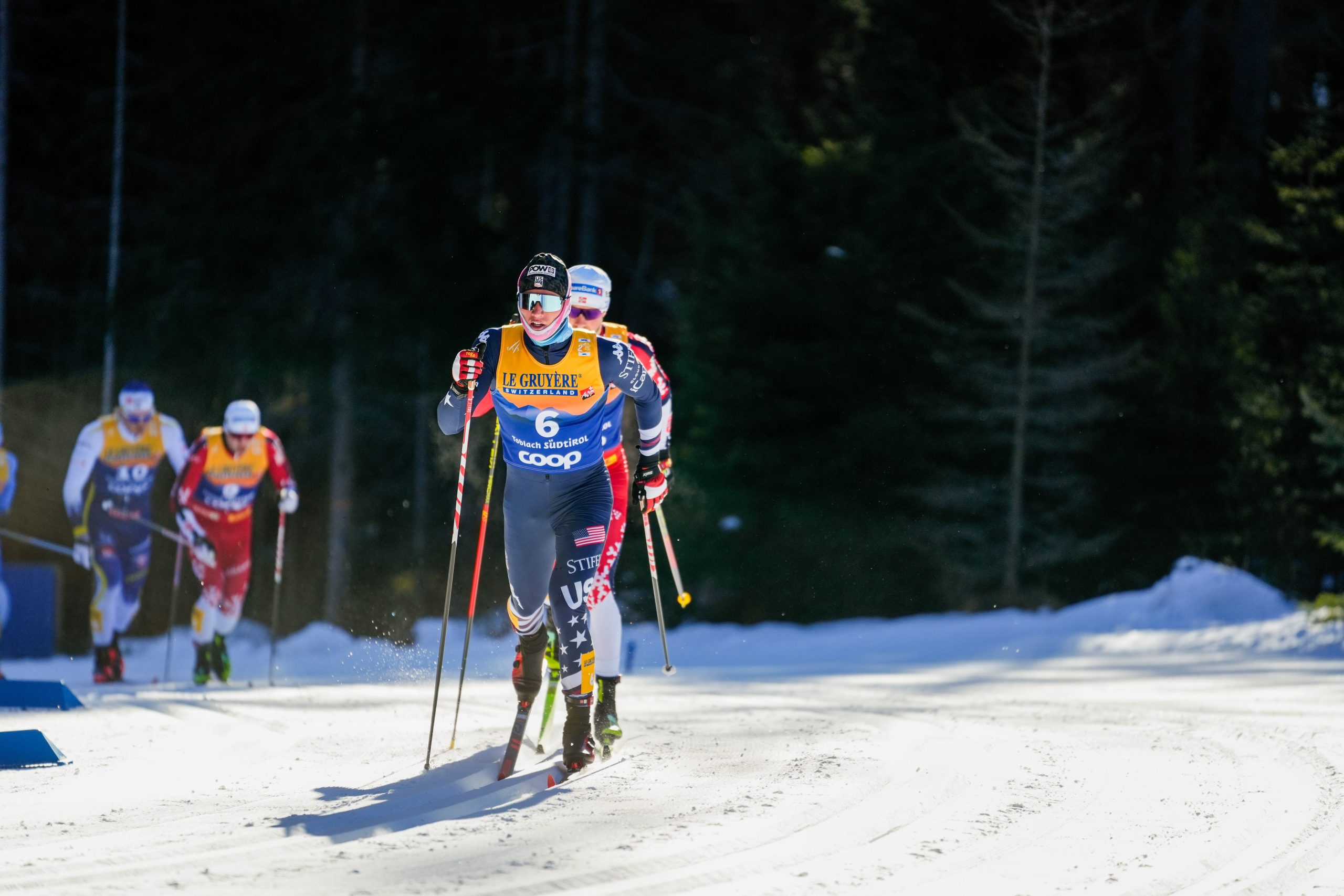
Schumacher in the Tour de Ski pursuit in Toblach, Italy, on New Year’s Day. (Photo: Vanzetta/NordicFocus)
Fifteen percent more
“No injuries. I’ve been training more. No illnesses,” Schumacher said of his preparation. “So yeah, which I don’t take for granted. Having a smooth training year is something to be really grateful for, and it’s nice to be here and feel ready.”
He said he trained “something like 15% more through the prep period,” a jump he had made before but that went better this time.
“I never felt way overextended or anything,” he said. “It’s a big jump, but something that I’ve done before, so it wasn’t totally foreign. But yeah, you never know how a big jump is going to go, and I’m glad it has worked out so far, at least.”
“There’s always kind of some trepidation, like how’s it going to be actually racing?” he said. “But I’ve been feeling good in training, and yeah, I feel like my technique and stuff is in a good place. So yeah, I’m also just excited to see where it all stacks up.”
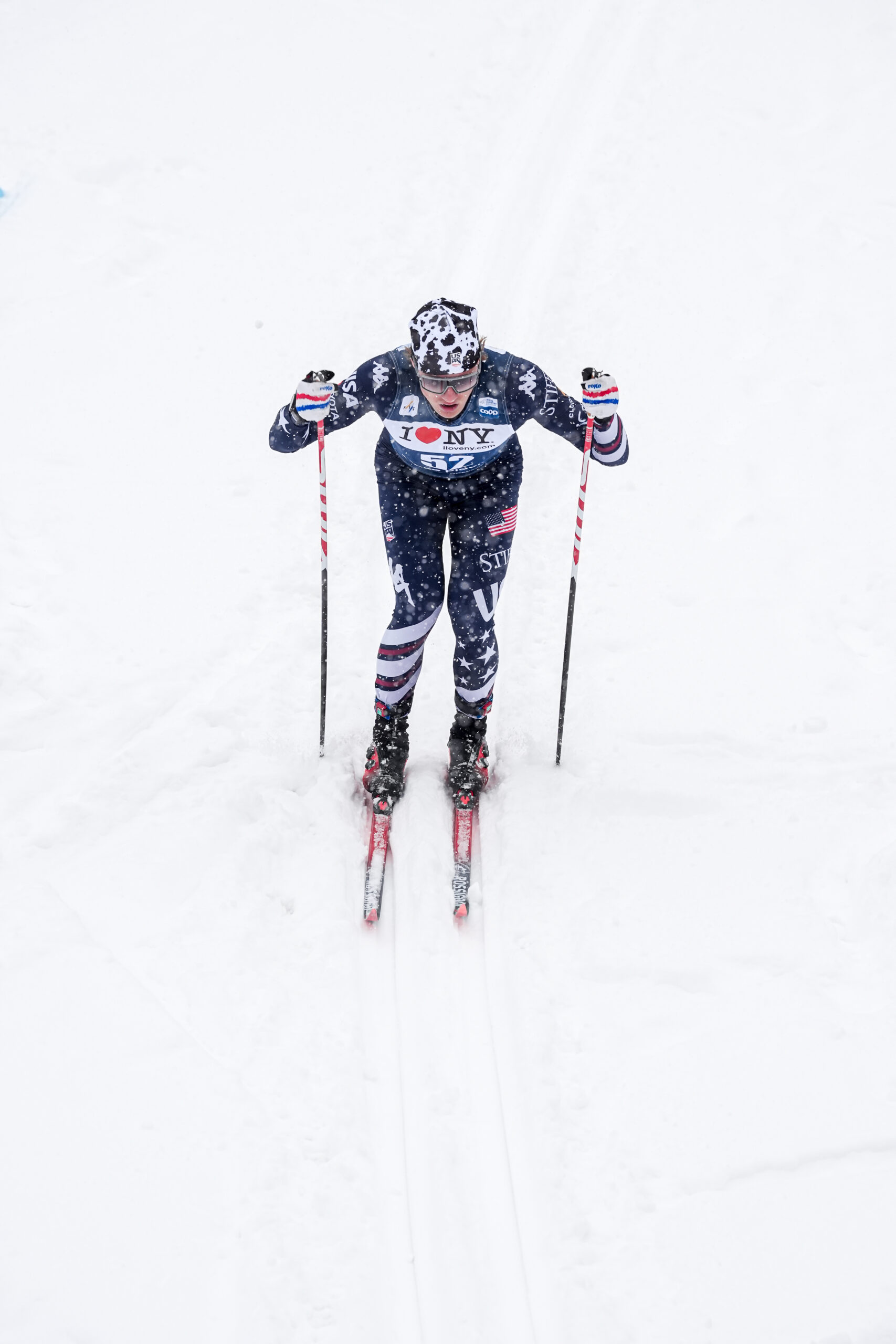
Schumacher in the 10 k at the Lake Placid World Cup in March. (Photo: Thibaut/NordicFocus)
Where he can put pressure
In June, Schumacher said he was leaving Rossignol, the brand he had skied on since he was 14. In July he confirmed he was moving to Fischer. The decision came out of testing he did in the spring, mostly after he got home, on several brands.
As he tested, he said, he noticed a bias of his own.
“I sort of had a bias to these new skis, which I think a lot of people do, where it’s kind of shiny and different and people give you more attention,” he said.
To take that out of it, he had Erik Flora, his coach at APU, help with the waxing “so skis were similar and I could really do pretty direct testing in a range of conditions.” He wrote down what he thought every day.
“I’ve been skiing on Rossignol my entire career, and there’s a part of me that just wanted a change, which was a little bit like, you know, Rossi’s been really good to me,” he said. “But yeah, I was just excited to try something new. And going into this season, I’m really excited to be on Fischer.”
He said a lot of the testing was subjective.
“I had boots from everyone too, so it was more of my feeling, and I just felt like I was able to ski the best with Fischer,” he said. “Just my body positions and where I could put power felt really smooth.”
Asked to explain that for readers who have never tested skis, he started with skating.
“The biggest thing is how far forward I can put my pressure,” he said. “If you think about running mechanics, or where we’re most efficient, it’s kind of in those sharp ankle, knee, hip angles. And when you have a sharp knee angle, a lot of that force kind of goes through the forefoot. You can use your Achilles, your calf, kind of these smaller muscles for efficiency.”
Far forward on the ski, in soft snow and hard, he said the Fischers did not lose speed or dig in. In classic, he liked the balance of the kick and how it felt underfoot, and the double poling. Then there is the edge.
“The Fischer doesn’t have as much edge, which can be a detriment, but I thought it felt good in a lot of conditions because the ski doesn’t just track perfectly straight,” he said. “It sort of goes where you’re pointing it, or it goes where you’re pressuring it. So you can almost feather it to turn instead of having to hop or something.”
“Rossi is famous for tracking super straight, which is awesome in hard conditions,” he said. “But when it’s softer, it’s nice to have a ski that, you know, if there’s a rut, maybe it’ll just kind of follow that and take the easiest path.”
“I tested mostly JC’s skis in the spring,” he said. “But then, yeah, they got a bunch of skis together for me, and so far they seem good. We’ll see in racing.”
Some of his old skis have stayed on the team. Zak Ketterson, who spoke with FasterSkier just before Schumacher, ended up with much of his former Rossignol fleet, and suggested a question for him: how does it feel to see Ketterson racing on them?
“I think it’s great,” Schumacher said. “Yeah, those, the 70 series on the skate skis are really good, and I think he’ll enjoy them.”
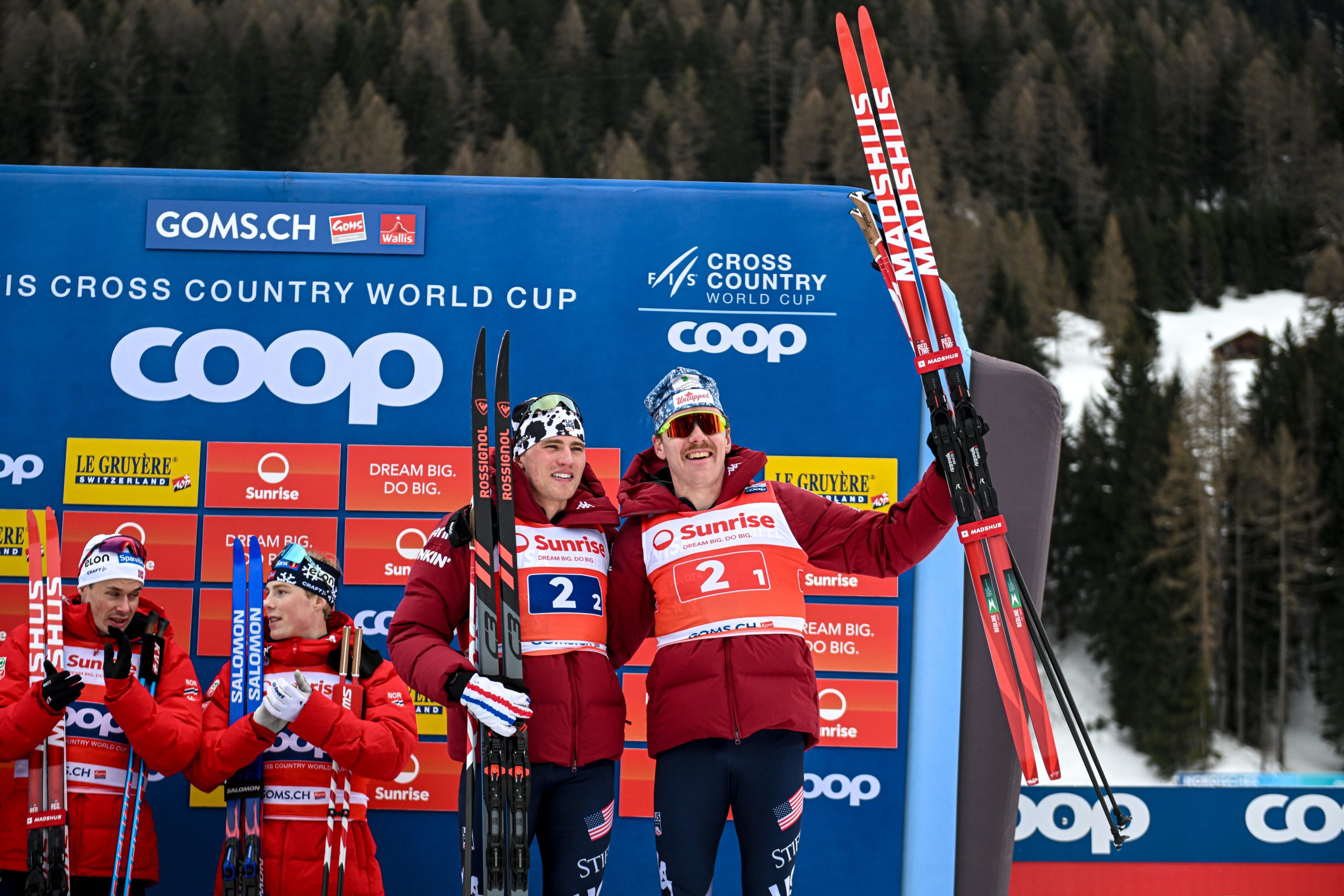
Schumacher and Ogden after the team sprint at the Goms World Cup in January. (Photo: Authamayou/NordicFocus)
Taking up the slack
Diggins retired after last season, and Schumacher said he feels part of the space she left.
“It’s definitely a learning process,” he said. “I’m different than Jessie in a lot of ways, so I definitely can’t just copy her.”
“The team lost a really strong leader, and we have a lot of good leaders on the team, but I definitely feel like someone who is just a big part of taking up that slack a little bit. And I think the biggest thing is just trying to maintain the values that our team strives for, which she did a good job in. It’s just gratitude, pride in who we are, friendship and family, kind of fostering that environment.”
So far that has meant small things.
“We started doing a trivia night in Muonio already,” he said. “That’s a new tradition, but I think a good one. And then we’re kind of taking on the Secret Santa planning, and we need to make sure we get signed bibs for all of our volunteers, people that are coming in and out.”
Ogden is not with the team in Finland. Schumacher said the men have not had much time together since last winter, and that the leadership conversations will happen as the season goes on.
“We’re still missing Ben, and he’s a pretty integral part,” he said.
And there is a second change coming. Head coach Matt Whitcomb will leave after this season to become head of school at Burke Mountain Academy in Vermont.
“We’re losing Matt too next year, who is kind of even a bigger leader on the team,” Schumacher said. “He likes to be quiet about it, but he’s definitely a driving personality for us.”
“My guess is we’ll sort of adjust to Jessie and then we’ll have to adjust again, but it’s good to be proactive and be thinking about, yeah, how we want to be, how we want to carry ourselves.”
Schumacher after the Olympic 50 k in Tesero in February. (Photo: Vanzetta/NordicFocus)
Getting the fight back
“The overall is a big one,” Schumacher said of his season goals. “I had a good campaign in that last year, and I’m not planning on missing any World Cup weekends this year, so that’s a big part of that goal.”
He will go home for Christmas and may pick and choose a few races after the Tour de Ski. For this weekend, he said, the goal is intensity. The first races are always harder for him to push into the red.
“Just practicing pushing myself and getting the fight back a little bit,” he said. “In training the whole summer, you’re like practicing not fighting and being smooth and hitting your levels perfectly and all this. And it’s time to forget about that and go race.”
The bigger goals sit further out, at the World Championships in Falun, Sweden.
“We’ve talked about the relay at World Champs, as we always talk about the relay,” he said. “But yeah, I think as we mature, that’s going to become more front and center, and there hasn’t been a championship relay medal before for the U.S., so I think that would be a sweet milestone to hit.”
“And then it’d be cool to get an individual medal at World Champs, but that’s a little far away. That’s definitely something that’s on my mind and feels totally possible, but gotta focus on the racing right in front of me first.”
Between weekends he plans technique work with the coaches, which he said should be easier now that the team has a third coach, and core work to keep the torso strength from a summer of double poling.
“Trying to keep that sort of torso integrity together through the racing season,” he said. It helped him last year, he said, and he expects it to again.
And Ruka has more snow on the ground this week than he has seen there before.
“I think it’s the most snow I’ve seen here,” he said.
Help Support Our Coverage!
If you value the thoughtful work and access FasterSkier provides, please consider becoming a Voluntary Subscriber. Your support directly fuels our work to cover the people, places, and moments that make our sport special.
As owner and publisher of FasterSkier, Matthew Voisin manages the day-to-day operations, content, and partnerships that keep the site gliding smoothly. Away from the desk, he’s doing his best to keep pace with his two energetic sons.

Comments
Commenting policyJoin the conversation. Comment and react with your Endurance ID — one account across the whole network.
Loading comments…