Julia Kern (USA) in the 10 k at the Lahti World Cup in March. (Photo: Authamayou/NordicFocus)
On Wednesday in Ruka, Finland, Julia Kern told Matt Whitcomb what she would miss. Whitcomb, the U.S. head coach, is in his last season with the team. After this winter he leaves to become head of school at Burke Mountain Academy in Vermont.
“I told Matt today, I was like, what am I gonna do next year when I get to the top of this hill?” Kern said. “… You’re always yelling, and I’m falling apart on this Ruka hill. It’s so tiring, and I feel like I’m barely moving, but … I just remember your voice always there.”
It is one of several changes for the U.S. women this winter. Jessie Diggins and Rosie Brennan are no longer on the road with the team, and Kern, 29, was the oldest athlete at the women’s camp this fall.
She spoke with FasterSkier on Wednesday from Ruka, where the World Cup opens Friday. She is named to all three U.S. starts for the weekend.
Kern in the 20 k at the Goms World Cup in January. (Photo: Authamayou/NordicFocus)
Comfortable and steady
“After I had a bit of a rough ending last season, I had some health issues,” she said. “I had elbow injury all year and the mystery lung cough situation. So I didn’t race much at the end of the season and kind of made a last attempt to rally for Lake Placid World Cup Finals because I couldn’t miss that.”
“My body wasn’t in a great place, but it was just really fun to be a part of.”
“I think the post-Olympics cycle is always an interesting time and hits people in different ways,” she said. “Kicking off the year doing physical therapy and rehab was definitely not the most exciting way to kick off the season.”
“I didn’t have a training camp until September, so that was really weird for me, because I love going to training camps and it’s super social.”
Instead she stayed home in Vermont.
“I ended up doing a lot of biking and running in the early summer, which was actually really fun ’cause I haven’t been able to run much the last few years,” she said. “So I had a lot of fun just being home in Vermont and just getting out the door and exploring places and being really grateful I could run again in the mountains.”
She rehabbed the elbow, and she said it feels good now. The fall brought a camp in Park City, Utah, and a week in Canmore, Alberta, with her club team, SMS T2, to get on snow.
“Going from Lake Placid all the way to end of October without snow was a really long time for me,” she said.
“It’s probably the most consistent, steady year I’ve had. I’ve changed some things up with training, have more steadiness, less travel. And so in some ways it felt really uneventful, but it was just comfortable and steady is the best way to describe it.”
Kern, left, with Jessie Diggins and Rosie Brennan after the Olympic skiathlon in Tesero, Italy, in February. (Photo: Barbieri/NordicFocus)
A turn of an era
The camp she had been waiting for came in Lake Placid, New York, with the U.S. women.
“It was really exciting to finally be at a camp and have young athletes anywhere from 17 to now I’m the oldest, 29, at that camp,” she said. “The team feels a little bit like a turn of an era in a way.”
“I’m a little bit straddling two eras, but that was really motivating and exciting and really kicked me into gear to get excited for what is ahead.”
Diggins and Brennan were on the road for all of her career until now.
“We for sure really miss Jessie. And I think also Rosie,” Kern said. “They were both kind of the oldest on the team, most experienced. And they, I think they both brought very different strengths to the table.”
“I’ve felt like one of the older athletes for a while, but they’ve been on the road my entire career. And so for me, it’s probably the biggest difference out of anyone. And we definitely miss them, but I still keep in touch with them, which is really great. Those friendships don’t leave when they retire.”
She said leadership on this team is not tied to age.
“People always assume that the oldest or the fastest athlete is a leader,” she said. “But … Matt Whitcomb does a really good job of reminding everyone that we’re all honestly all leaders. And I think a really strong team thrives when people bring different strengths to the table.”
After the Olympics, she said, she put her energy into the women’s team as a whole.
“How can we build a group of leaders and everyone brings something different to the table, and a very cohesive team that really has fun on the road and wants to train together and learn from one another?”
She first trained with the national team in Lake Placid, as a high school athlete.
“I remember being like, oh my God, Jessie, Sophie Caldwell, like Ida, Rosie, like all these amazing athletes,” she said. “And I got to train with them and eat meals with them and see, like, oh, they’re actually human.”
Of this fall’s camp, she said:
“We played games between sessions, and it was just natural and flowing, and we were working really hard, but also everyone was really invested in us succeeding together.”
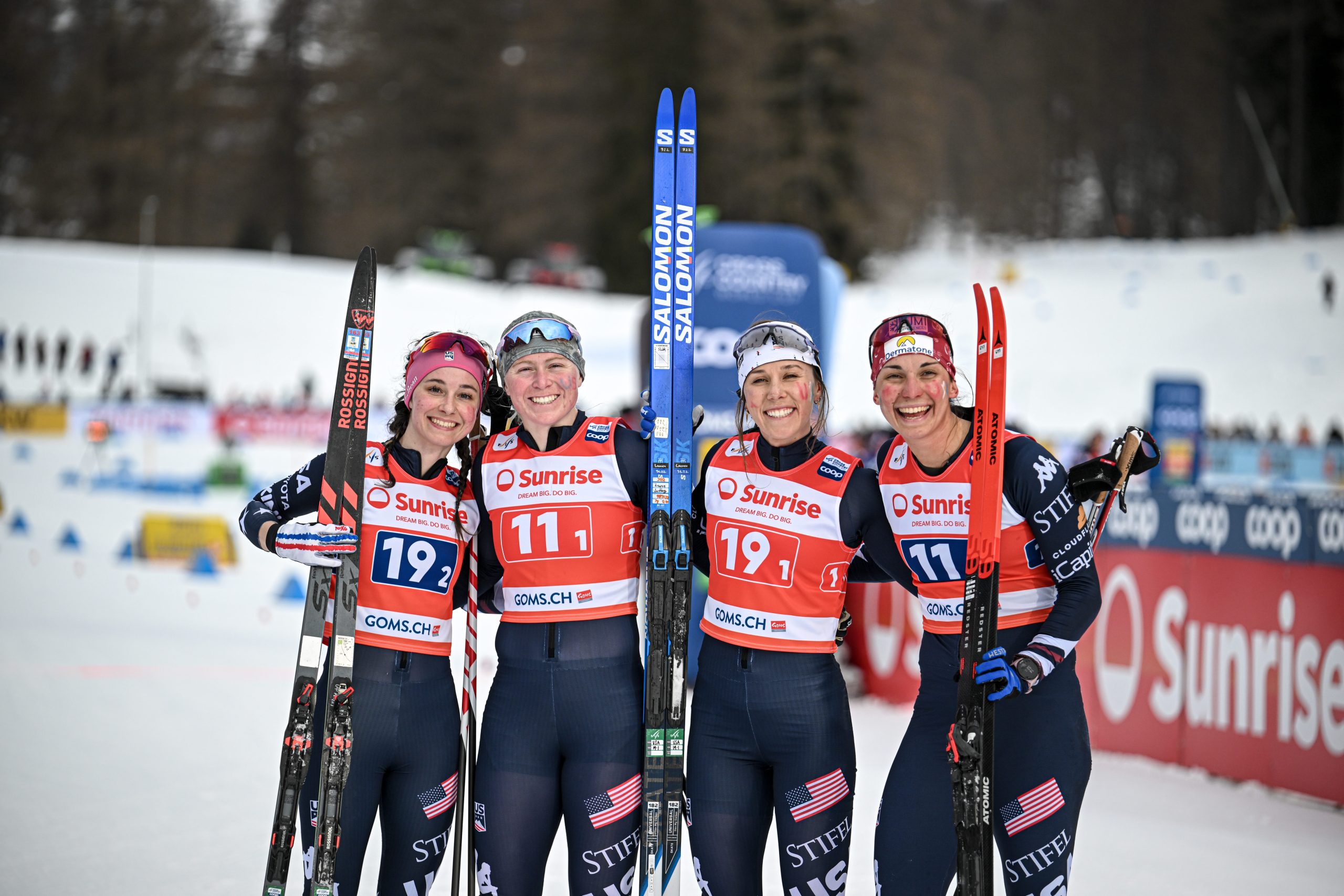
Kendall Kramer, Sammy Smith, Lauren Jortberg and Kern after the team sprint at the Goms World Cup in January. (Photo: Authamayou/NordicFocus)
Women’s Wednesday
The team held a trivia night last week, a new tradition. Secret Santa, Kern said, goes back much further.
“That’s been a tradition that goes all the way back to Kikkan,” she said, meaning Kikkan Randall. “Jessie and Rosie experienced it, but we normally do that in Davos. And I think it’s a really fun way to bring everyone together before the holidays and everyone parts ways for a bit.”
Others are newer.
“One of the things we started as a women’s team last year, maybe even two years ago, is Women’s Wednesday, but it’s not always a Wednesday,” she said. “It’s more just once a week we try to get together, whether it’s we do a craft or we are talking about starting a book club where you read a few chapters every week. A game night. I’ve been playing euchre with the boys, which has been fun.”
“Last year in Davos, we made Minute Mug cakes because we had a microwave and some flour.”
This week in Ruka, with the team in apartments, the women have been having dinner together.
“Those little things on the road make a huge difference, because when you’re kind of in hotel rooms, it’s really hard to really get together unless you put something on the schedule,” she said. “We don’t spend that much time together in the offseason. So it’s really in the winter where you build that sense of team.”
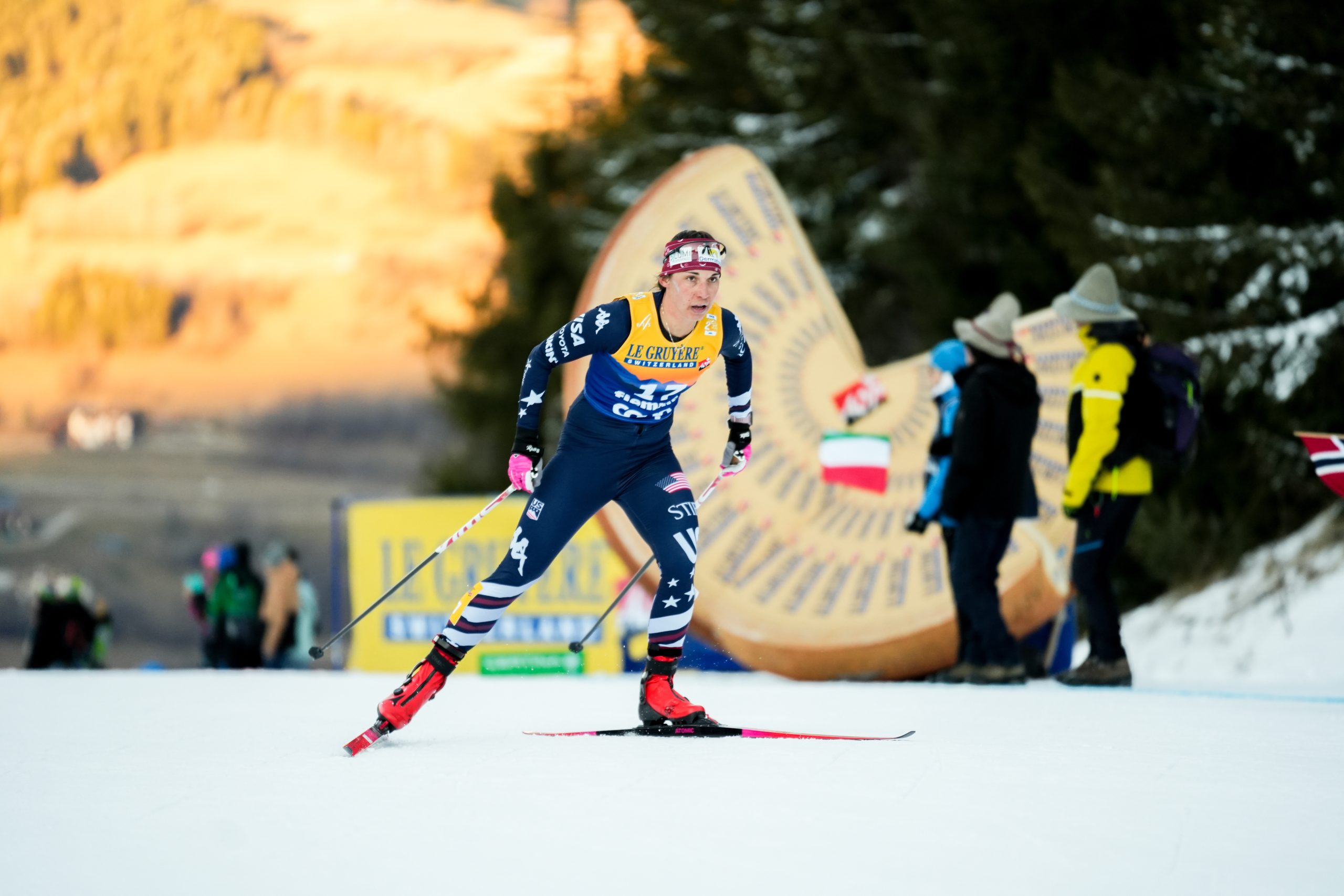
Kern on the final climb of the Tour de Ski in Val di Fiemme, Italy, in January. (Photo: Vanzetta/NordicFocus)
A blank slate
The World Championships this winter are in Falun, Sweden. Kern won team sprint medals with Diggins at the last two World Championships, bronze in Planica in 2023 and silver in Trondheim in 2025.
“I’ve really enjoyed Falun as a venue, especially the distance courses there,” she said. “Normally I’m always really excited for the sprint. The sprint is really tricky there. I’ve had some really good sprints and challenging ones, so I think it’s going to be a good challenge to see if I can bring it together on the big moment.”
She described the distance courses as constant work.
“Ironically, the Mördarbacken seems big, but compared to the Ruka hills or really a lot of other venues, it’s not that big,” she said. “You can’t really rest, especially in a skate race there. You’re never resting. You’re always cornering, always moving. You’re always riding the downhills. And I think that’s why our team has had a lot of success there.”
“It’s like a sloped golf course in some way, where you have these climbs that aren’t insanely long but not short either.”
The sprint course, she said, is the opposite: steep and “herky-jerky,” with technical downhills and a history of crashes.
“It’s a really tricky sprint course that challenges everything.”
Beyond Falun, the relay is a goal every year. For the season as a whole, she wants to race well in everything.
“I’m really excited just to try to race really consistently in sprint and distance and fight for a great overall ranking,” she said. “As I’ve gotten older, I’ve become more of an all-rounder, and I’ve had really good consistency in my training. And so I just kind of want to be in the mix in all of the races.”
She does not know yet what that will look like.
“I feel like I have less of a gut feeling than normal kicking off the season, which sometimes my gut feeling is totally wrong,” she said. “And so in some ways I feel like I’m going in with a blank slate, which is really exciting, but I also, I have no idea how this season is going to go.”
Her week-to-week focus is simple.
“It sounds simple, but consistent hydration on the road when it’s in the winter and it’s cold is really hard,” she said.
The other focus, she said, is enjoying the people around her.
“When the team is jiving and people are happy and having fun, that’s when the racing follows, and ultimately down the road you remember the silly moments in between.”
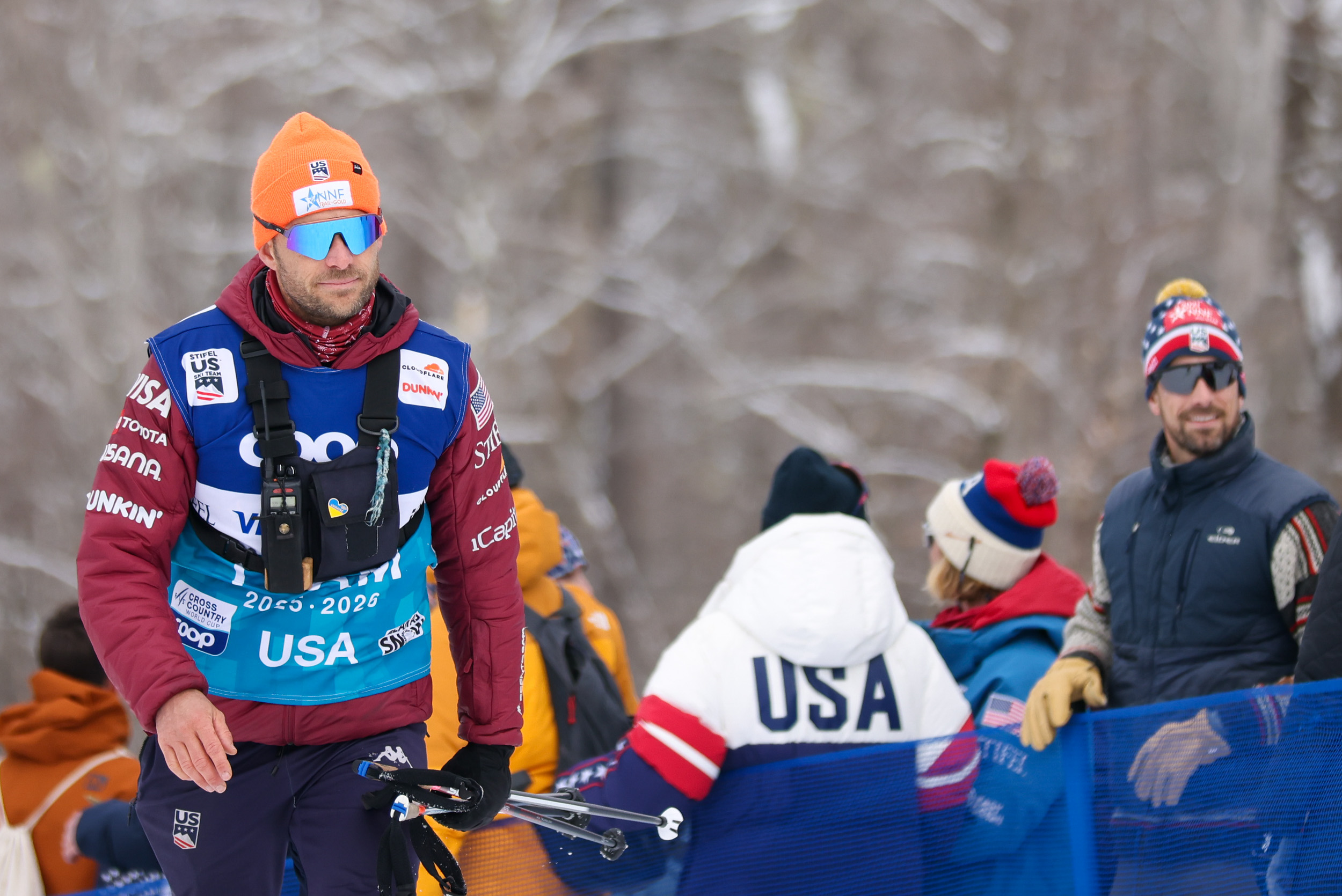
U.S. head coach Matt Whitcomb at the Lake Placid World Cup in March. (Photo: FasterSkier / Matthew Voisin)
One last year with Matt
Whitcomb has been with the U.S. team for two decades.
“I think it’s definitely emotional, and I feel really grateful I’ve had him for my entire career, pretty much,” Kern said. “Matt’s known me since I was like 13, and he’s been that steady U.S. ski team coach there all the time.”
“I think he’s played so many important roles in our U.S. ski team system and U.S. skiing as a whole. So I think those are going to be some really big shoes to fill, and it probably will look different because I don’t think anyone can fill those kind of shoes.”
She said the team is trying to enjoy this season with him.
“Matt’s been trying to get out with us, skiing with us, enjoying these venues one last time,” she said. “He has this different perspective because he’s been to these places for 20 years.”
“There’s definitely those moments in those places where Matt is just iconic. But we’re really grateful we have one last year with him to enjoy it. And he’s not gonna be going very far.”
Help Support Our Coverage!
If you value the thoughtful work and access FasterSkier provides, please consider becoming a Voluntary Subscriber. Your support directly fuels our work to cover the people, places, and moments that make our sport special.
As owner and publisher of FasterSkier, Matthew Voisin manages the day-to-day operations, content, and partnerships that keep the site gliding smoothly. Away from the desk, he’s doing his best to keep pace with his two energetic sons.

Comments
Commenting policyJoin the conversation. Comment and react with your Endurance ID — one account across the whole network.
Loading comments…