This coverage is made possible through the generous support of Kathy Hall and A Hall Mark of Excellence Award, founded by Marty and Kathy Hall. To learn more about A Hall Mark of Excellence Award, or to learn how you can support FasterSkier’s coverage, please contact info@fasterskier.com.
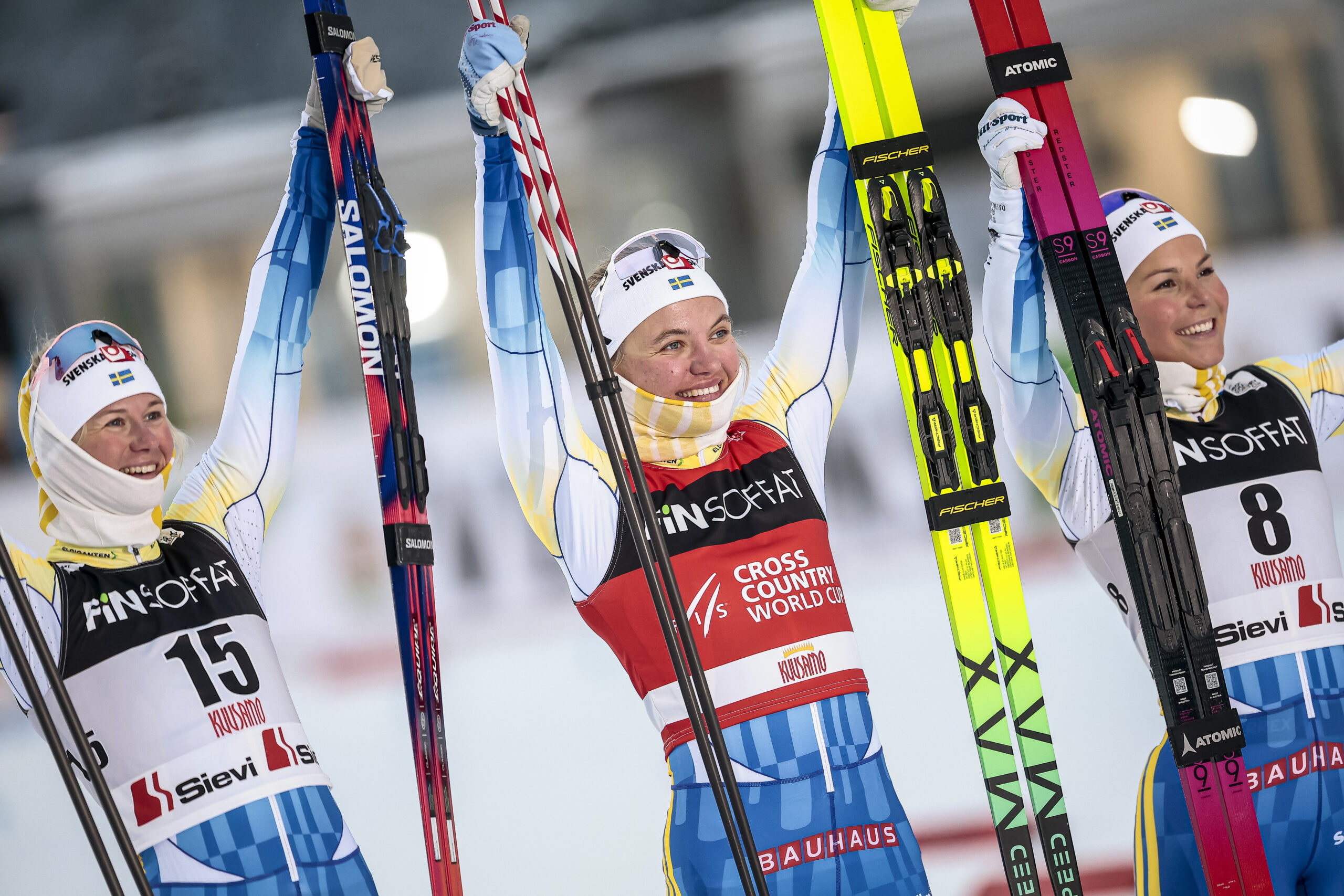
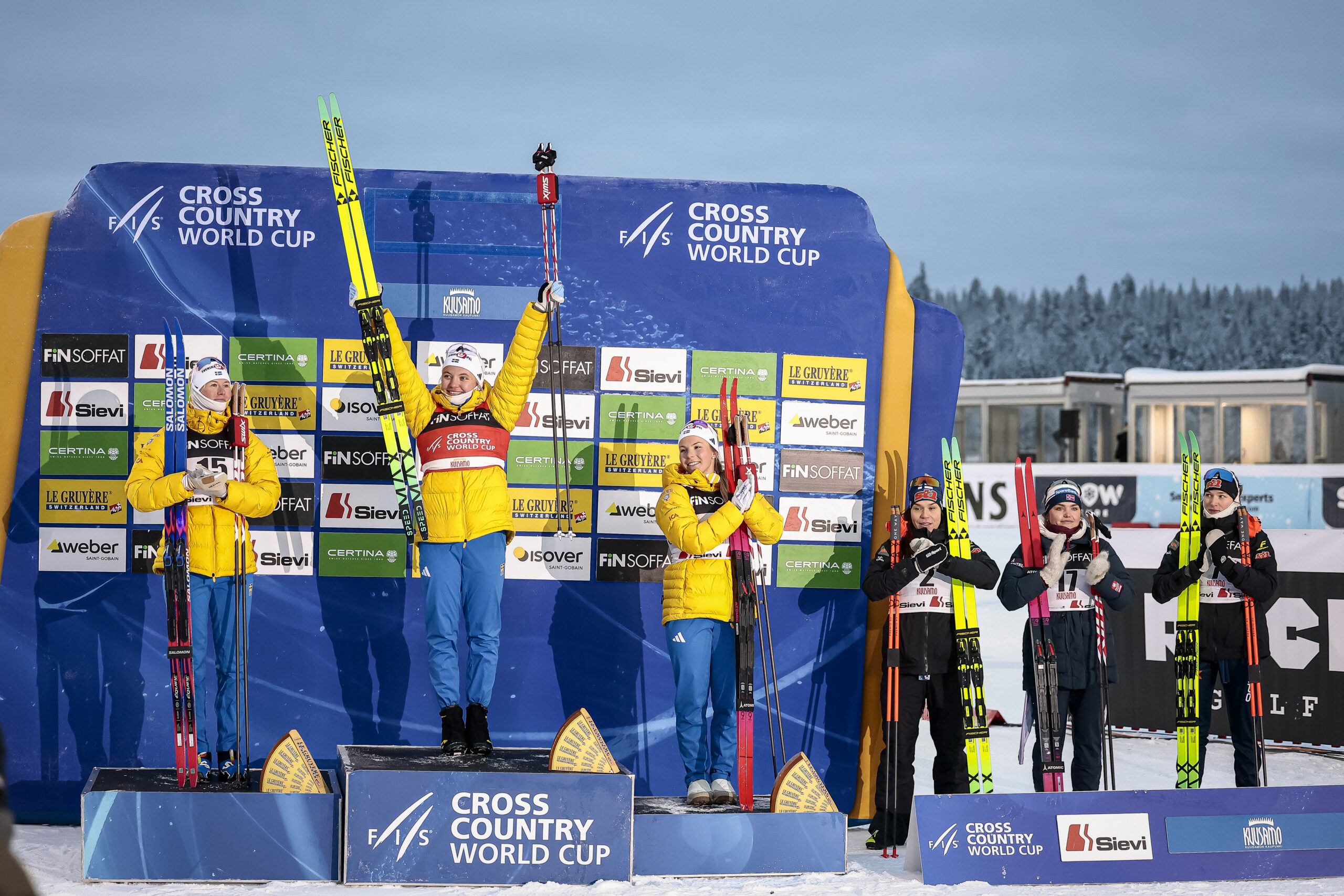
Maja Dahlqvist, Linn Svahn and Johanna Hagström (l-r) of Sweden after their sweep of the classic sprint in Ruka, Finland. (Photo: Modica/NordicFocus)
On Friday, after finishing second in the 10 k classic, Linn Svahn said she hoped the rest of the weekend in Ruka, Finland, would go the same or better. “I’ll try my best then hopefully, a victory,” she said.
On Saturday she got it. The Olympic sprint champion set the fastest qualifying time, won her quarterfinal, came through her semifinal in second and then won the classic sprint final by 0.58 seconds over her teammate Maja Dahlqvist. Johanna Hagström was third, 2.55 seconds back, and for the second day running Sweden had the whole podium.
Jasmi Joensuu of Finland was fourth in front of the home crowd. Ingrid Bergene Aabrekk of Norway was fifth and Tiia Olkkonen of Finland sixth.
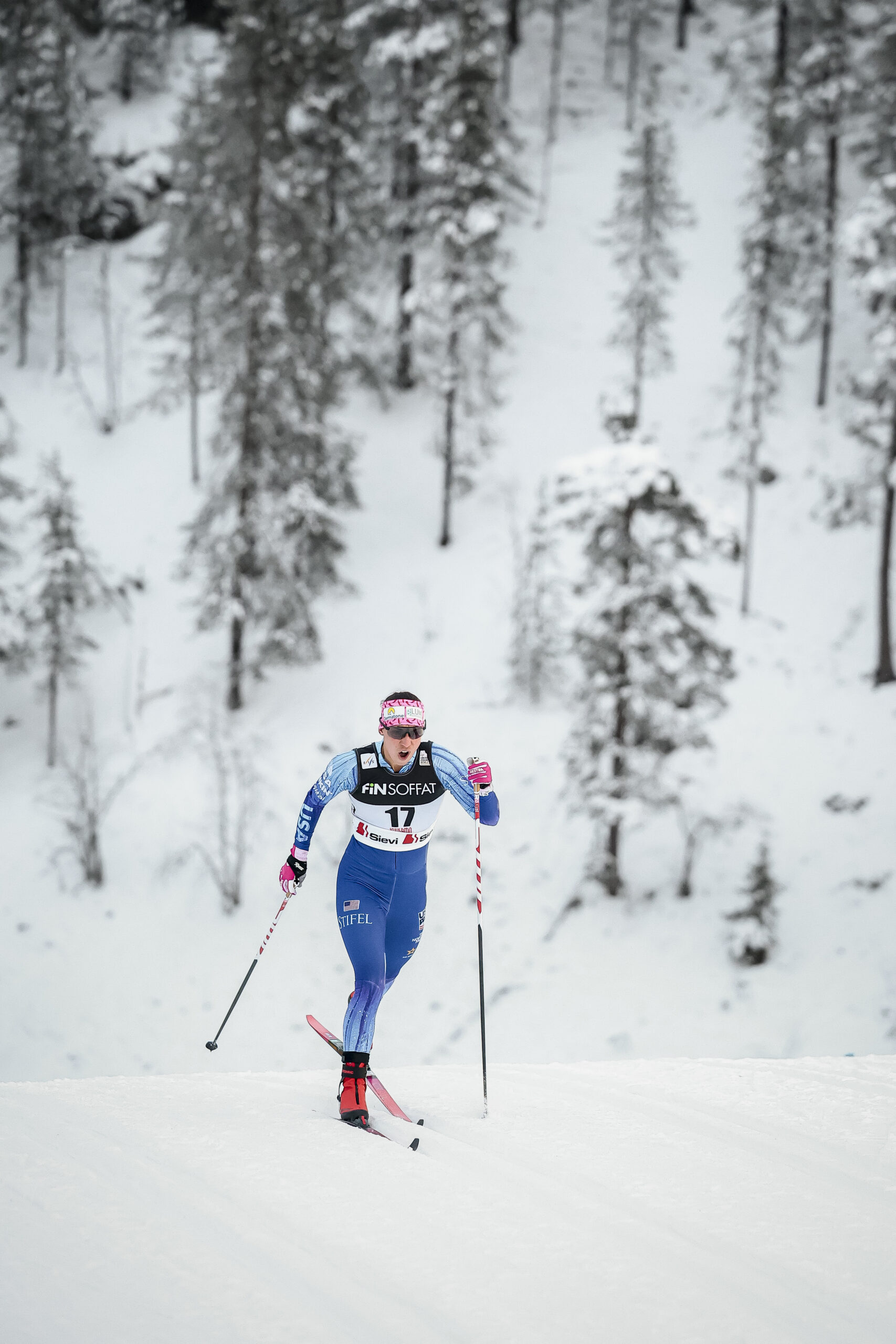
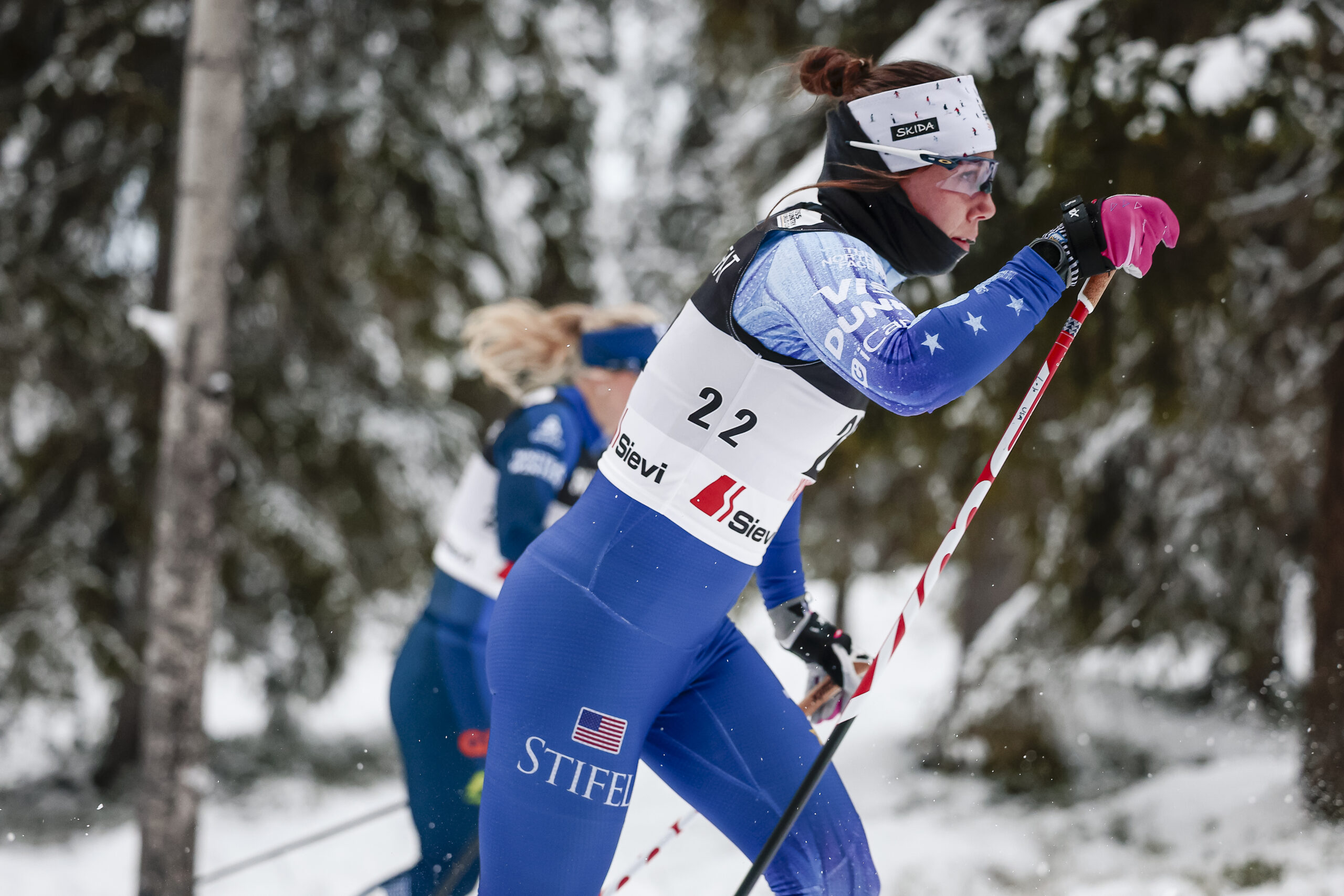
Lauren Jortberg was the only American, woman or man, to reach the heats. She qualified 22nd and was fourth in her quarterfinal after a tangle on the final climb, which left her 19th on the day. Julia Kern missed the heats by 0.11 seconds in 31st.
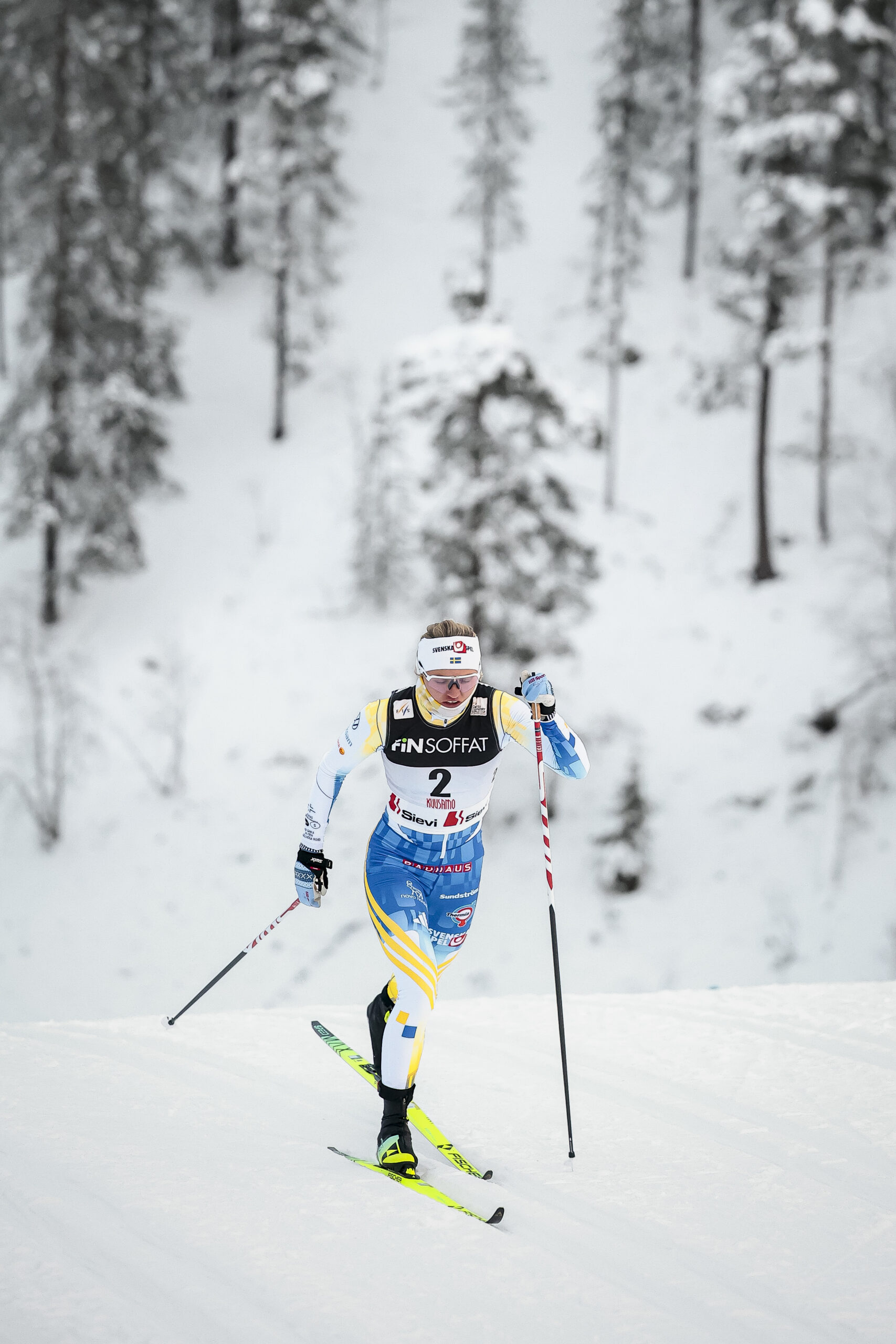
Linn Svahn (SWE) on her way to the fastest qualifying time in Ruka. (Photo: Modica/NordicFocus)
Ruka in November, Falun in February
A year ago the Ruka sprint went to Norway’s Kristine Stavås Skistad, ahead of Jonna Sundling, Dahlqvist and Hagström. Svahn was not in that field. Kern was 41st.
By February the order looked different. At the Milano Cortina Olympics, Svahn won the classic sprint ahead of Sundling and Dahlqvist in a Swedish sweep. Skistad, the Ruka winner, was fifth. Kern was sixth, and Hagström was 13th.
So November told part of the story. Sundling and Dahlqvist were on the podium in both races. The woman who won the race that mattered most was not in Ruka at all.
For Svahn, that gold was a long time coming. A shoulder injury forced her out of the 2021 World Championships after one race and kept her out of the 2022 Olympics in Beijing, and a concussion from a fall in training before the sprint at the 2025 World Championships in Trondheim cost her those championships too. Milano Cortina gave her the first major championship medal of her career.
The next one is at home. The World Championships open in Falun, Sweden, in late February, and Falun has been good to Svahn: her World Cup sprint win there on Feb. 28, 2026, was her fourth sprint victory in Falun. On Saturday she won the qualifier by 2.06 seconds over Joensuu.
Sundling, the Olympic silver medalist, was not on the start list this weekend. Skistad was seventh, third in a semifinal that sent only its top two to the final.
Julia Kern (USA) in the Ruka sprint qualifier, where she placed 31st. (Photo: Modica/NordicFocus)
Kern, One Spot Out
Only the top 30 qualifiers race the heats. Kern finished in 3:06.45, 0.11 seconds behind Finland’s Anne Kyllönen in 30th and one hundredth ahead of Amelia Wells of Great Britain in 32nd.
In February she was sixth in the Olympic sprint, the best American in the race. On Saturday she was one place out.
“Despite being on the wrong side of the flip, I feel like I skied the qualifier better than other years and my energy felt good,” Kern wrote in a text. “I had a goal of starting faster which I did, and I had moments out there that felt good. My double pole felt strong, but I struggled a bit on the climb.”
“I know the steep striding is an area I need to work on and always is tricky this early in the season with only a few days on snow,” she wrote.
Emma Albrecht was 54th. For Canada, Alison Mackie tied for 43rd, Sonjaa Schmidt was 46th and Katherine Stewart-Jones 59th.
Lauren Jortberg (USA) in her quarterfinal in Ruka, where she finished fourth and 19th overall. (Photo: Modica/NordicFocus)
Quarterfinals: Swedes Through, Others Tangled
“It’s your classic cold Ruka sprint,” said U.S. head coach Matt Whitcomb. “It’s just one of the best sprint venues that we have in the World Cup. It’s short, it’s quick, it’s a true sprinter sprint.”
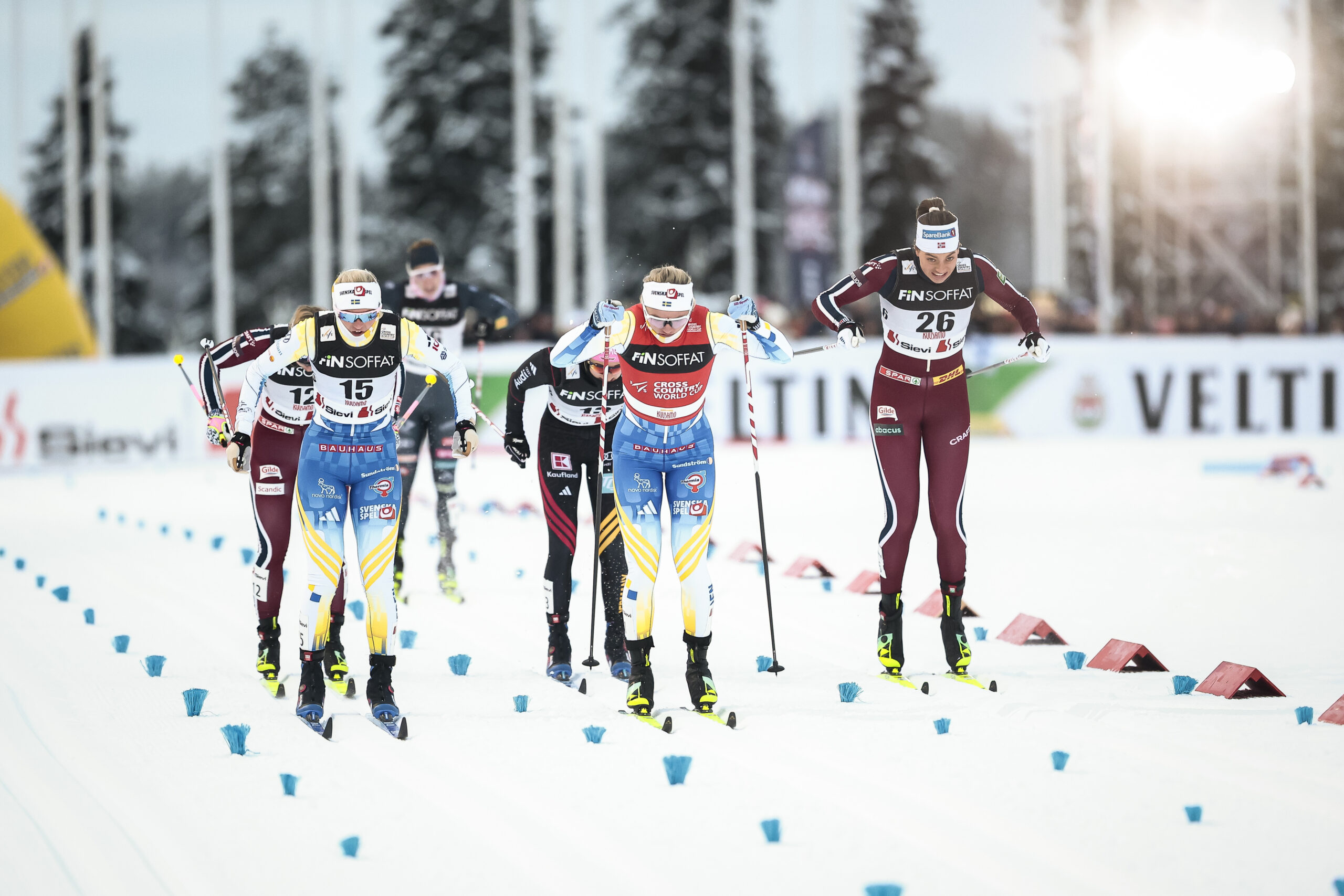
The top two in each of the five quarterfinals moved on, along with the two fastest of the rest. Svahn, Dahlqvist and Hagström each won their quarterfinal.
The first quarterfinal was the deepest. Dahlqvist won it in 2:54.79, the fastest time of any heat all day, and Skistad beat Joensuu for second in a photo finish by one hundredth of a second. Joensuu and Iris de Martin Pinter of Italy, fourth in the heat, were fast enough to move on as the two lucky losers. Natalia Terenteva, racing as an Individual Neutral Athlete, was fifth.
In the third quarterfinal Federica Cassol of Italy lost a pole and finished sixth, while Laura Gimmler of Germany won ahead of Aabrekk. Johanna Matintalo of Finland, fourth in qualifying, was third and out. In the fourth quarterfinal, Gina Del Rio of Andorra won ahead of Olkkonen, and Milla Grosberghaugen Andreassen of Norway, third in qualifying, finished sixth after a fall on the climb. Hagström won the fifth ahead of Norway’s Helene Ekrheim Haugen, with Karlsson third and out.
Svahn won the second quarterfinal ahead of Hedda Østberg Amundsen of Norway. Jortberg was in that heat too.
Whitcomb said she had been “a little bit back at the 0.7K mark” in qualifying before she “was able to just absolutely nail the final climb.”
“Good energy, was able to keep her frequency from the bottom to the top, which includes a slippery and steeper part at the top of the hill that tends to bog people down,” he said. “She was just able to keep that tempo high … and really went by like 10 or 15 people on that climb.”
“And then she skied a tactically very smart quarterfinal,” Whitcomb said, “where she started conservatively, paced herself, moved into position through the draft and then attacked on the hill.”
On that climb, Switzerland’s Anja Weber came up on Jortberg’s right, outside the track near the fencing and coaches.
“On the last climb I had the far track and then Anja came up next to me but not in a track, and there’s just not really enough room for both of us,” Jortberg said. “And so my pole went in between her skis, or she skied in between my poles, I guess, however you want to look at it.”
“It’s just a race incident,” she said. “But obviously, for me, it was pretty devastating because it really kind of took me out of competing for moving on.”
Weber finished sixth. Jortberg was fourth in 3:02.41.
“Still to finish fourth in her quarterfinal in spite of that little slow-up is really awesome, and she’s put a lot of work into this, so we’re really proud of her,” Whitcomb said.
Jortberg was not sure she would race at all. She was sick last week, and she said she had been on the line of healthy enough to start, with skipping Ruka to be sure of Trondheim as the other option.
“I was actually sick last week, so I really wasn’t sure where my body and shape would be,” she said. “But I had this feeling that I was about to conquer Ruka because I feel like I’ve worked really hard. I’ve been working really hard on my classic.”
“I’m glad I raced and I felt really strong,” she said. “I paced the qualifier a bit, maybe too much.”
Hedda Østberg Amundsen, Maja Dahlqvist, Laura Gimmler, Linn Svahn and Kristine Stavås Skistad (l-r) in the first semifinal. (Photo: Modica/NordicFocus)
Semifinals: The Slow Heat Costs Three
The first semifinal held the Olympic champion, the Olympic bronze medalist and last year’s Ruka winner: Svahn, Dahlqvist, Skistad, Gimmler, Amundsen and de Martin Pinter. It went out at a modest pace.
Dahlqvist won it in 2:58.37, 0.04 ahead of Svahn. Behind them it took the photo finish to sort out Skistad, Gimmler and Amundsen, who crossed in 2:58.70, 2:58.71 and 2:58.72.
None of them made the final. With only two automatic places in each semifinal, the last two spots went to the fastest of the rest, and the second semifinal was skied at an honest pace from the start. Joensuu won it in 2:57.42, 0.04 ahead of Hagström, and Olkkonen (2:57.71) and Aabrekk (2:58.15) took the lucky-loser places. The fourth-place time in the second semifinal was faster than the winning time in the first. Haugen and Del Rio were fifth and sixth.
According to the official results, the jury gave Svahn a written reprimand for obstruction.
Linn Svahn and Maja Dahlqvist (l-r) of Sweden in the finishing stretch of the final. (Photo: Modica/NordicFocus)
The Final
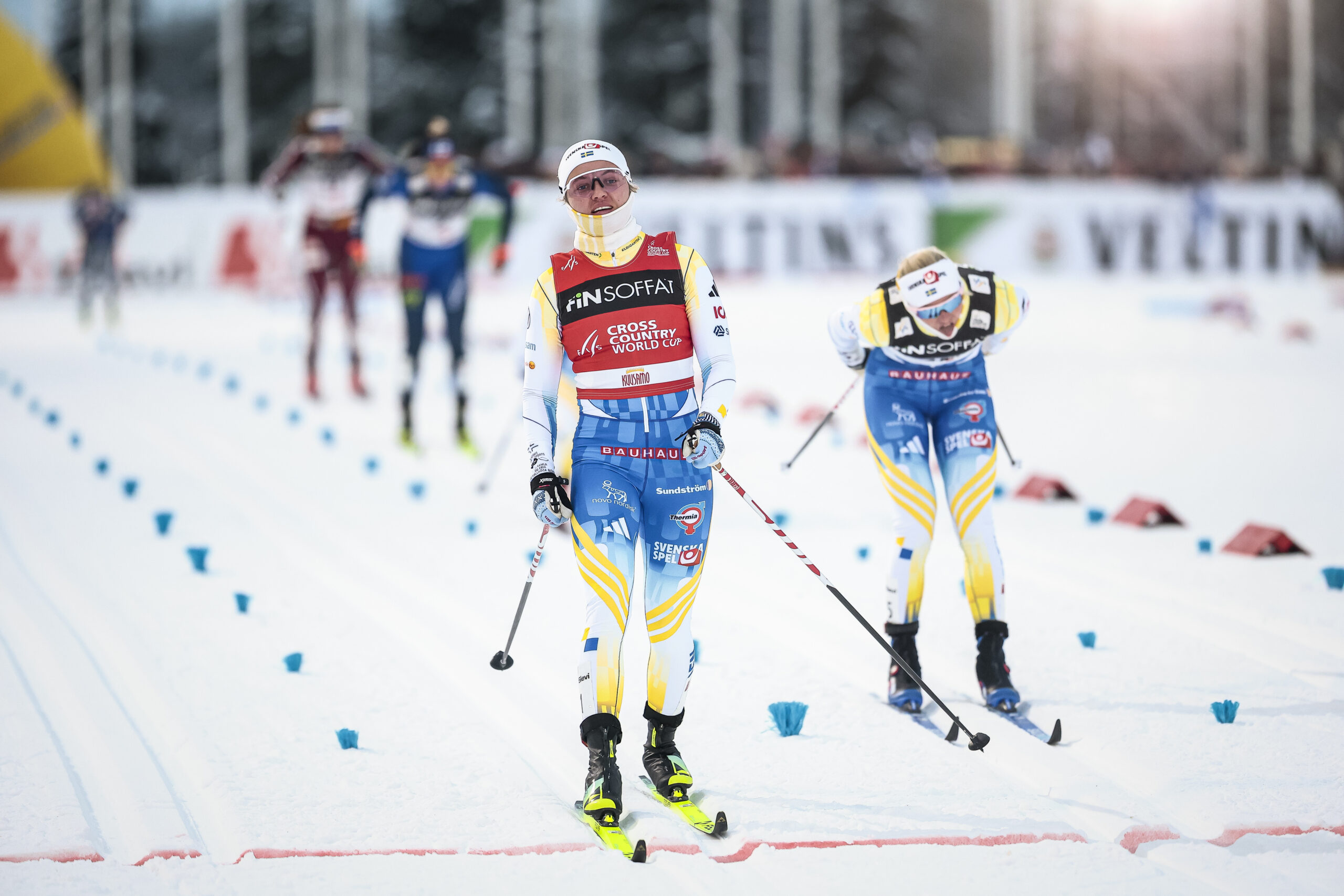
Three Swedes reached the bottom of the last climb together. Svahn and Dahlqvist pulled away from Hagström on the hill and came down into the stadium side by side, and in the final meters Svahn moved clear. She won in 2:58.36.
Behind Hagström, Joensuu was fourth, 4.10 seconds back. Aabrekk was fifth and Olkkonen sixth.
Svahn now has a second and a win in Ruka, and the weekend ends Sunday with a 20 k freestyle mass start.
For the U.S., Whitcomb said the team was nine days into its trip.
“For the rest of the team, that was our only qualifier, so it was a disappointing day,” he said. “We’ve had nine days on the ground. We’re no longer jet lagged, but we are still sharpening.”
He said it usually takes the team “a few hard races, a few hard workouts to get things going.”
“And so we weren’t super sharp today,” Whitcomb said.
He called it “a disappointing day results-wise, but not discouraging.”
“We know what to expect when we come to Ruka, and our head is up and the hammer is down, and we look for a good day tomorrow,” he said.
If you value the thoughtful work and access FasterSkier provides, please consider becoming a Voluntary Subscriber. Your support directly fuels our work to cover the people, places, and moments that make our sport special.
The top six in Ruka: Maja Dahlqvist, Linn Svahn, Johanna Hagström, Jasmi Joensuu, Ingrid Bergene Aabrekk and Tiia Olkkonen (l-r). (Photo: Modica/NordicFocus)
As owner and publisher of FasterSkier, Matthew Voisin manages the day-to-day operations, content, and partnerships that keep the site gliding smoothly. Away from the desk, he’s doing his best to keep pace with his two energetic sons.

 This coverage is made possible through the generous support of Kathy Hall and A Hall Mark of Excellence Award, founded by Marty and Kathy Hall. To learn more about A Hall Mark of Excellence Award, or to learn how you can support FasterSkier’s coverage, please contact info@fasterskier.com.
Comments
Commenting policyJoin the conversation. Comment and react with your Endurance ID — one account across the whole network.
Loading comments…