This coverage is made possible through the generous support of Kathy Hall and A Hall Mark of Excellence Award, founded by Marty and Kathy Hall. To learn more about A Hall Mark of Excellence Award, or to learn how you can support FasterSkier’s coverage, please contact info@fasterskier.com.
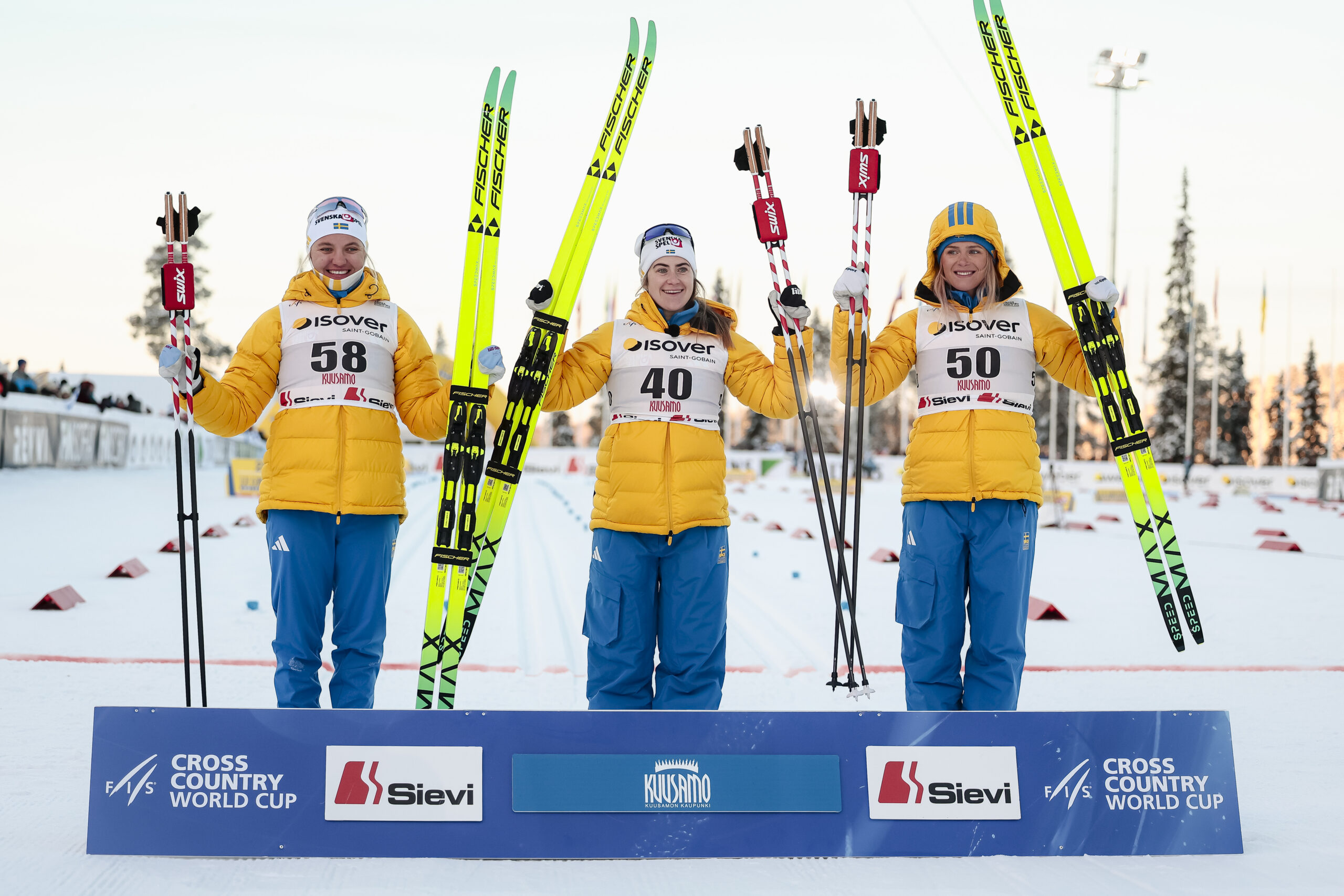
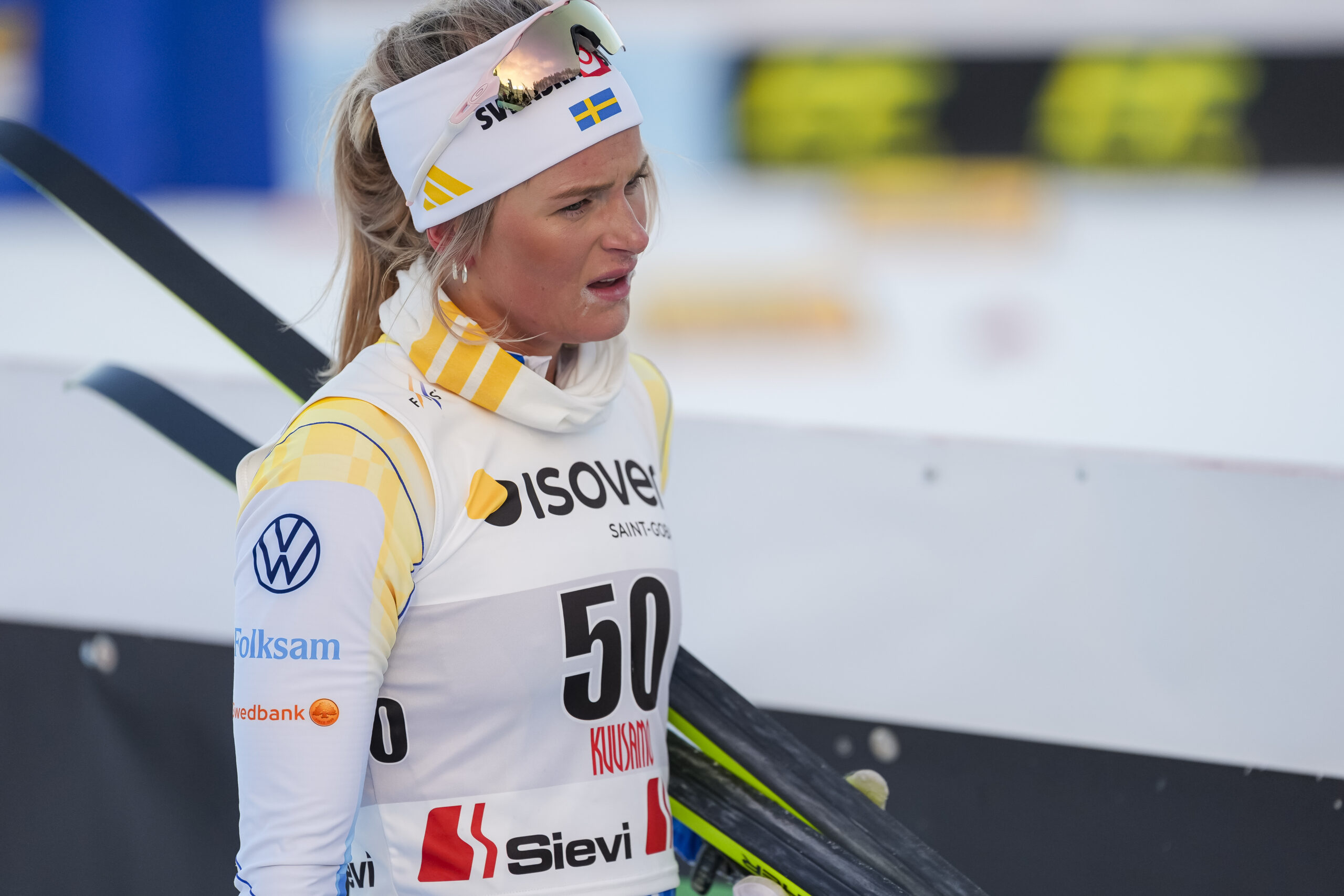
Linn Svahn, Ebba Andersson and Frida Karlsson (l-r) of Sweden after their sweep of the 10 k classic in Ruka, Finland. (Photo: Modica/NordicFocus)
The first race of a World Cup season always carries a little of the winter before it. That winter ended with an Olympics in Italy and with Jessie Diggins skiing the last race of her career in Lake Placid. On Friday in Ruka, Finland, under a clear sky, the new one began with three Swedish women on the podium.
Ebba Andersson won the 10 k classic interval start in 25:19.4. Linn Svahn was second, 9.1 seconds back, and Frida Karlsson was third at 10.2 seconds. Natalia Terenteva, racing as an Individual Neutral Athlete in her first World Cup since the 2021-22 season, led at halfway and finished fourth. Heidi Weng was the top Norwegian in fifth, 23 seconds behind Andersson.
For the U.S. women, the start list looked different. Diggins retired in March after clinching her fourth overall World Cup title, and Rosie Brennan announced in the spring that her World Cup career was over. Julia Kern, 29, was the oldest athlete at the U.S. women’s camp this fall.
“We for sure really miss Jessie. And I think also Rosie,” Kern told FasterSkier on Wednesday. “They were both kind of the oldest on the team, most experienced.”
Two days later she skied to 36th, her best result in a Ruka interval start, and came away happy with it.
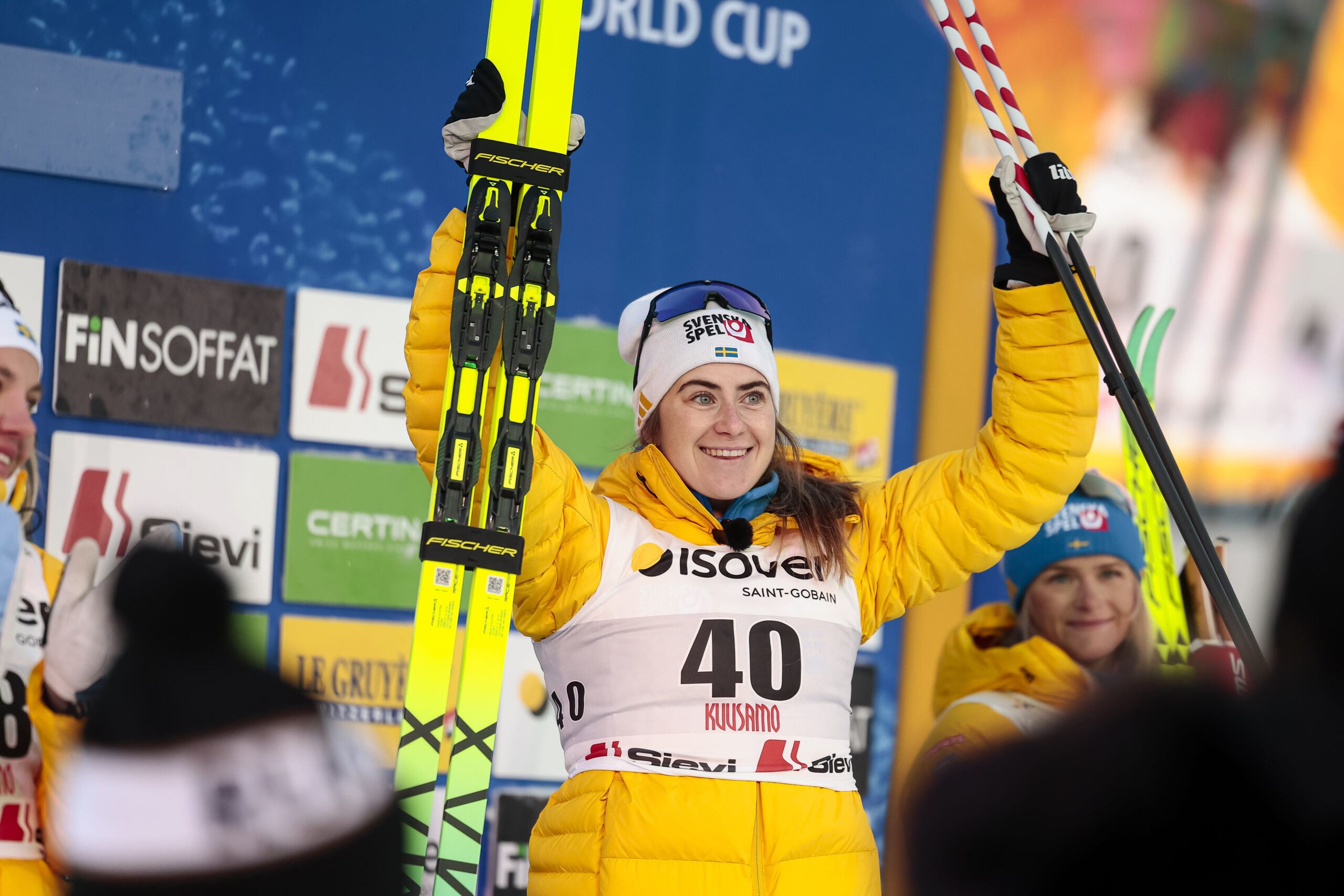
Ebba Andersson (SWE) celebrates her win in the 10 k classic in Ruka. (Photo: Modica/NordicFocus)
A new loop, and a patient winner
The women raced two laps of a loop that was new this year, 4,843 meters long with 169 meters of total climb, according to the FIS course data. The snow was packed and the sky was clear. Kern said organizers had added a hill.
Andersson did not lead early. Karlsson was fastest to the first checkpoint at 1.1 kilometers, and Andersson was third, 4.8 seconds back. By 3.2 kilometers Andersson had slipped to fourth, 7.4 seconds behind Terenteva, who started five minutes before her and skied the fastest time of the day through that section.
Andersson was second at 4.8 kilometers, 3.5 seconds down on Terenteva, and in front by 5.9 kilometers. She did not give the lead back. She skied the final 1.7 kilometers in 4:05.9, the fastest anyone covered that stretch. Terenteva needed 4:18.9 for the same ground, 13 seconds more.
“I had a good feeling during the race, so I just tried to stay calm and be patient,” Andersson said in comments released by FIS. She said she had “some power to push it at the end.”
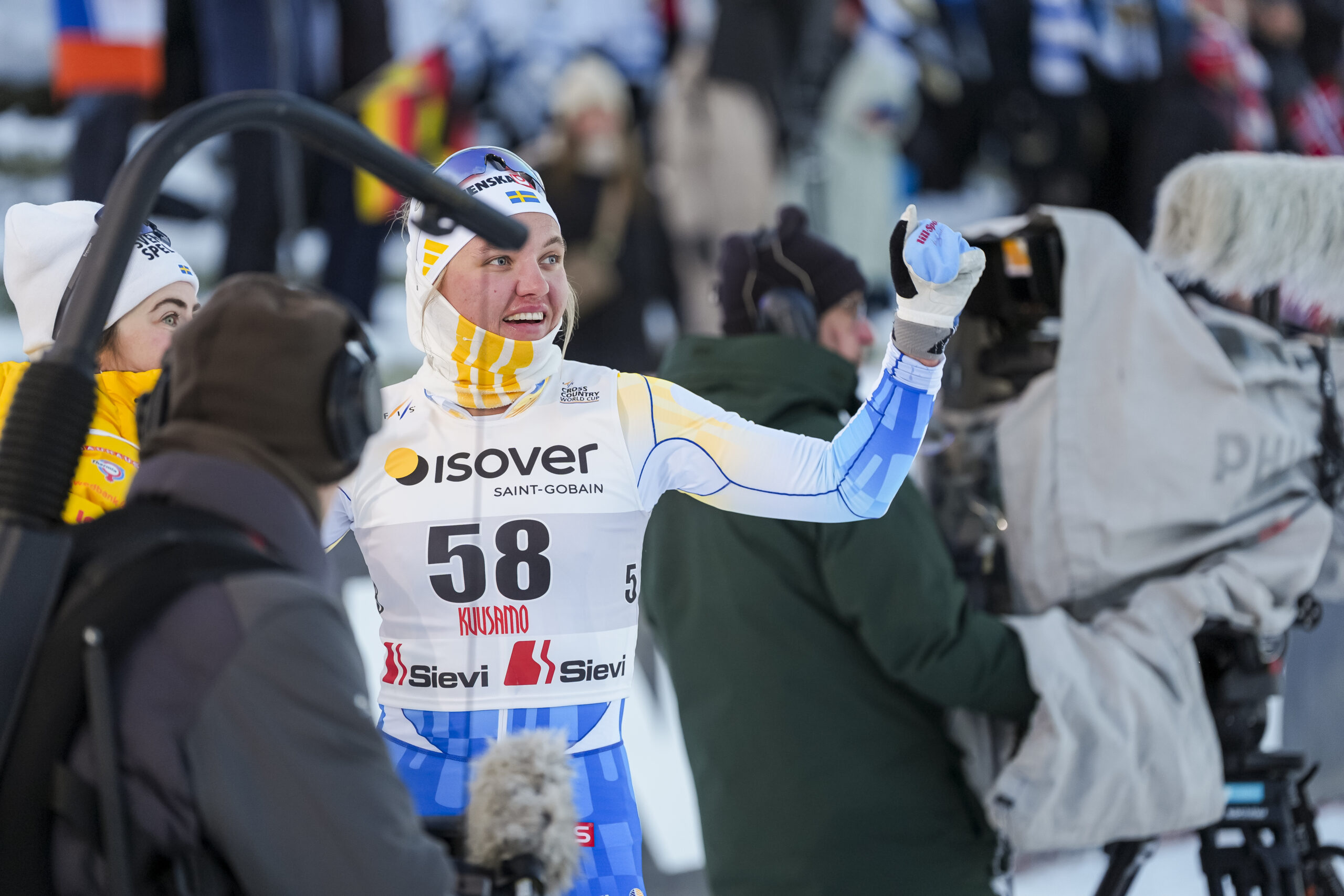
Svahn came the other way. She was 13th at the first checkpoint, 11.8 seconds off the lead, and moved up through the field from there. Her last 1.7 kilometers were the second fastest in the field, and she crossed the line 1.1 seconds ahead of Karlsson for second.
The quickest skier between 5.9 and 8 kilometers was neither Swede. It was Norway’s Lotta Udnes Weng, who started third, went through that section 11.1 seconds faster than Andersson and finished ninth.
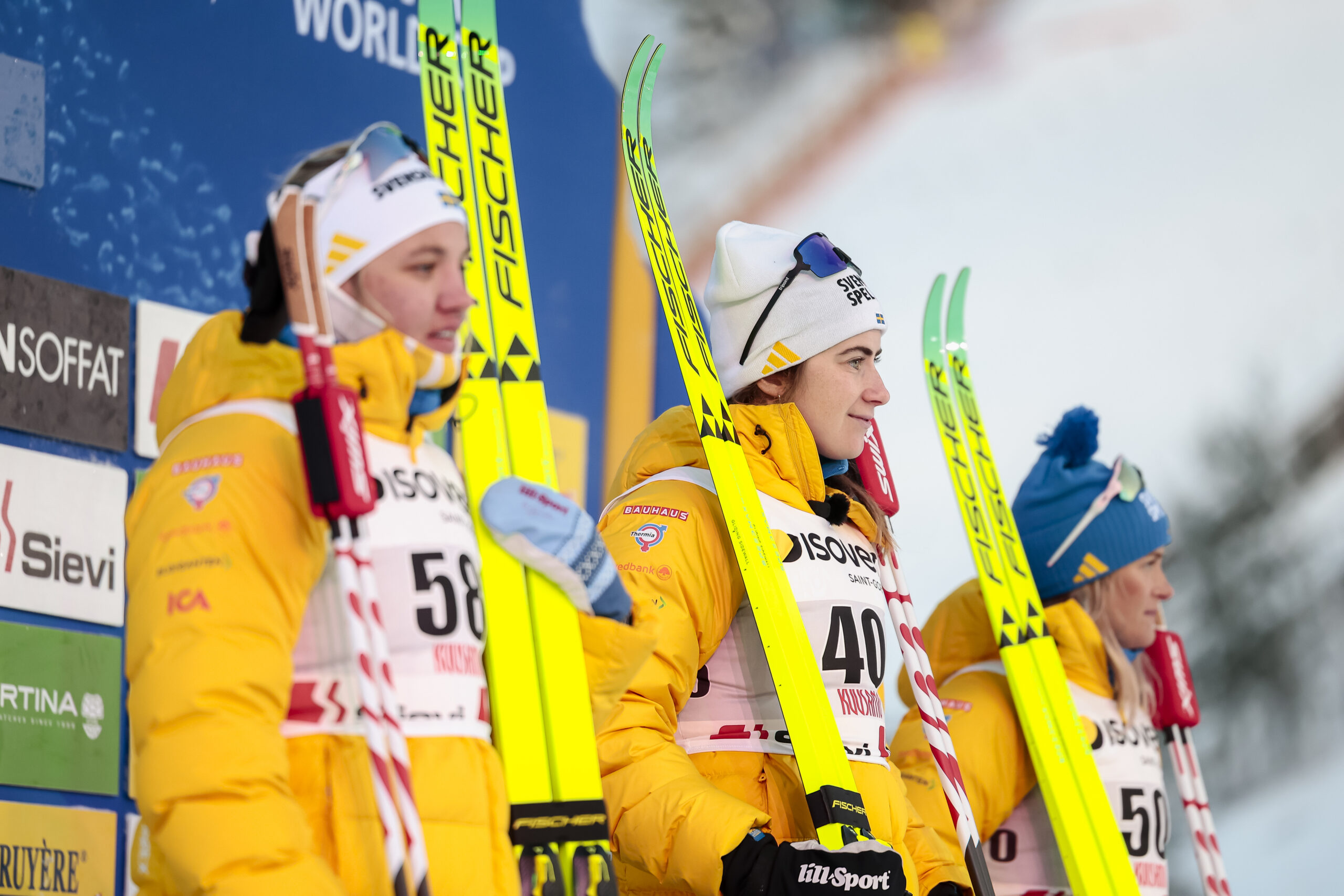
Svahn, Andersson and Karlsson (l-r) on the podium in Ruka. (Photo: Modica/NordicFocus)
Sweden picks up where it left off
All three women on the podium came to Ruka as Olympic champions from Milano Cortina: Andersson in the 50 k, Svahn in the sprint, Karlsson in the 10 k and the 20 k. Andersson is also the reigning world champion over 10 k. Karlsson had won this race the previous two years. Moa Ilar finished seventh, making it four Swedes in the top 10.
“I felt before the race that we have a strong team and I was convinced that some of us were going to do good races today,” Andersson said.
Karlsson put it more plainly.
“On paper, we are the strongest team but we also delivered,” she said. “To do that, we need good skis and everything needs to come together, and it did.”
Svahn, who took second with her late push, said: “I am quite happy. It was nice with a triple, and we had good skis and everything, so it was fun racing.”
Andersson leads the World Cup standings after one race.
“Hopefully it shows that the Swedish girls are still the team to beat,” she said.
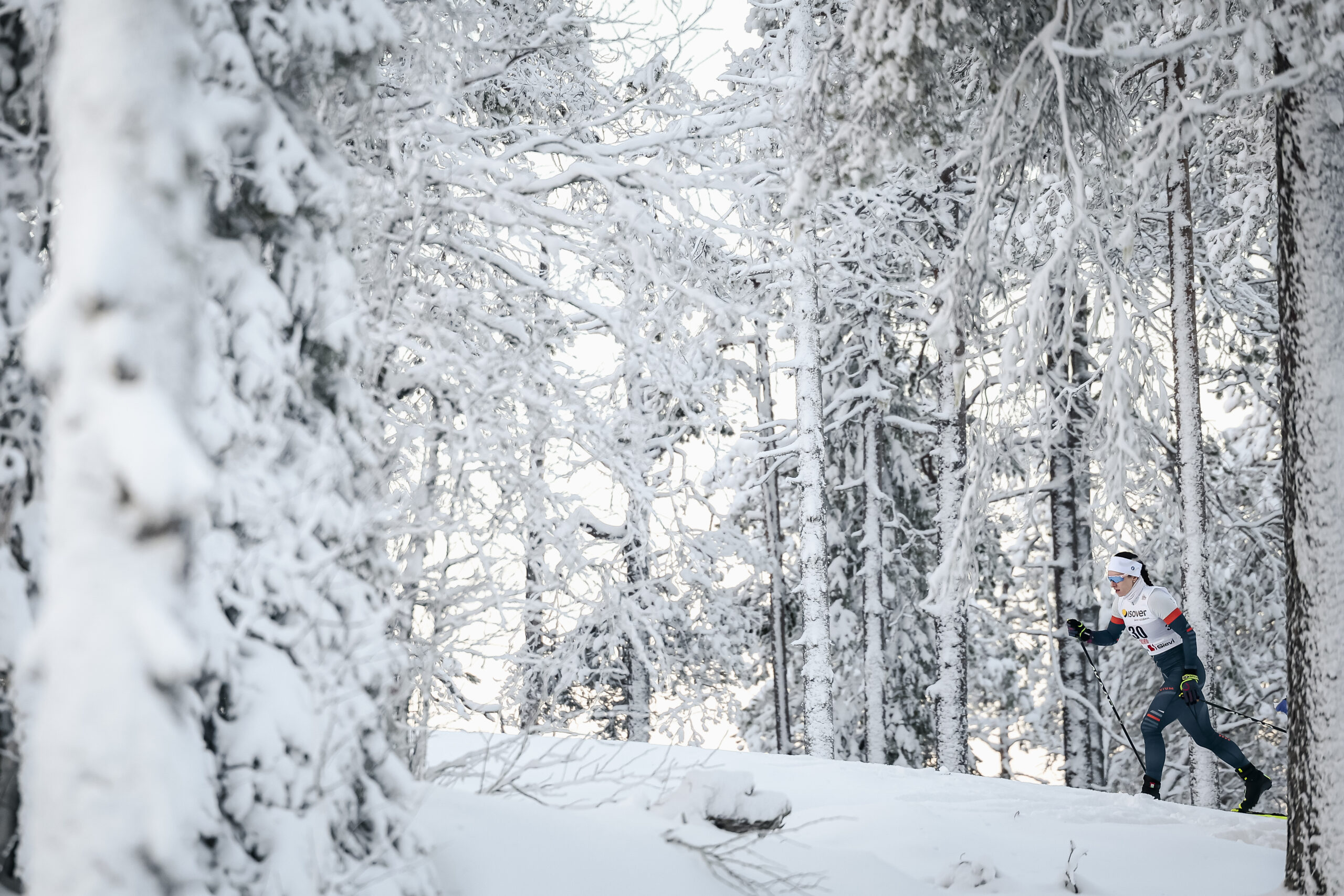
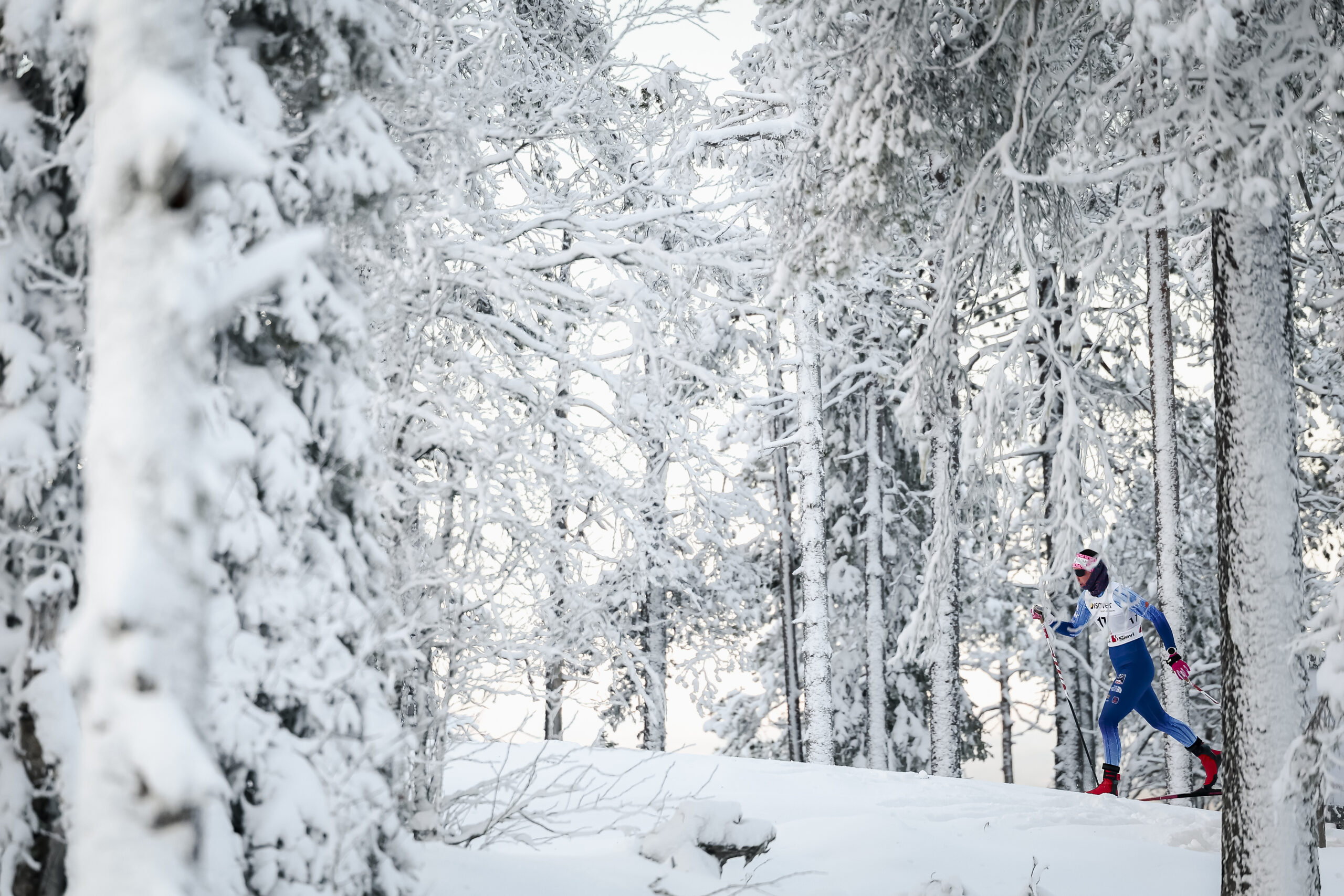
Natalia Terenteva (AIN) skis through the snow-covered forest on the Ruka course. (Photo: Modica/NordicFocus)
Terenteva is back
Terenteva raced the World Cup as Natalia Nepryaeva, and in the 2021-22 season she won both the Tour de Ski and the overall World Cup title. She had not raced a World Cup since. She is on FIS’s list of athletes approved as Individual Neutral Athletes this season, and under FIS rules neutral athletes race only individual events, with no national flag, anthem or uniform.
The designation is not new. FIS began clearing neutral athletes for competition last season, ahead of Milano Cortina, and Dariya Nepryaeva, also racing as a neutral athlete, finished 28th on Friday.
Terenteva’s race was the most aggressive of the leaders. She was second at the first checkpoint, 2.4 seconds behind Karlsson, then skied the fastest section of the day from 1.1 to 3.2 kilometers and led at both 3.2 and 4.8 kilometers. The final 1.7 kilometers cost her. Her time there was only the 14th fastest in the field, Svahn passed her on the clock, and she finished fourth, 19 seconds behind Andersson.
It was her first World Cup race in more than four years, and she led it at halfway. Like it or not, she will be a factor this winter.
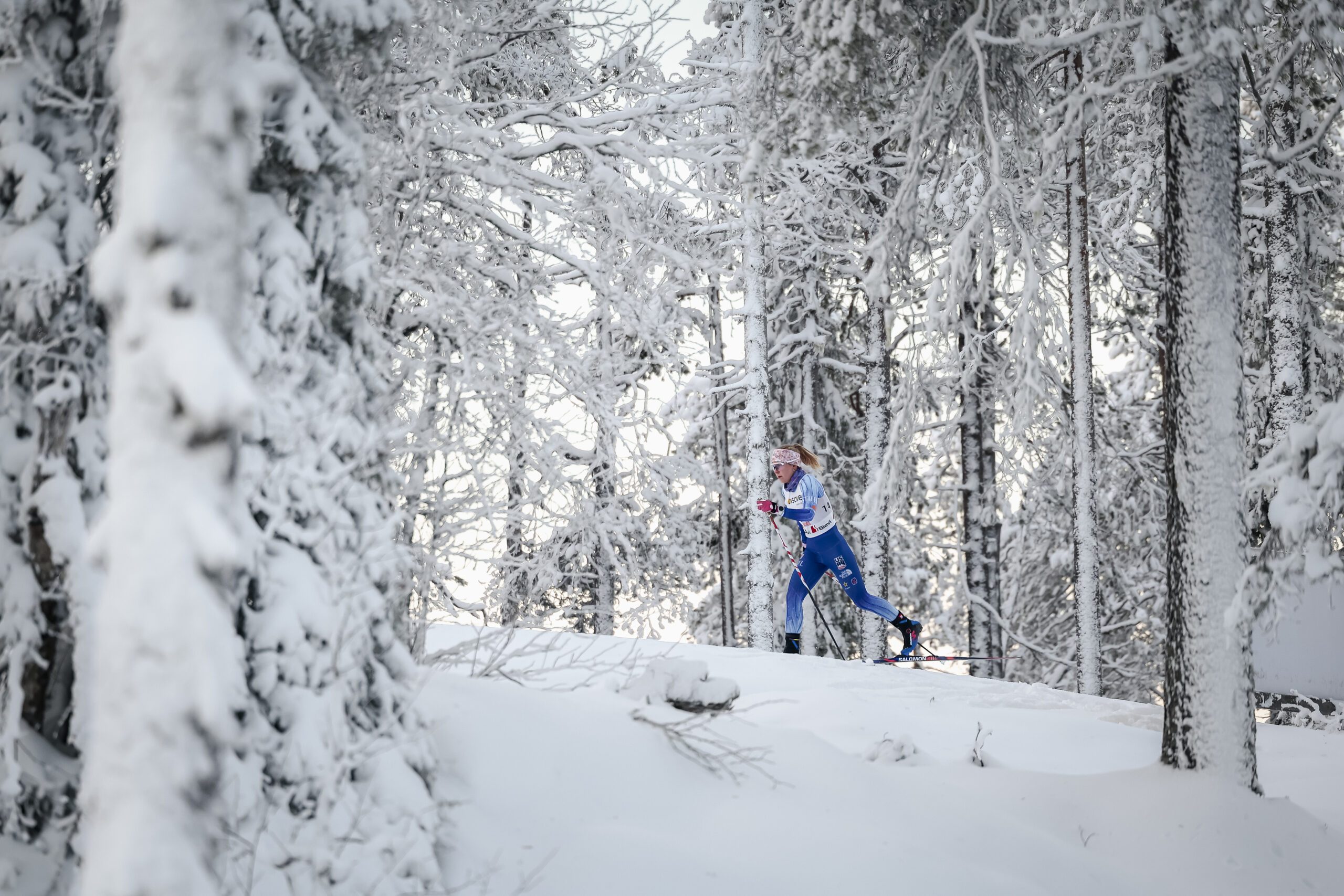
Julia Kern (USA) strides through the forest in Ruka on her way to 36th. (Photo: Modica/NordicFocus)
Kern’s best day in Ruka
Kern, who skis for Stratton Mountain School, started 17th and was 56th at the first checkpoint. She worked forward from there, from 47th at 5.9 kilometers to 41st at 8 kilometers to 36th at the finish, 1:49.5 behind Andersson. Her last 1.7 kilometers were the 18th fastest in the field. Her previous best in a Ruka interval start was 42nd, a year ago.
“It was really fun to kick off the season again,” she said in a voice memo after the race. “… I was really, really happy with today. That was my personal best in the Ruka 10K.”
The race has never been an easy one for her.
“I think this race has always been really challenging for me. It’s the first race of the season. It’s a lot of herringboning and really steep striding,” she said. “… So it’s like a rip-the-Band-Aid-off type of race in the early season.”
Her first World Cup starts came in Québec City in March 2017, and she said a result like Friday’s is still worth marking.
“It’s important to remember that you can celebrate a 36th place on World Cup,” she said.
Last winter ended for Kern with an elbow injury and what she called “the mystery lung cough situation.” On Friday she said the elbow felt great.
“I did a lot of work with physical therapy this summer and it’s in a really great place,” she said. “Gotta stay on top of it, but everything’s looking good.”
The lungs held up too. FIS recorded the air temperature at minus 9 Celsius.
“My skis felt great and it wasn’t super frigid like other years, so my lungs held up well,” she said. “And yeah, my energy felt good. I think the race sharpness is still building, but it was a great first effort.”
She spent the early summer running and biking at home in Vermont.
“I feel like the Ruka hills were a little less punishing today after doing a lot of mountain running. I think that definitely helped,” she said. “And I feel like just my general threshold fitness is higher. So the hills felt a little bit easier, but still really hard.”
“They added another hill, so it was like extra challenging out there,” she said. “A lot of herringbone today.”
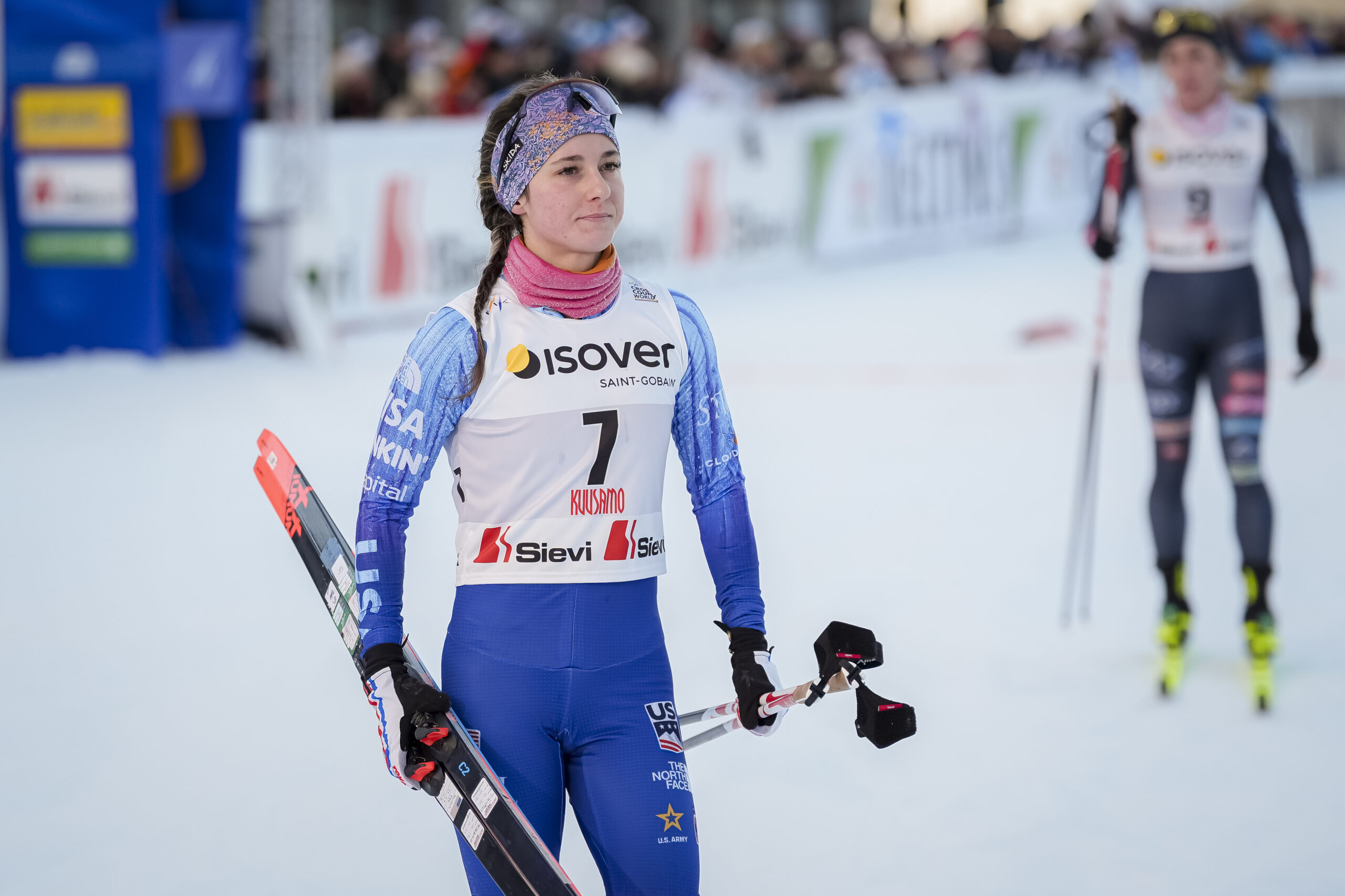
Kendall Kramer (USA) in the finish area after placing 48th. (Photo: Thibaut/NordicFocus)
Kendall Kramer of Alaska Pacific University was the next American in 48th, 2:21.4 back.
“The race was a great effort, I appreciated the new course and felt better than last time,” she said in a text message. “I just wanted to ski with good technique and not flail around out there. Ski more mature.”
She raced on skis picked for grip.
“I didn’t choose fastest skis, I chose skis with best kick so I paid for that on downhills,” Kramer wrote.
She said she held back early.
“I didn’t want to blow out my arms in the beginning so I tried to long stride and then just bring it in the rest of the time,” she wrote.
Kramer was 54th at 8 kilometers and moved up six places over the final 1.7 kilometers, where her time was the 31st fastest in the field.
“I am looking forward to another shot!” she wrote.
Emma Albrecht of the Bridger Ski Foundation, who earned her World Cup start as last season’s overall SuperTour leader, was 64th.
Sophia Laukli (USA) on course in Ruka, where she finished 52nd. (Photo: Modica/NordicFocus)
Sophia Laukli of Aker-Dæhlie started 74th of 79, was 67th at 3.2 kilometers and moved up to 52nd. Before two FIS races in Beitostølen, Norway, last week, her most recent start was the 20 k mass start in Ruka a year ago, according to FIS.
“It was definitely a bit surreal to be back here after a year,” she said in a voice memo. “This was the last race I did, and when you end on a tough note about a year ago, it’s maybe not super exciting to be back here, but I actually was pretty happy and didn’t feel too much dread. I was mostly very excited to race again and I still am.”
The race itself, she said, felt better than the result.
“The race was honestly pretty good and felt better than maybe the result, but that tends to be the case in Ruka,” Laukli said. “I definitely felt very good on the uphills.”
She said she enjoyed the new climb. The flats were harder.
“But I think as always, I struggled a bit on the flat section and bled a lot of time there,” she said. “So I still need to figure that out and need to figure out this race, but there were positives in that the climbing felt good.”
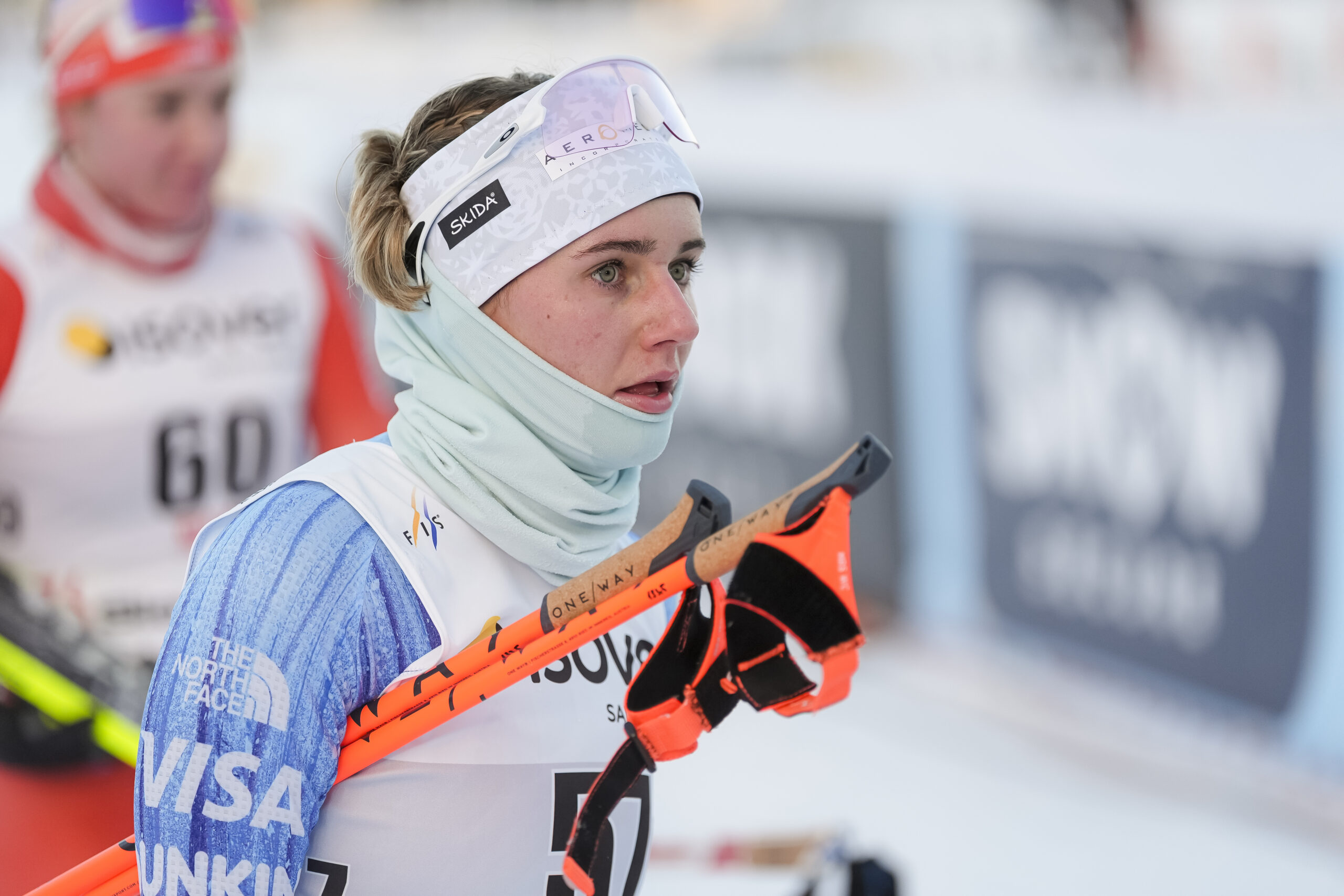
Novie McCabe (USA) after the 10 k classic in Ruka. (Photo: Thibaut/NordicFocus)
Novie McCabe of Alaska Pacific University was 69th, 3:15.5 back.
“Was a bit rough out there today, I kind of just had a hard time getting into race mode and struggled to push hard,” McCabe said in a text message. “It was a bit like that from the beginning, so I kind of just tried to focus on breaking it up into sections and getting through it!”
“I raced some World Cups last year, but it’s been a while since I started on Period 1, so it feels nice to be back here in Ruka and I hope I can have a better performance in the 20k!” she wrote. “Today told me that I am not in very good shape, but hopefully that’s not true and it was just a bad day! Excited for another chance Sunday.”
Away from the course, the team got its Thanksgiving on Thursday night.
“We had a Thanksgiving dinner last night, which was great,” Laukli said. “We don’t always get that, but our chef Megan pulled off a very legit Thanksgiving meal.”
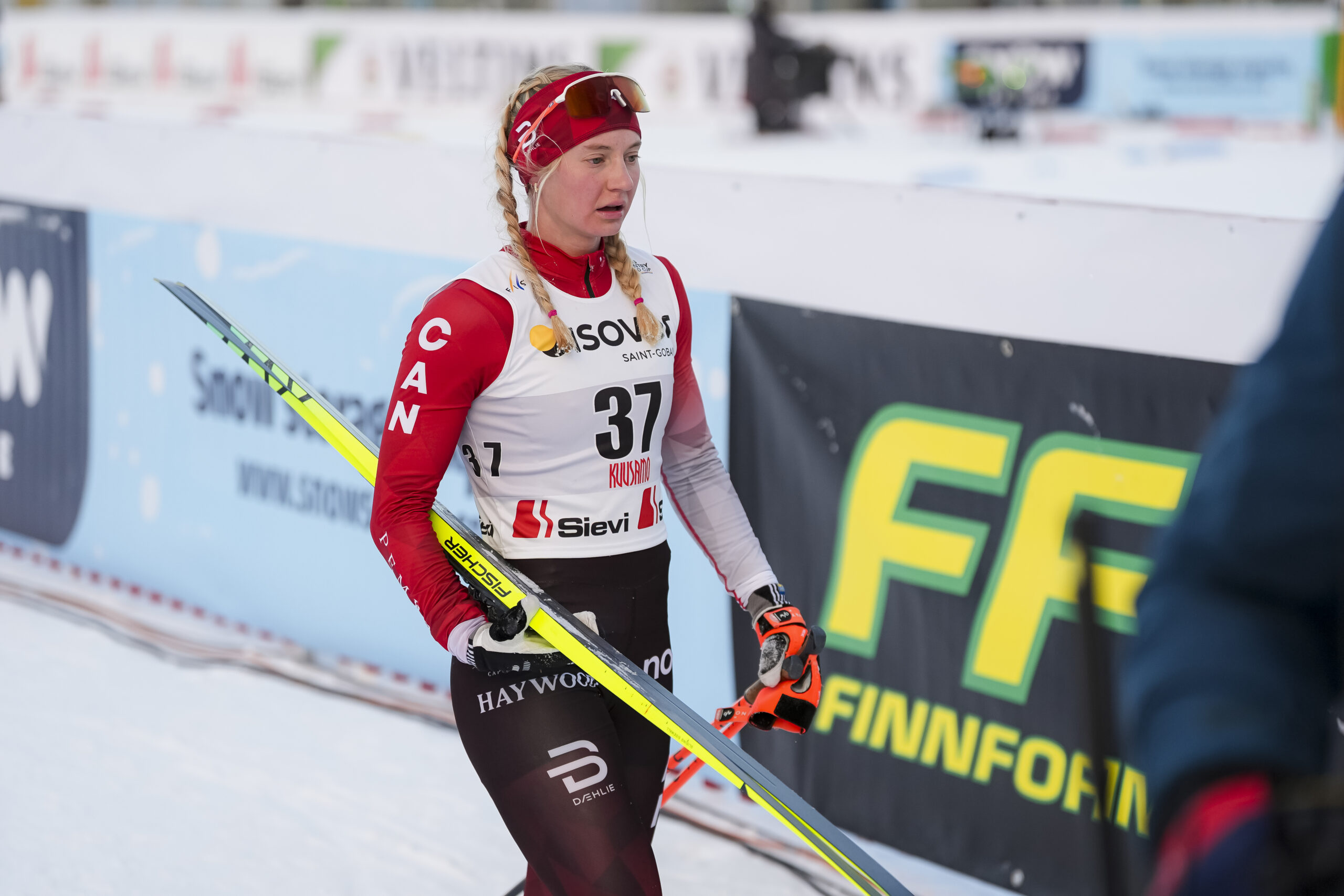
Sonjaa Schmidt (CAN) after finishing 32nd, the top Canadian. (Photo: Thibaut/NordicFocus)
Four Canadians inside 11 seconds
Sonjaa Schmidt of Whitehorse Nordic was the top Canadian in 32nd, 1:43.8 behind Andersson. Nordiq Canada named her to its first World Cup period as the leader of the Continental Cup rankings, and on Friday she skied the ninth-fastest time in the field between 3.2 and 4.8 kilometers.
Alison Mackie of the Edmonton Nordic Ski Club, eighth in the 10 k freestyle mass start at the Olympics in February, was 52nd at the first checkpoint and moved up all the way to 34th. Katherine Stewart-Jones of Nakkertok was 37th and Liliane Gagnon of Club Skibec Nordique was 38th. From Schmidt to Gagnon, the four were separated by 10.9 seconds.
Jasmine Drolet of Club nordique Mont-Sainte-Anne was 58th. Amelia Wells, who was named to Canada’s Olympic team for Milano Cortina last December, now races for Great Britain and finished 42nd.
Linn Svahn (SWE) pumps a fist in the finish area after taking second. (Photo: Thibaut/NordicFocus)
Sprint next
Ruka continues on Saturday with the 1.2-kilometer classic sprint, and the weekend ends Sunday with a 20 k freestyle mass start. The World Cup then moves to Trondheim, Norway, and Davos, Switzerland, before the holidays.
Svahn, the Olympic sprint champion, has Saturday circled.
“Hopefully for the rest of the weekend it will be the same or even better,” she said. “I’ll try my best then hopefully, a victory.”
Kern is looking forward to it, too.
“I had good feelings out there, but also a lot of room where I feel like I can kind of improve,” she said. “So I’m really happy with it and I’m really excited to sprint tomorrow.”
If you value the thoughtful work and access FasterSkier provides, please consider becoming a Voluntary Subscriber. Your support directly fuels our work to cover the people, places, and moments that make our sport special.
As owner and publisher of FasterSkier, Matthew Voisin manages the day-to-day operations, content, and partnerships that keep the site gliding smoothly. Away from the desk, he’s doing his best to keep pace with his two energetic sons.

 This coverage is made possible through the generous support of Kathy Hall and A Hall Mark of Excellence Award, founded by Marty and Kathy Hall. To learn more about A Hall Mark of Excellence Award, or to learn how you can support FasterSkier’s coverage, please contact info@fasterskier.com.
Comments
Commenting policyJoin the conversation. Comment and react with your Endurance ID — one account across the whole network.
Loading comments…