

This article was made possible through the generous support of our voluntary subscribers. If you value coverage like this, please support FasterSkier with a voluntary subscription.
This is a follow-up to my last article, Speed Creates the Load, Not Intensity. Before going further, it helps to define terms. Intensity is reflected in the heart rate response. Load is the physiological stress that drives adaptation. This piece takes a different angle, using high-intensity workouts and race heart rates to assess fitness and monitor for overtraining.
Over the last two decades, much of my coaching has involved working with athletes who are underperforming, overtrained, or struggling to regain fitness. When the data is available, one of the first things I examine is the relationship between training intensity and speed across the season. I am looking for improvements in efficiency, but I am also paying close attention to what happens during races and hard workouts.
Race data is almost always the most revealing.
I recently reviewed the training of a top domestic athlete whose sustainable race heart rate fell by roughly 10 to 15 beats per minute between November and March. Why? Given the time of year, that should immediately raise concerns. A substantial decline in sustainable race heart rate during the competitive season rarely points to improved fitness. More often, it is a warning sign that the athlete is carrying excessive fatigue, is no longer capable of producing the same muscular power, or has entered a state of overtraining.
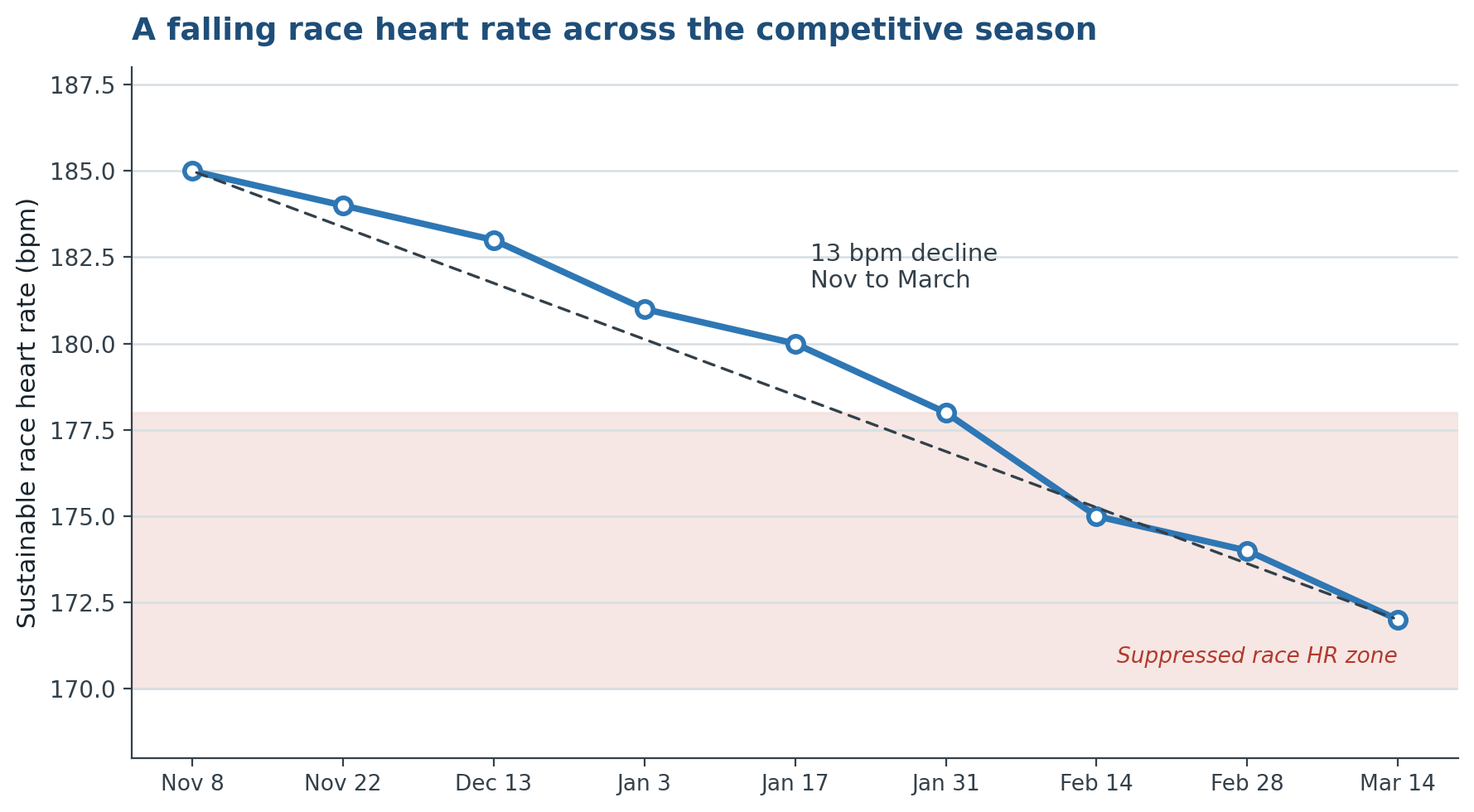
A reduced race heart rate means less cardiac output unless stroke volume increases enough to compensate. In well-trained athletes, that compensation is usually very small. The result is less oxygen delivered to the working muscles, reduced oxidative metabolism, slower lactate clearance, diminished phosphocreatine resynthesis between surges, and ultimately a reduced ability to sustain high race speeds. In simple terms, the athlete cannot create the same physiological demand because the muscles are no longer capable of producing the same amount of work.
When a Lower Race Heart Rate Reflects Improved Fitness
A declining race heart rate is often misunderstood. Some physiologists and coaches suggest it reflects improved cardiovascular function. That can be true, but only if performance has clearly improved.
The critical question is simple: is the athlete racing faster?
If an athlete is producing greater speed or power at a lower heart rate, several physiological adaptations have likely occurred:
- Greater stroke volume. The heart pumps more blood with each beat, allowing similar cardiac output with fewer beats.
- Improved movement economy. Better technique and neuromuscular coordination reduce the oxygen cost of movement.
- Greater peripheral adaptations. Increased mitochondrial density, capillary density, and oxidative enzyme activity improve oxygen extraction and utilization.
If these adaptations have occurred to a meaningful degree, performance should improve. The athlete should be racing faster while holding a similar physiological level, not racing at a lower heart rate.
In my experience, I have never seen an athlete race at a substantially lower heart rate because they became fitter or more economical. The improvement almost always shows up as increased speed or power, not as a dramatically reduced race heart rate. If race performance is unchanged, or worse, declining, a lower heart rate is unlikely to be explained by improved fitness.
This distinction matters because many coaches correctly recognize that heart rate decreases at submaximal workloads as fitness improves. That is exactly what we expect during aerobic training. Racing is different. At maximal or near-maximal effort, the goal is to maximize performance, and that rarely shows up as a lower heart rate.
Is Stroke Volume Really the Explanation?
Stroke volume is frequently cited as the reason trained athletes can race with lower heart rates. While that explanation sounds plausible, it probably accounts for only a negligible part of what we observe during maximal competition.
In trained endurance athletes:
- Stroke volume reaches near-maximal values at roughly 40 to 60 percent of VO2max.
- Beyond that intensity, further increases in cardiac output come primarily from increases in heart rate.
- Stroke volume changes relatively little in already well-trained athletes.
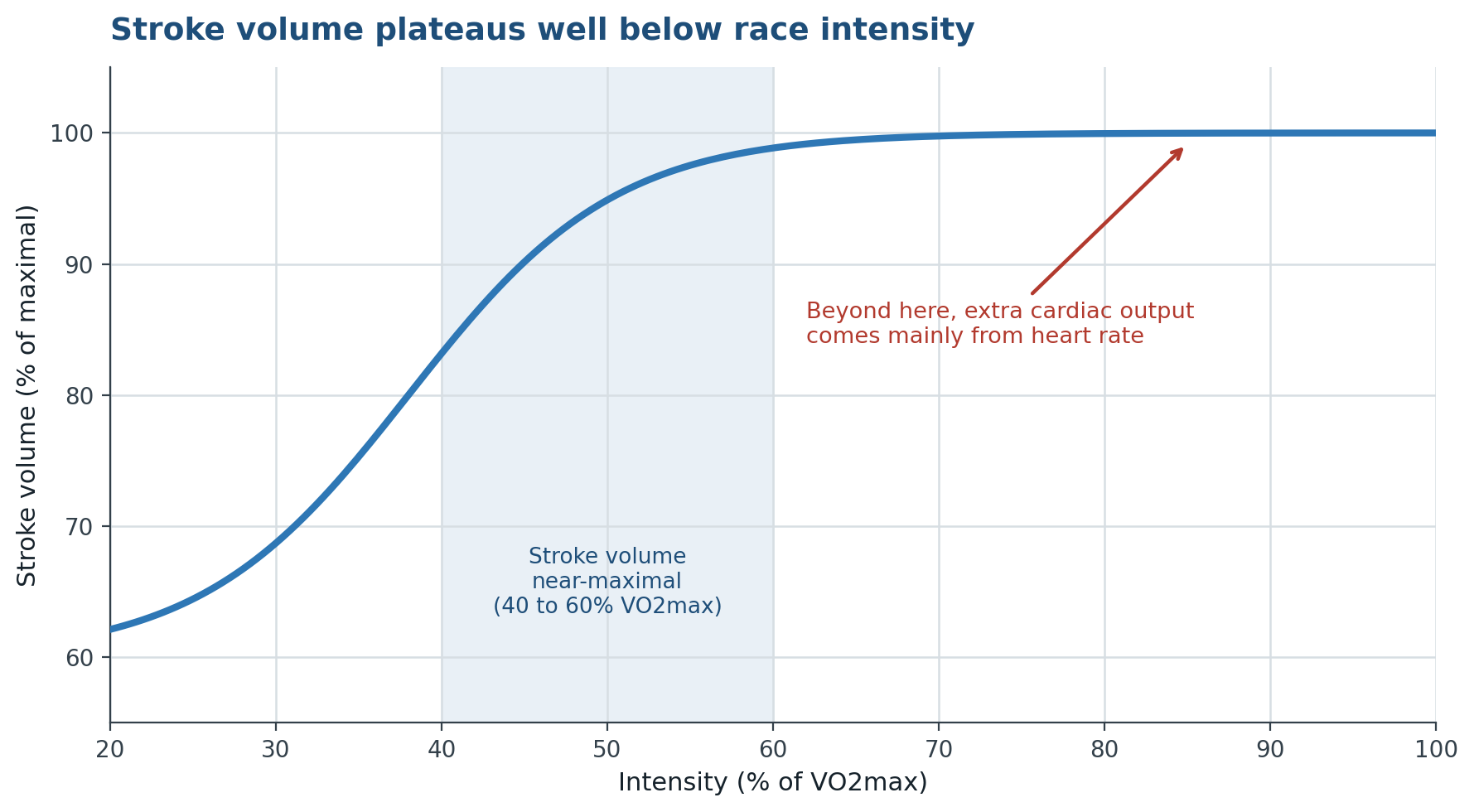
So if an athlete’s sustainable race heart rate falls from 185 to 175, it is unlikely that stroke volume has increased enough to fully maintain cardiac output. The science does not support that explanation in most well-trained athletes. Something else is going on, and extended fatigue, maladaptive training, and long-term overload are the likely causes.
The Muscles Drive the Heart
One concept that is often overlooked in endurance physiology is that heart rate responds to muscular work. It does not create it. The muscles generate the metabolic demand and the cardiovascular system responds. If neuromuscular power production declines, metabolic demand falls. The heart no longer needs to pump as rapidly because the muscles are not asking for the same amount of oxygen. This aligns closely with a concept I first wrote about nearly twenty years ago and returned to in my previous article:
Speed creates the load, not intensity.
The muscles create the demand. The heart responds. When an athlete loses the ability to generate force, speed, and power, race heart rate falls as a consequence. The cardiovascular system may be functioning normally. It simply is not being driven to the same level because the neuromuscular system has become fatigued.
When a Lower Race Heart Rate Is a Warning Sign
A falling heart rate is one of the earliest objective signs that an athlete may be accumulating excessive fatigue. When athletes become excessively fatigued, they often lose the ability to recruit muscle fibers effectively and sustain race-specific power. Because muscular demand falls, heart rate falls with it.
Rather than interpreting the lower heart rate as improved efficiency, coaches should ask whether the athlete is still capable of producing the same speed or power.
Warning signs include:
- Sustainable race heart rate declines progressively over a few weeks to months. Monitoring heart rate helps catch this early, so training can be adjusted before it becomes a bigger problem.
- Race performance stagnates or deteriorates despite similar perceived effort.
- Legs feel flat and heavy, as if they never really warm up.
- The athlete cannot respond to the demands of uphills or changes in pace.
- Heart rate remains well below normal race values even during maximal effort.
- Recovery between hard sessions becomes progressively slower.
- Easy training may still feel normal while racing and high-intensity training become increasingly difficult.
This pattern is often described as parasympathetic overreaching, although terminology varies. Regardless of the label, suppression of maximal or sustainable race heart rate by 5 to 15 beats per minute over weeks should never be ignored. It frequently reflects excessive cumulative training load, inadequate recovery, or overtraining. Waiting until performance completely collapses is waiting too long. In many athletes, a declining race heart rate is one of the first objective indicators that recovery and adaptation to previous training were insufficient.
Coaches sometimes celebrate lower lactate values as improved aerobic fitness. During excessive fatigue, however, reduced lactate production often reflects reduced muscle recruitment rather than improved metabolic efficiency. The athlete cannot produce enough power to generate high lactate concentrations.
Chronically low glycogen availability, whether from excessive training or inadequate carbohydrate intake, can also suppress race heart rate and lactate. The athlete cannot generate the metabolic demand required to reach previous racing intensities.
The heart is reactive, not proactive. It responds to the metabolic demand created by the working muscles. When the muscles cannot produce force because of fatigue, the cardiovascular system has less work to do. A lower heart rate is therefore often the consequence of reduced performance, not the cause.
Why Elite Athletes Rarely Race at Maximal Heart Rate
Elite endurance athletes rarely spend an entire race at maximal heart rate. As performance improves, limitations increasingly shift away from the cardiovascular system and toward the muscles’ ability to generate force repeatedly while resisting fatigue.
Improvements in neuromuscular power, economy, and fatigue resistance allow athletes to sustain higher speeds without requiring proportionally higher heart rates.
As athletes become capable of producing greater speed and power, they generate a larger physiological stimulus. The cardiovascular system responds to that demand, but it is the neuromuscular system that ultimately determines how much work can be produced.
Practical Coaching Implications
Heart rate should never be interpreted in isolation. Always evaluate it alongside speed, power, performance, and perceived effort.
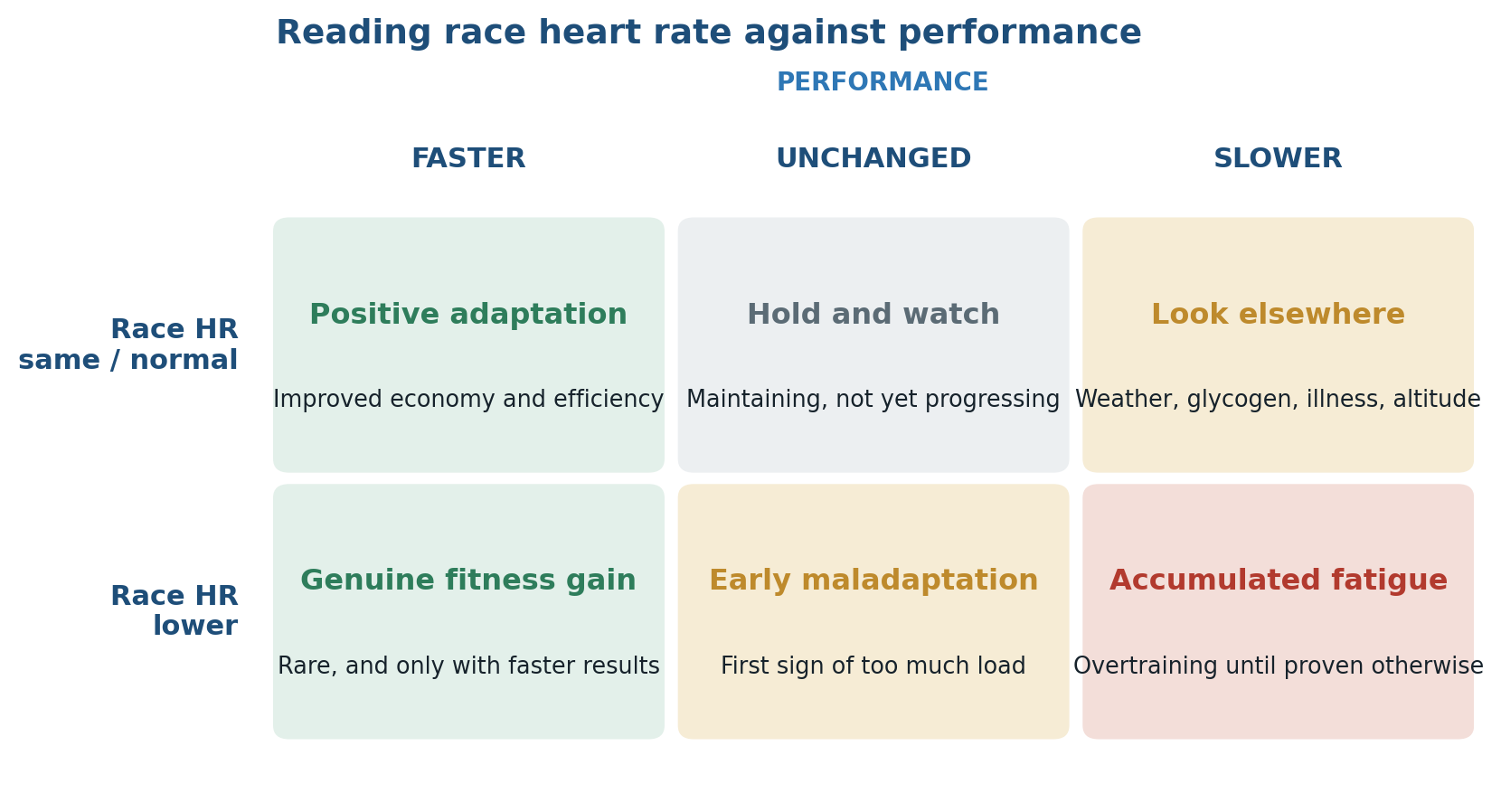
- Similar heart rate plus faster performance equals positive adaptation, improved economy, and greater efficiency.
- Lower heart rate plus unchanged performance equals the early stage of maladaptation to training loads.
- Lower heart rate plus slower performance equals a clear indication of accumulated fatigue, inadequate recovery, illness, low energy availability, or excessive training load.
- Normal heart rate plus declining performance equals a reason to consider environmental conditions, glycogen availability, illness, altitude, or reduced movement economy.
Over the course of a successful season, athletes should become capable of producing greater speed and power while maintaining similar race heart rates. When race heart rate falls substantially without a corresponding improvement in performance, assume fatigue before assuming fitness. That mindset will keep many coaches from overlooking one of the earliest objective signs of excessive training stress.
A lower heart rate should never be viewed as evidence of improved fitness on its own. If an athlete is racing faster, producing more power, and performing better, a modest reduction in heart rate may simply reflect positive adaptation. But when race heart rate falls while performance stagnates or declines, resist the temptation to credit what may actually be the earliest objective sign of excessive fatigue. The goal is to catch a falling heart rate during hard efforts early and adjust training as soon as possible. Weeks or months of inaction will greatly increase recovery time and cost additional effective training time.
Help Support Our Coverage!
If you value the thoughtful work and access FasterSkier provides, please consider becoming a Voluntary Subscriber. Your support directly fuels our work to cover the people, places, and moments that make our sport special.
Join the FasterSkier community!

Jim Galanes
Coach, competitor, correspondent, commentator—Jim Galanes has spent a lifetime on cross country skis, always serving as a keen observer of our sport. A three-time Olympian in both Cross-Country and Nordic Combined, Jim has tested the theories, initiated the instruction, assessed the results. Now, FasterSkier is thrilled to announce that Jim joins our staff of writers and contributors, adding his unique and time-tested insights to the editorial offerings of this publication.