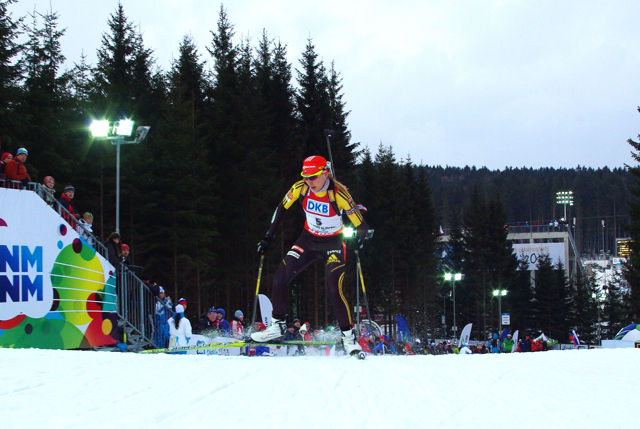
Anastasiya Kuzmina of Slovakia (shown here at 2013 World Championships) defended her former teammates and pleaded with the media to respect their privacy.
“How stupid can you possibly be?” Norway’s head coach Per Arne Brotnan asked in an interview with his local newspaper, Hamar Arbeiderblad. “There are still those who think it’s possible to cheat and get away with it… It is good that they were caught. It shows that those who try to cheat cannot feel secure.”
Björn Waldebäck, the doctor of the Swedish Olympic Committee, was similarly unimpressed with the athletes’ intelligence level: “If you’re doing this, at the border line or just above what is allowed, there are other ways,” he told Sweden’s Aftonbladet newspaper. “Doing this directly before the Olympics is insane. It is like driving past a school at 220 km/hr, in the first days after school is back in session.”
But what about the other athletes?
Slovakian star Anastasiya Kuzmina, who is originally Russian but switched her citizenship, urged caution by the media and others as the case blows up.
“I am personally acquainted with the girls, with Katerina and Ira,” she told Russian website Championat. “It’s now too early to talk about the situation. Their guilt has not been proved officially. It’s too early to start all this publicity in the press. I cannot imagine how stressful it is for the girls. I think we should all be more understanding and wait for the results – unless there is a trial, it is too early to say they are guilty.”
Norway’s NRK broadcaster interviewed some of the Norwegian athletes who are headed to the Olympics and who spent the season so far competing against the Russians.
Ann Kristin Flatland, who won a World Cup earlier this season, was cautious in her reaction: “There is another sample which has to be analyzed before we can say that they have been doping,” she told NRK. “But it is a shame if it turns out to be the case, it is a shame for our sport in particular, and for the Russians… I never thought about [whether they were doping]. I compete and I feel like we are on equal footing in races, and I have great faith in everyone involved. So it is really stupid if this turns out to be true.”
“It is terribly sad that this is happening in our sport, and I’m of course sorry for the Russians to have this for their home Games,” said Tora Berger, last year’s overall World Cup champion and a gold medalist at the last Olympics. “I live in faith that those I’m competing against are clean, and I hope that the anti-doping work is done as well as possible.”
And commentators and administrators weighed in on the anti-doping fight.
United States Biathlon President Max Cobb told FasterSkier in an interview that as far as he was concerned, as much was being done as possible. “Unfortunately, the tests will always lag just a tiny bit behind the cheaters,” he said. “But I know that the IBU has really been very aggressive and worked hard on this. They have done a lot of testing, and they are also using the blood passport program to look for anomalies that might be caused by things they can’t test for.”
Werner Franke is a professor of cell and molecular biology at the German Cancer Research Center in Heidelberg, but is an expert in anti-doping efforts; in 1991, he helped write a book which uncovered aspects of the East German doping system. He told Germany’s Zeit newspaper that he suspects the banned substance in question was recombinant erythropoietin (EPO):
“Endurance disciplines such as cross-country skiing or biathlon are the best discipline for taking EPO… I think the system from the Soviet Union is still corrupt in its successor states. After the Olympic Games in London in 2012, test samples showed that 30 Russian athletes had doped eight years earlier in Athens.”
The coach who had been training Starykh has worked with known dopers in the past, and the Russian team had also re-hired a doctor who had been sacked after their 2009 doping scandal in which three Russians received bans.
Patrick Schamasch, who retired as IOC Medical Director in 2012, said that Russia was in a transition period.
“Having worked with them I can say that they’ve confronted this problem head on,” he told the Washington Post. “Russia can now be counted among those countries that have very effective doping controls. I am hopeful that the dark days of doping in Russia are behind us… a certain number of athletes who are still in the hands, probably, of coaches from the old regime. Bit by bit, their (doping) numbers will go down because new coaches and advisers will arrive who weren’t involved in what happened before.”
Chelsea Little is FasterSkier's Editor-At-Large. A former racer at Ford Sayre, Dartmouth College and the Craftsbury Green Racing Project, she is a PhD candidate in aquatic ecology in the @Altermatt_lab at Eawag, the Swiss Federal Institute of Aquatic Science and Technology in Zurich, Switzerland. You can follow her on twitter @ChelskiLittle.