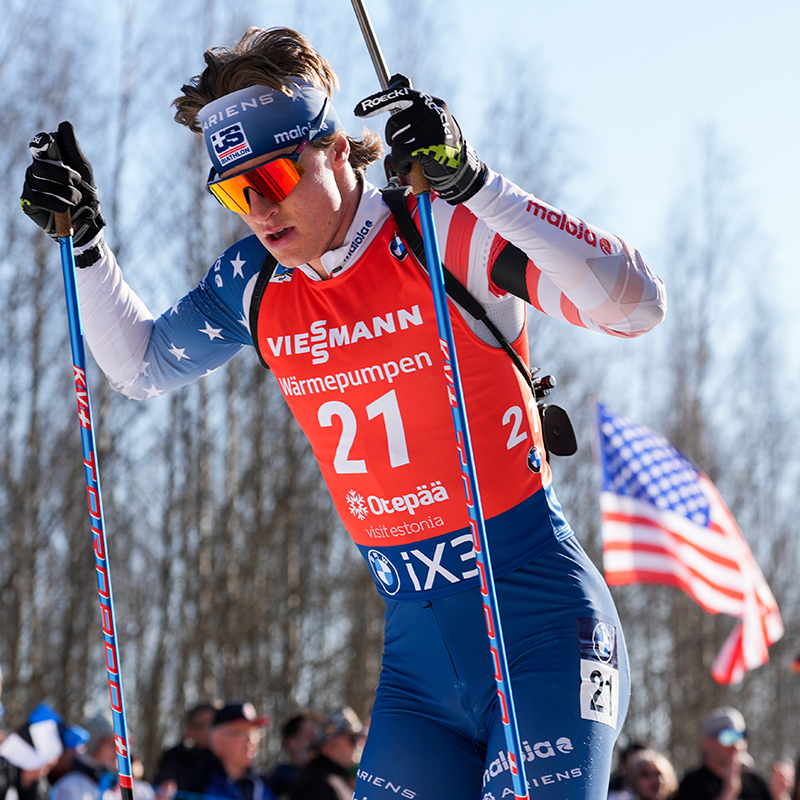

The hills above Moretown are the kind that teach you to move without thinking about it: long grades through maple and birch, a tangle of dirt roads, a thousand sneaky rollers perfect for running shoes or a classic stride. From the valley floor, you can see Sugarbush and Mad River Glen, their lifts still in October and their trails crisscrossed by hikers who’ll be skiers in a few short weeks. This is the terrain that shaped Tabor Greenberg, and it’s never been far from him. He grew up here, learned to love motion here, and now—a few towns and a handful of highway exits away—wears UVM green while settling into his sophomore year and his first season as a member of the U.S. Cross-Country Ski Team.
He smiles about the small details—like the tiny airfield that doubles as the local ski area where he first wore Nordic skis—and shrugs at the big ones, the ones that make headlines. He’s Vermont in that way: spare with words, long on work. “I’ve been skiing my whole life,” he says, recalling the first slip-on-your-boots skis and the BKL weekends that threaded winters together.

His dad was an alpine racer who transitioned to Nordic skiing after sustaining injuries; the family kept everyone in motion, engaging in hiking and running in the summer, as well as soccer and lacrosse.
By seventh grade, Greenberg had joined GMVS, stepping into a team culture that combined high standards with a sense of play. Older athletes, such as Brian Bushy and Josh Valentine, became the big brothers who made training feel like a privilege rather than a chore. “Their enthusiasm always made the workouts more fun,” he says. “Seeing them go to U18s in Estonia or Youth Olympics, I didn’t even know what those things were at first. I just saw them going to Europe to do these bigger races and thought, ‘That seems fun.’ I want to do that.”
That is as close to a “secret formula” as you’ll get from him. There’s no magic threshold session in his story; it’s a years-long accumulation of good days outside with people he liked being around. “Most of my motivation comes from that,” he says of the lifestyle—then adds, almost apologetically, that he’s built the discipline to do the work even when motivation lags.
A tough first year—and a reset
College arrived with promise and some hard lessons. Greenberg’s first season at UVM was marred by extended illness. He red-shirted, raced sparingly, and spent too many days horizontal. “I struggled being sick all season,” he says. “So this year it’s mainly been just trying to stay healthy—good recovery, sleeping a lot, staying hydrated, having a good connection to doctors if something does come up.”
UVM’s Head Coach, Patrick Weaver, doesn’t sugarcoat it. “Tabor’s first year was undoubtedly a tough transition, as he came in dealing with an extended illness that he struggled with throughout the year, so he essentially ended up not racing for UVM at all,” Weaver says. “This year he has come back in great shape and stayed healthy so far, so that’s been great—to see what he can do as a healthy person.”
Weaver sees something else, too: a young athlete who changes the room simply by how he works. “He works extremely hard, and it’s his work ethic that’s been a valuable asset to the team,” says Weaver. “Leading by example like this helps bring up the overall level of the team.”
And there’s the local angle that still means something in Burlington. “Having a Vermonter on the team is super important for the program. Having a fast Vermonter on the team is even better,” Weaver says. “We felt very fortunate that Tabor wanted to stay in Vermont and represent UVM and the state. This is something he’s super proud of, which is really fun to see.”

Engineering the comeback
Ask Greenberg about academics, and he answers as matter-of-factly as he does about training. He’s a mechanical engineering major, plotting a five-year path that allows the academic load to align with travel and race blocks. “I can do 12 credits a semester instead of 15 or 16 for the most part,” he explains. “It should ease the load a bit… hopefully manageable while traveling.”
If the men’s U.S. Ski Team has a surprising number of engineers, Greenberg doesn’t read much into it. The field simply makes sense to him, a way to invest time in “quality concepts” while keeping a door open for life after skiing. But it’s easy to see the overlap when he talks technique: leaning farther into the hill in both V1 and V2, getting the arms forward, experimenting with double-pole positions, learning to find “forward without actually getting the feet up,” and keeping his shoulders relaxed while playing with different hip-drive patterns. He’s not obsessing over new lifts in the weight room—”not really,” he says when asked about special gym work—so much as building a better mental model and then holding those shapes during long skis.
And there’s a plan behind the plan. Greenberg still consults with longtime coach Colin Rogers while working daily with Weaver. “Especially when I’m not at school, my plan is I kind of run it by both Colin and Patrick,” he says. “Going into races, I’ll make a plan that makes sense to both of them.” The dual-mentorship model mirrors the arc of other Vermonters who’ve succeeded after leaving UVM, and it’s part of why Weaver talks about schedules and guardrails. The U.S. Ski Team opens doors—camps, resources, broader input—but also adds travel and volume. “With all the other opportunities available, it is challenging to create a schedule that ensures a student-athlete does not overextend themselves,” Weaver says. “We’re working on it to ensure he can excel academically and still maintain a high level of performance in skiing.”
The day the D Team call came
The call confirming his spot on the U.S. Ski Team didn’t arrive with a trumpet solo; it found Greenberg on a beach in Mexico. He was decompressing after a winter that had felt like a dead end. “I was pretty unhappy with skiing at the moment,” he admits. Then teammate Murphy Kimball texted to say his points might have slipped him under the sub-400 distance-racing criterion. “Later, Kristen [Bourne] called me,” Greenberg says. He already knew by then, and his reaction was classic Tabor—pleased but unsentimental. “It’s cool to be on the national team, but it’s not really, like, a game-changer. On the D Team, now you race World Cups and see there is still work to do.”
That pragmatism tracks with how the spot was earned. Last year, sick more often than healthy, he raced only eight or nine times. But when he did line up healthy, he made it count—most notably at the Cable SuperTour 20k classic mass start, where he finished fifth in a front group on a good points day. Those points, stacked with a handful of other starts, slid him inside the threshold.

U.S. Head Coach Matt Whitcomb sees a different kind of threshold in Greenberg, one that’s about temperament and fit. “This kid, he’s a really special kid,” Whitcomb says. “He takes a little bit to get to know. He’s a little quiet, but what I learned from his coaches is that he is always listening. You might be having a meeting with him, and he’s kind of looking off to the side a little bit, and you think you’ve lost him. And then there’s this little pause, and he’ll come right back at you with just the most on-point question.” Whitcomb calls that attentiveness a key to belonging on a team where the banter never stops. “Our guys rip on each other all day—in the right way, the loving way—and I see Tabor instantly plugging into the men’s team already.”
It’s not just the ear; it’s the engine. Whitcomb points to Greenberg’s anchor leg on the 2023 U18 relay—”he came from way behind and caught Norway in the stadium”—as a marker of racecraft and mindset. “Tabor’s that kind of competitor,” Whitcomb says. “He’s a hunter, both literally and figuratively.” The literal part showed up at the team’s Utah camp; the figurative part is the one that matters in March.

Vermont pride, Vermont places
Greenberg didn’t choose UVM because he was unaware of other options available. He did the homework, looked West, and still chose home. “Growing up in Vermont, we’d go to an Eastern Cup that overlapped with Carnival, and it was always the UVM guys winning,” he says. “When I was younger, I was like, these guys are the best there is then… I really enjoyed the venues here more than out West. I kind of just had a gut feeling this was the right place.”
Ask him where he’d send an out-of-state friend to understand his Vermont, and he has a ready list: Trapp Family Lodge when the snow is deep; Mad River Glen on a powder day; the Long Trail from Lincoln Gap to Appalachian Gap and on to Waterbury when the leaves go red and gold. He’s not performing here; this is simply the life that restores him. Between classes and training blocks, he’ll thread in a bit of fishing, the occasional bow-hunting session if the calendar allows. In Utah, he saw a pair of bucks at 250 yards and later walked to within 80 before choosing—wisely—not to take the shot; he hadn’t practiced enough. “It’s definitely peaceful,” he says of being in the woods, then stops short of over-claiming the performance benefits. “I don’t know if there’s that much of a correlation.”
Maybe he doesn’t have to draw the line. Anyone who’s tried to race well knows that a happy athlete is a better one, and his habits read like a local’s guide to contentment: early bedtimes, long skis, ridge-line hikes, a few casts before dinner.
Goals, set quietly
Greenberg’s target list for the season is crisp: Junior Worlds, NCAAs in Bozeman, and—if the form and selection break right—a World Cup start in Lake Placid. “Same game plan no matter what,” he says. “Ski fast.” The sequencing matters: peak well for Nationals and you put your Junior Worlds case on solid footing; hold fitness and you can ride the rhythm into March.
For now, he trains with the UVM group and will tweak the plan as winter approaches. “Right now it’s pretty similar to everyone else,” he says. “In the winter, I’ll try to work in a few bigger weeks or blocks that’ll help me get ready for that March racing period.” If the path sounds simple, that’s the point. When you’ve just dug yourself out of a year of being sick, you don’t complicate success.

What coaches see
Whitcomb’s portrait is of a listener who processes information quickly and competes more intensely. “Thoughtful,” “very funny,” “great technician,” “great competitor”—words that land differently because they’re delivered with the caution of a coach who doesn’t over-praise. Whitcomb is equally quick to underscore the growth curve ahead. Greenberg absorbed a challenging year, he says, and handled the reset maturely. “He was very smart in his buildup this year, and he’s brought himself back to a very high quality level of training,“ Whitcomb says. “It’s going to be a fun career to watch.”
The thing about top-30s
The U.S. men’s program now has a new normal—medals and crystal-globe chases—but Whitcomb is adamant that the sport’s middle rungs still matter. A first World Cup top-30 for a young American is still a scene, a bus-wide celebration. “When a guy like Tabor or Lucas Wilmot gets their first top-30, it will be just as exciting for the team as someone, on that same day, on the podium,“ Whitcomb says. That’s the context for Greenberg’s ambitions: real, reachable steps on a ladder that’s higher than it used to be.

The Vermont through-line
It’s not nostalgia to suggest that place still matters in American skiing; it’s simply observation. Vermont has sent a steady stream of athletes into the national team pipeline, and UVM is a key contributor to that current. Greenberg is another link in that chain, one who still resembles the kid who ran those ridges, played those pickup games, followed older teammates into bigger arenas, and filled in the knowledge with discipline.
Then there’s the image that may say more about him than the résumé line: a kid in Utah walking a buck into 80 yards and passing on the shot because the practice wasn’t there yet. It’s not caution; it’s calibration. It’s someone who knows the difference between wanting and being ready.
If you’re looking for a template, that might be it. A Vermont upbringing that made movement a joyful experience. A high school program that made hard work fun. A first college season that reminded him that things can go sideways. A reset that prioritized health and attention to detail. Two coaches who trade notes and coordinate calendars so a student-athlete can keep a broader life in balance. And an athlete who understands he needs to put in lots of hard work to be ready to take the shot when it presents itself.
Love Stories Like This? Help Keep Them Coming.
Feature interviews like this one take time, access, and care to produce. If you value thoughtful storytelling and independent ski journalism, please consider becoming a Voluntary Subscriber. Your support directly fuels the work we do to cover the people, places, and moments that make our sport special.
Join the FasterSkier community.


Matthew Voisin
As owner and publisher of FasterSkier, Matthew Voisin manages the day-to-day operations, content, and partnerships that keep the site gliding smoothly. Away from the desk, he’s doing his best to keep pace with his two energetic sons.