

By the time Sophia Laukli picks up the phone from Lillehammer, it’s raining again.
“There is, like, a small 1k loop up at Sjusjøen,” she says, “but it’s… yeah, it’s, like, raining every day, so it’s not really great conditions.”
On paper, Laukli is one of the most intriguing dual-sport athletes in endurance sport: a U.S. Ski Team member and Olympian who has also become a force in international trail running. In person—or over Zoom—she’s thoughtful, understated, and very clear on one thing: the way she trains now, in Norway, looks a lot more boring than the world might imagine.
You come to Norway expecting secrets, she says. What she found instead was simplicity.
“They’re so simplistic around ski training,” Laukli explains. “It’s not rocket science. You can do the same… You do essentially the same workouts every single week, all year round.”
That realization—combined with a crash-and-burn experiment as a full-time runner and a new coaching relationship with her boyfriend, longtime Norwegian pro skier Gjøran Tefre—has quietly reshaped her career.
As this Olympic season approaches, Laukli’s bet is clear: train like a skier, keep the training simple, stay within herself, and let the results show up in both sports.

Maine Roots, Late Commitment
For all the talk about Norway, Laukli’s story really starts in coastal New England.
“I was actually in the Boston area until I was, like, six or seven,” she says. Then came a year and a half in Norway, and finally Yarmouth, Maine—the place that still feels like home.
“From my memories and my ski memories, it’s all from Maine.”
Her father is Norwegian, so skis were always around. Winters meant skiing, family trips to Norway, and a life that looked, from the outside, like an early pipeline to the World Cup. From the inside, it didn’t feel that way at all.
“It was a very recreational thing,” she says. “I didn’t really enjoy it that much. It was just kind of like, obviously, we’re gonna ski because it’s winter. But I didn’t know anything else.”
In Maine, her parents weren’t just ski parents—they were essentially the ski people in the community.
“They were my coaches,” she says. “And very present in the ski world, which was hard for me… A part of me became pretty hesitant towards skiing.”
She gravitated toward soccer and tennis. Skiing felt obligatory.
“Up until midway through high school, skiing was kind of just something I did because my family did it,” she says.
The idea of becoming a professional athlete wasn’t just unrealistic—it was unimaginable.
“I was gonna just go to school and be a nerd or something,” she says. “Being a professional skier wasn’t even a consideration.”
Then came the pivot: joining the iconic Yarmouth High School ski team, coached by the legendary Bob Morse.
“It opened my eyes a lot,” she says. “It wasn’t super competitive, but it showed me the sport that felt forced on me was actually something I liked—and could be really good at if I tried.”
Looking back, she’s grateful it took so long.
“I’m super happy I went through that zero-pressure, uncommitted relationship to skiing,” she says. “Today I have so much motivation to be 100% committed… and I’m far from burnt out compared to many skiers who commit when they’re 12.”

Discovering Running (By Hating It First)
The other half of her dual-sport identity—trail running—comes from an even stranger origin story.
“Running was something that I actually hated,” she says, laughing. “I really, really, really did not like to run when I was young.”
Running in Maine didn’t help.
“It just wasn’t enjoyable to run there,” she says. “Unless you really liked running on roads and golf courses.”
She ran cross country her senior year only because the coach wanted her on the roster for states. She ran track for one year and found it “horrible.”
“It wasn’t until I started training out West in the summers, finding mountains… that I actually enjoyed running.”
Those Western US trails served as the practice grounds, preparing Laukli for some of the world’s biggest trail races. But first she had to figure out college—and how training would fit around it.
Middlebury to Utah: Building a Life Around Skiing
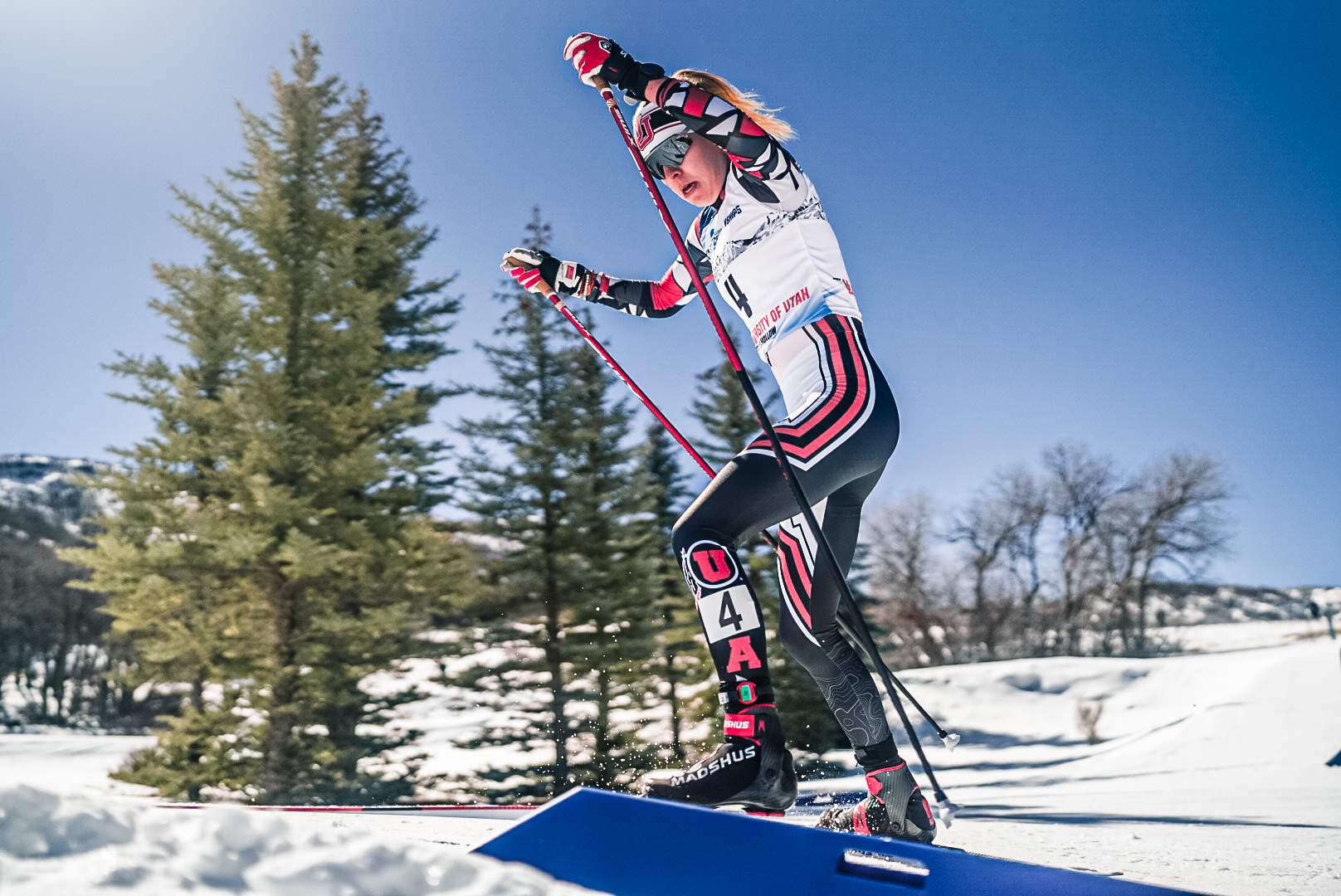
Laukli chose Middlebury because, at the time, academics were the top priority.
“I knew I didn’t want to be done skiing,” she says, “but it wasn’t the priority.”
Covid changed everything. Remote classes allowed her to chase early World Cup opportunities without living on campus. Once Middlebury required students to return in person, the timing coincided with the rapid ascent of her ski career.
That led to a transfer to the University of Utah.
“Utah is built for athletes,” she says. Most classes were online and flexible. She chose economics not out of passion but practicality.
“I didn’t necessarily choose the thing I thought was interesting,” she says. “I chose what would best suit my ski career.”
Now, even as a full-time pro based in Norway, she’s studying again—an online Norwegian MBA.
“I’ve never been someone who can come home from training and sit on the couch until my next session,” she says. “I think I was missing having more than just training.”
Balancing skiing and school helps her prevent the sport from consuming everything.
The Running-Only Experiment That Failed
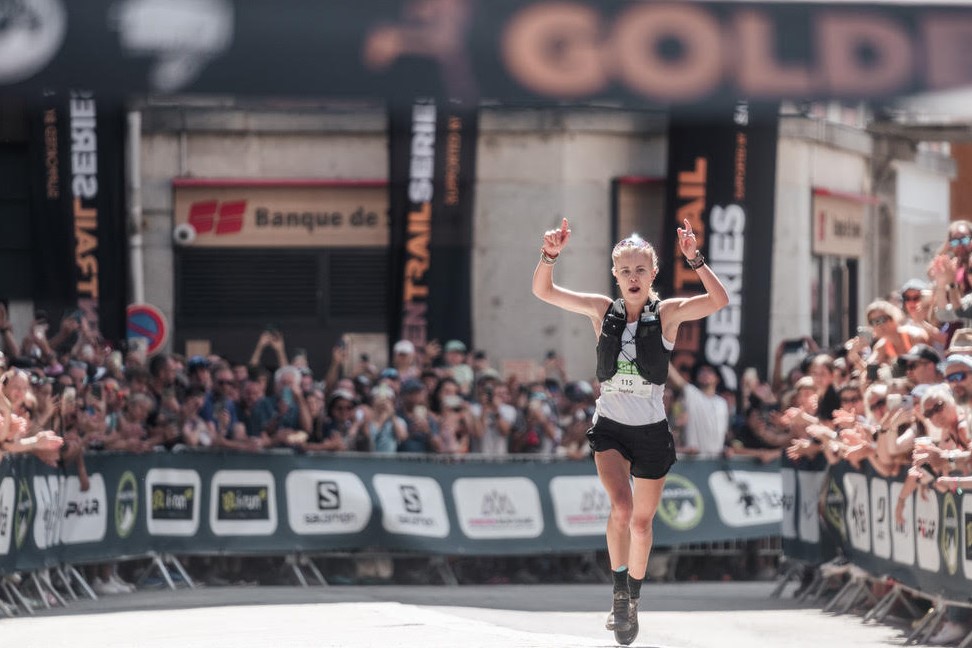
Last year, after the World Championships, Laukli decided to lean all the way into running. It seemed logical—if she’s good at running without specifically training for it, imagine how good she’d be if she did.
“I always thought I’d be a much better runner if I had just run,” she says.
So she tried it. No roller skiing. No ski sessions. Just running—every day.
“I was running 10 to 12 hours a week,” she says. “And I was so tired each day. I was getting worse and worse at running. And obviously not good at skiing.”
The experiment collapsed at a race where she felt utterly depleted. She flew home, frustrated and confused. That’s when she sat down with her boyfriend, Gjøran Tefre.
“He said, ‘It’s fine. I’ll write a plan. Don’t freak out,'” she says. “‘We’ll get you a coach, but ski training is straightforward. We’re gonna baby you into ski training again.'”
Two weeks completely off. Then a return to “textbook” ski training.
Within a week of roller skiing, something wild happened: her running started feeling good again.
The pattern was clear. She ran better when she trained like a skier.

Kristen Bourne Saw The Same Thing
“Last season was definitely a struggle for her, both running and skiing,” says U.S. Ski Team assistant coach Kristen Bourne, who monitors Laukli’s training load. “And she’s just trying to figure out why.”
For Bourne, the shift wasn’t just physical—it was psychological.
“I’m a huge believer that what makes a difference from a good athlete to a great athlete is the athlete who is very invested in their own process,” Bourne says. “The ones who are thinking, advocating for what they need—not just deferring to a coach because the coach’s word is gospel.”
That ownership, she says, is new in Laukli.
“She’s definitely leaning into that more this year,” Bourne says. “Which is really cool.”

The Gjøran Factor: Coach, Partner, Check on Reality
Mixing a relationship with coaching is a delicate thing. Laukli knows the risks—she’s heard them all.
“I’ve been told by many people this is not a good idea,” she says. “And other people are like, ‘Wow, I wish I could do that.'”
She also knows why it works.
For one, they communicate constantly. For another, his intentions are pure.
“One of the hardest parts of finding the right coach was that they either only cared about skiing or only cared about running,” she says. “He’s the only one who actually wants me to do well in both.”
Still, she doesn’t call him her “coach.”
“I want our personal life and work life to be separate,” she says. “We need other people in the room.”
That’s where Bourne plays a key role.
“At this level, athletes have so much experience—they do know what they need,” Bourne says. “So my goal isn’t to dictate everything. It’s to help Sophia articulate what she feels and translate it into training.”
The two systems—Tefre’s daily presence and Bourne’s structured oversight—meet in the middle.

The Norwegian Experiment: Simple Workouts, Serious Control
When Laukli moved to Norway, she expected cutting-edge workouts—maybe some secrets behind the country’s dominance.
“It’s almost been the opposite,” she says. “They’re so simplistic around ski training.”
Five-by-ten-minute intervals around the Holmenkollen loop. The same long, easy days. Repeated blocks of threshold.
“You’re gonna become better if you do five-by-ten once a week for 12 weeks in a row,” she says. “You’re gonna become better.”
The key difference from the U.S.? Control.
Almost every Norwegian skier has a weekly treadmill “profile test,” which involves six-minute stages at a 10 percent incline, with lactate samples taken at each step and heart rate recorded.
“It’s to see if you’re in the right range,” Laukli says. “Not to get better each week.”
Bourne sees value in that simplicity.
“Sometimes a coach wants to prescribe the flashy intervals,” Bourne says. “But honestly, the athletes who can execute the basics really, really well—that’s where the gains are.”
She sees Laukli finally embracing that mindset.
“Athletes shouldn’t feel like training is something done to them,” Bourne says. “They should feel like they’re building something in collaboration with the coach. Sophia is starting to live that.”
Laukli agrees that American juniors often overtrain because they don’t know any better.
“If I go too hard too many times in a row, it’s a much worse year,” she says.
The hardest part? Slowing down when training with Norwegian women who can drop her on almost every roller-ski interval.
“Every interval I do here, I know I’m not gonna keep up,” she says. “At 17, that would’ve crushed me. Now I have evidence that I can beat them in the winter.”
Two Seasons, One Mindset
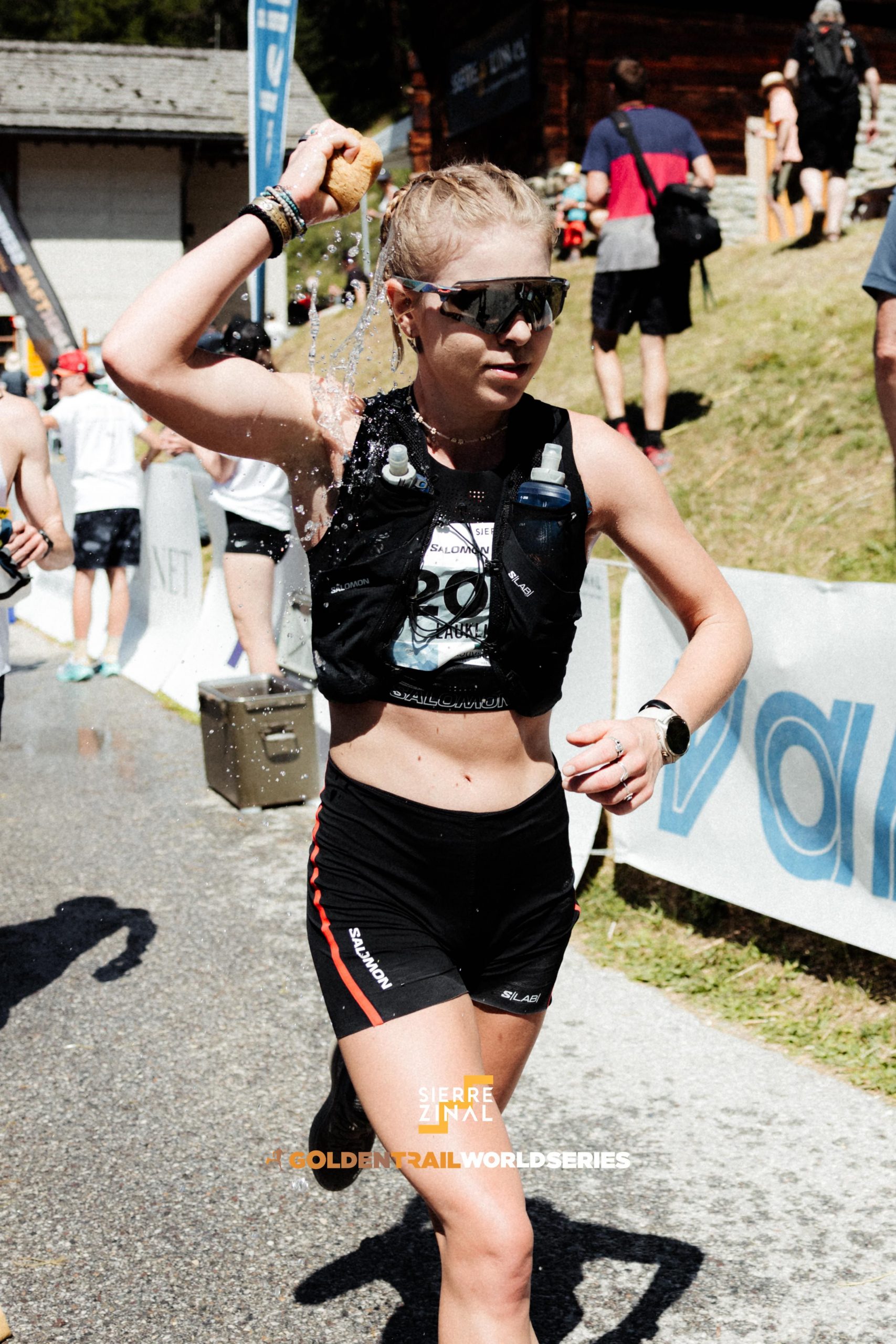
Running and skiing back-to-back seasons creates year-round excitement—and pressure.
“I have two competition periods,” she says. “It’s easier to motivate. But it also means I’m 100% consumed by performance all year.”
That obsession became a barrier last year. Now, Laukli is working with Bourne and Tefre to shift her mindset.
She has clear goals for skiing: the Olympic 10k, the Olympic relay, and the final hill climb at the Tour de Ski.
She has equally specific running goals: above all, returning to Sierre-Zinal, where she once ran 2:53 on the iconic 31 km route.
However, she’s no longer defining success solely by results.
“There’s so much I’m working on—technique, tactics, how I ski courses,” she says. “It’s easy to be on a start line and focus on whether those things show up.”
Bourne sees that evolution clearly.
“Sophia has the instincts of a really high-level athlete,” Bourne says. “But learning to trust those instincts—rather than obsessing about the result column—is where she’s growing most.”
Why Salomon Fits: One Athlete, Two Worlds
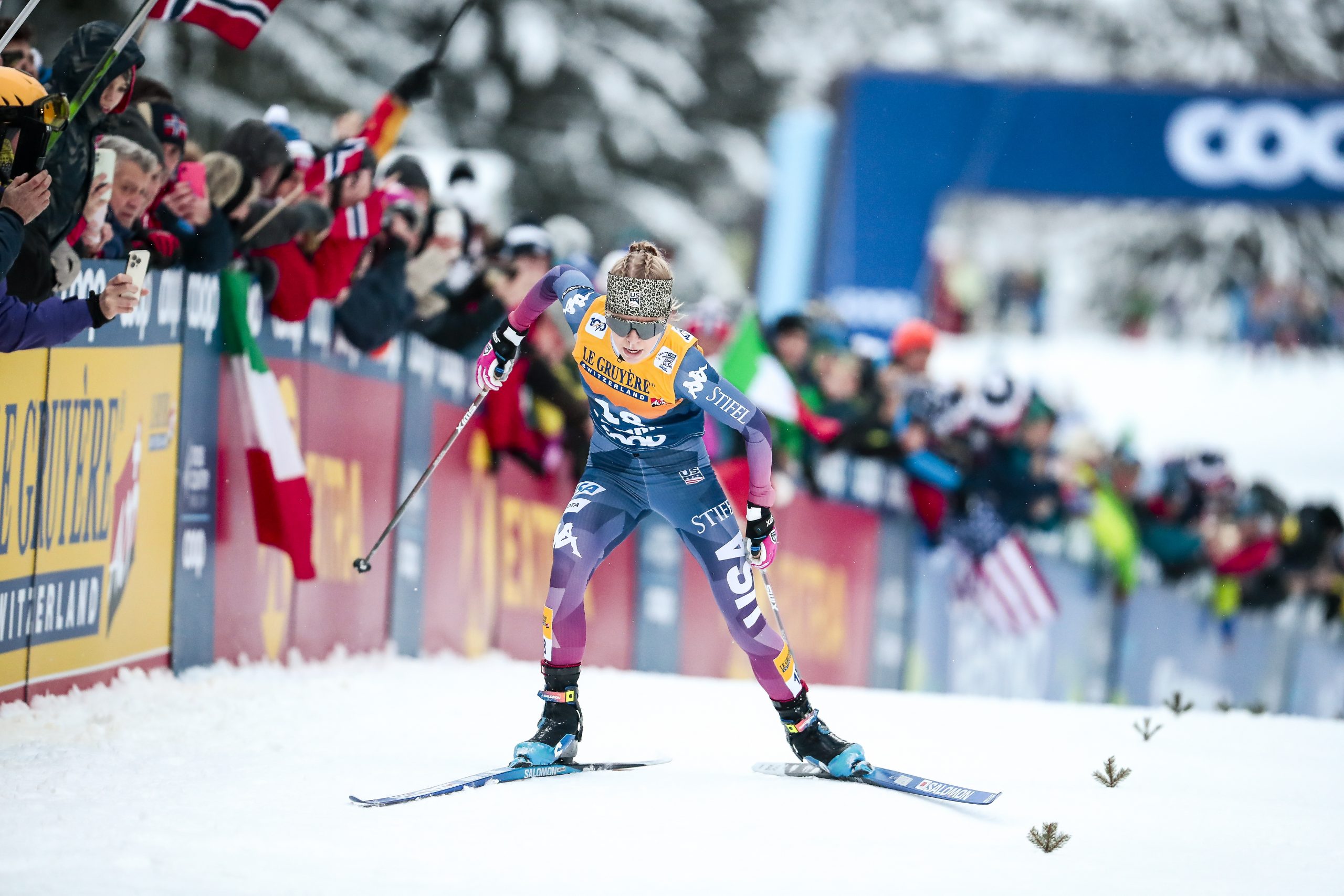
For an athlete splitting her year between the World Cup and the Golden Trail Series, sponsorship could easily become complicated. Many runners work with running-only brands; many skiers work with ski-only brands. For Laukli, that would have been a logistical mess — and maybe even a dealbreaker.
Instead, she found the perfect home with Salomon.
“I’m super grateful that I get to have my sponsor, my main sponsor, support me in both,” she says. “Because then it’s a lot easier to focus on each season. I know that they’re supporting me in that.”
That unified support matters. It lets her shift from skis to singlets without the politics of competing brand calendars and conflicting performance expectations.
“I don’t really know if it would be possible for me to be a runner for another brand and a skier for a different brand,” she says. “Like, defending to them that I can’t run a normal running season because it’s the Olympics, or I need to drop World Cups so I can run better this year — that just wouldn’t work.”
With Salomon, the opposite is true. Everyone’s aligned.
“Having everyone be on the same team makes it manageable,” she says. “And a lot more motivating, because everyone has the same goal.”
She works directly with Salomon’s France-based team, and Laukli lights up when she talks about the group behind her.
“They’re all French,” she says, laughing — a nod to the company’s deep culture in both ski sport and trail running. It’s also a reminder that Laukli lives firmly in the middle of two endurance worlds that Salomon understands and embraces.
That harmony matters. Her identity isn’t split; it’s blended. And Salomon is built for that.

Sunny Weekends and Simple Breakfasts
Some things have gotten simpler, like her pre-race breakfast.
“I used to do peanut butter and banana,” she says. “Now I just have cereal. Apparently, simple is better.”
World Cup life has also taught her the importance of flexibility.
“You learn how to adapt,” she says. “Something will always go wrong on a race weekend.”
When she’s asked for her favorite place on the circuit, she doesn’t hesitate.
“Davos,” she says. “It’s sunny. You can have bad races, and it doesn’t matter because it’s a really nice place to hang out.”
That small detail fits her evolving philosophy. Training is simpler. Goals are more balanced. And the sport—skiing and running—feels more sustainable.
Somewhere between Maine and Norway, between Middlebury and Utah, between World Cup stadiums and alpine trails, Sophia Laukli has built a training model that doesn’t look flashy. It’s repetitive. It’s measured. It’s rooted in trust, communication, and doing the basic things right, over and over again.
And if the Norwegians are right—and if Laukli’s instincts keep sharpening—those basics may be exactly what carry her to the front this season, in both sports.
Love Stories Like This? Help Keep Them Coming.
Feature interviews like this one take time, access, and care to produce. If you value thoughtful storytelling and independent ski journalism, please consider becoming a Voluntary Subscriber. Your support directly fuels the work we do to cover the people, places, and moments that make our sport special.
Join the FasterSkier community!


Matthew Voisin
As owner and publisher of FasterSkier, Matthew Voisin manages the day-to-day operations, content, and partnerships that keep the site gliding smoothly. Away from the desk, he’s doing his best to keep pace with his two energetic sons.


