

 This coverage is made possible through the generous support of Marty and Kathy Hall and A Hall Mark of Excellence Award. To learn more about A Hall Mark of Excellence Award, or to learn how you can support FasterSkier’s coverage, please contact info@fasterskier.com.

For six hours on Tuesday, the U.S. Cross-Country Ski Team watched Finland scroll past the windows of a northbound bus, the day’s thin slice of sunlight slanting low across the snow. The sun in late November never rises entirely above the horizon there—”maybe ten degrees,” Matt Whitcomb noted—and so the world outside was washed in a pastel light that never quite felt like midday. In that part of the Arctic, sunrise and sunset are effectively the same event.
That is the moment Whitcomb pays attention to every year.
“As it sets, as you’re driving in those first two hours of the bus ride,” he said, “it sort of feels like it’s the official close of the preparation season.” The athletes may have left Muonio only hours earlier, but that sunset marks a boundary: everything before is training; everything after is racing. “That’s it,” he said. “The prep season’s over. It’s time to race now.”
The bus carried all seventeen athletes—nine men and eight women—each holding a different version of readiness. Some were energized, some were still finding their legs, some were quietly anxious. An Olympic season magnifies everything. For veterans, this opener in Ruka is familiar and charged; for athletes on the bubble, the weekend marks the start of a two-month test whose outcomes will determine whether they get to ski in Italy in February.
But for one last window of time, before the waxing trucks and the bib pickup and the official training, the whole team was suspended in this Arctic twilight. It is a soft entry into what quickly becomes a hard world.
When the bus crested the final kilometers into Ruka, the athletes looked out the left side toward the hill that dominates the course—a climb they will race up and over repeatedly in the coming days. “Every year,” Whitcomb said, “that road goes right up the largest hill on the course… your first trip up that is in the bus.” The hill glowed under floodlights. Below it, the village looked like it had been placed inside a glass ornament. “It’s lit up like a snow globe around here.”
By the time the athletes stepped off the bus and into the cold, the World Cup season had begun.
What They Carry From Muonio
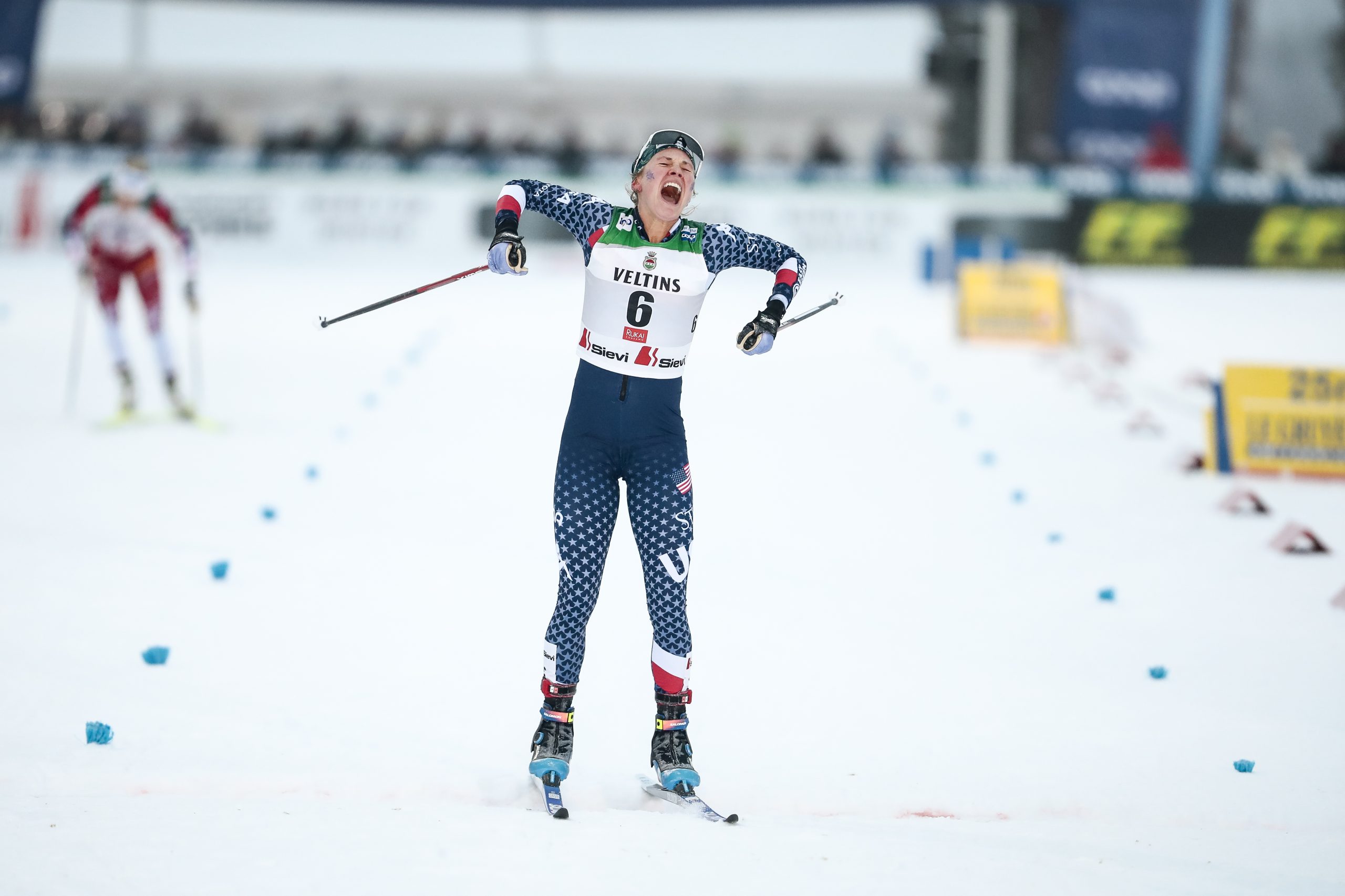
A week earlier, the team was skiing through air so cold it could freeze eyelashes. Muonio is remote even by Finnish standards, a strip of trails and cabins surrounded by deep quiet. The temperatures dropped to –5°F for the high and –10°F for the low, and the athletes masked up, moving carefully to avoid frozen lungs. No one did intensity that day; even the coaches agreed the cost wasn’t worth the risk.
And yet the camp was a success.
“It was right on the edge of being too cold,” Whitcomb said, “but we made it work. And nobody has residual coughing, so I think that’s the tangible indicator that we didn’t push too hard.”
More importantly, Muonio was calm this year. There were no lingering illnesses, no cascade of early-season injury setbacks. “This year has been a better year with regard to preparation,” he said. “We’ve had fewer long-term illnesses, fewer acute injuries.” In an Olympic season, where every missed week feels like a month, that is no small thing.
Muonio is the last place where the athletes can simply train, ski, nap, and repeat. Once they arrive in Ruka, the season accelerates in a way no one can fully control.

Ruka’s Glow and Ruka’s Pressure
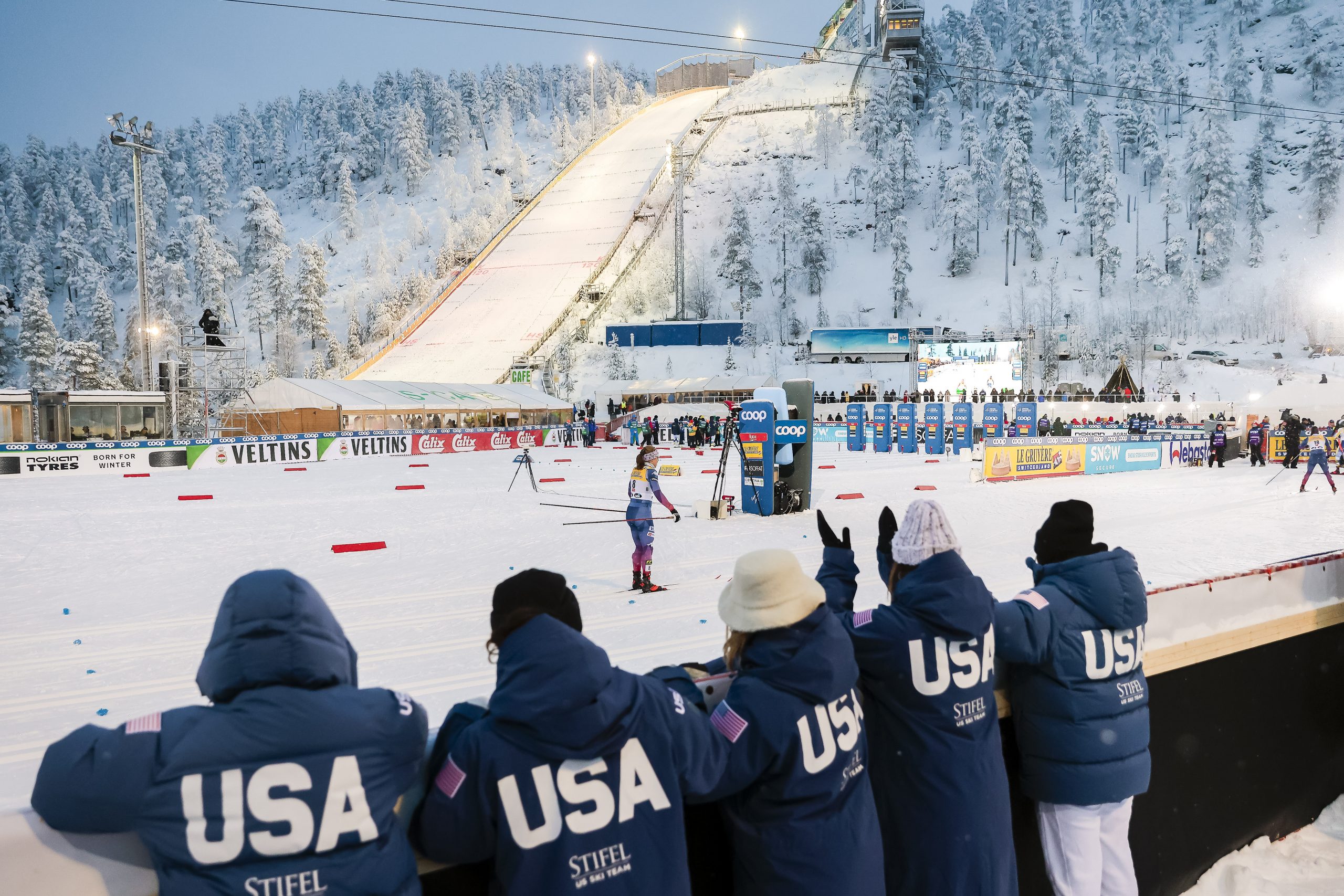
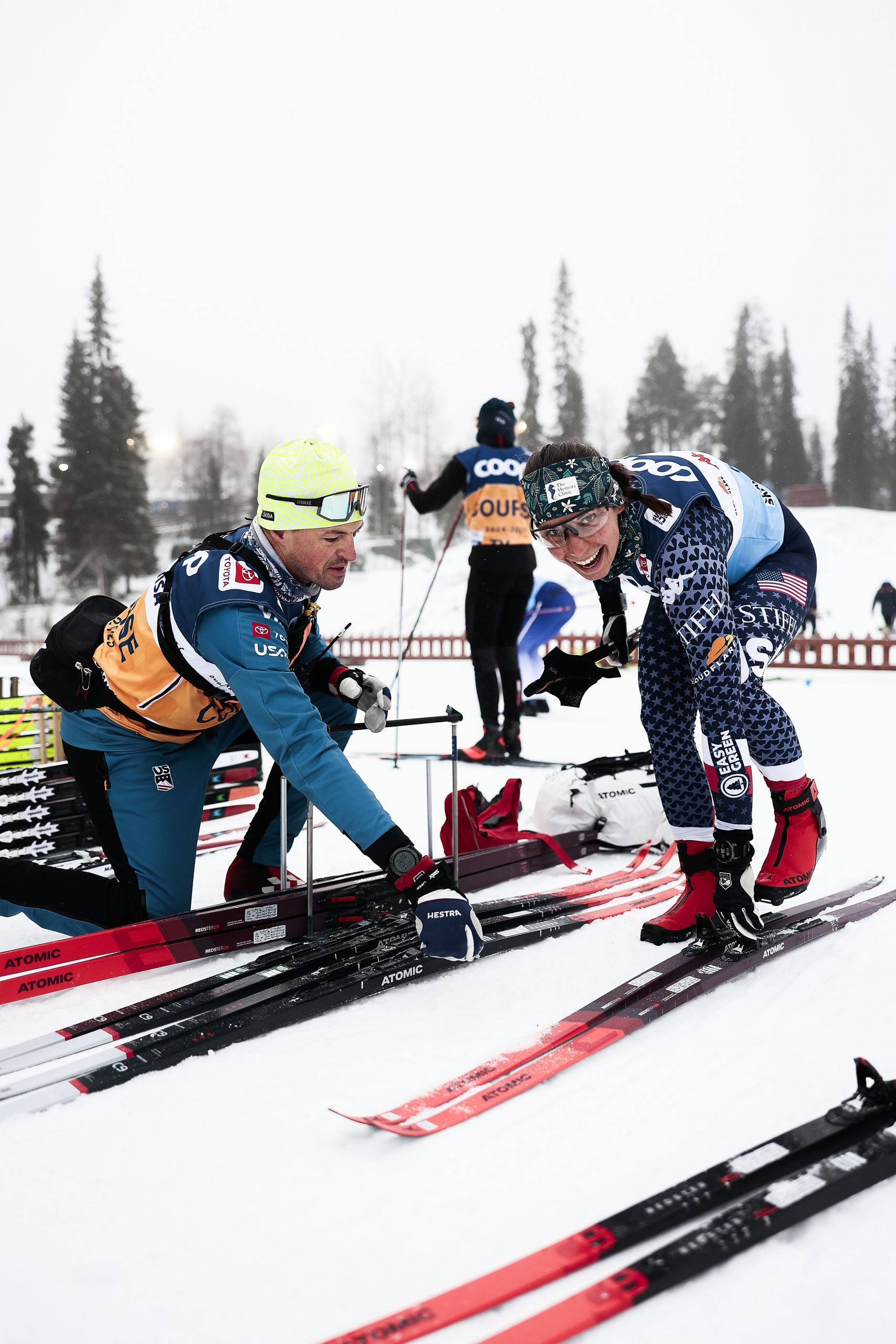
Ruka is where the World Cup hardens into its proper form. The quiet trails of Muonio are replaced by a carnival of nations: wax trucks pulled side by side, technicians moving in practiced circuits, athletes from every powerhouse country striding around the stadium. For all teams, the opener reveals the truth of the summer: whose fitness is real, whose technique held up, whose body needs another two weeks before coming online.
“The moment we arrived here in Ruka,” Whitcomb said, “you start to see the waxing vehicles from other nations… the reality of it hits, and you could feel butterflies sort of emerge as a team.” Even the veterans feel it. “Munio last week was all about recovering from jet lag… and you arrive here, and it’s like: official training, then race, race, race. It’s go time now.”
He emphasized that the stress is not negative. Stress, in his framing, is a sign that something meaningful is at hand. “It’s indicative of the privileged environment that we live in,” he said. “We’re doing something important, something these athletes work really hard for, and something that they’re ready for—and that’s why they feel stressed.”
In an Olympic year, there is no such thing as a low-pressure opener.
The Team Within the Team
The most striking thing about this group, Whitcomb said, is not its athletic potential—though several athletes are carrying top-10 ambitions into the weekend. It’s the internal energy.
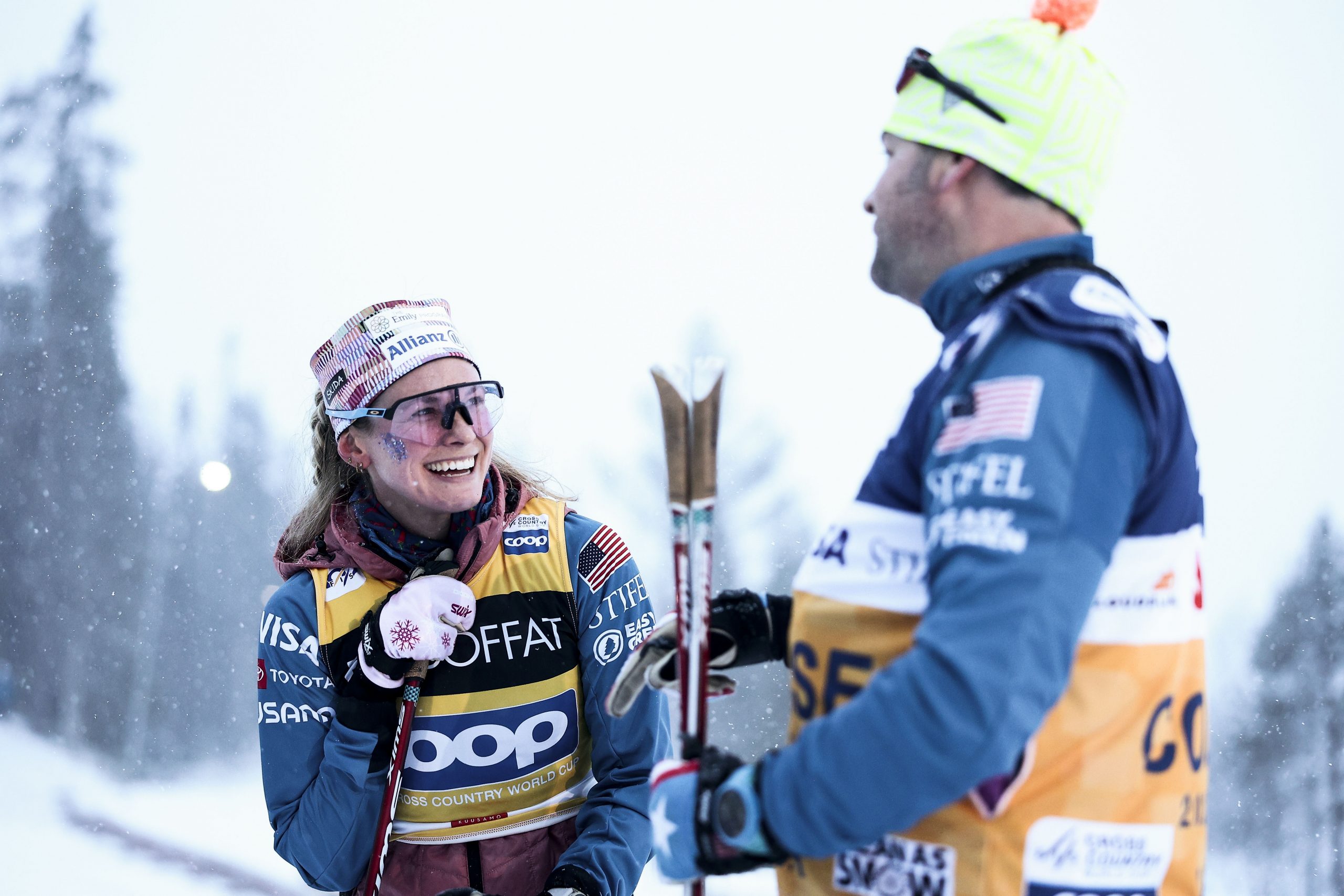
“It feels as supportive a team as I think we’ve ever had,” he said. “Not better, but certainly as good as any team we’ve ever had.” A year ago, he described a similar feeling, but something about the last month apart has deepened it. “They just vibe together,” he said. “They’ve really missed each other.”
From outside, the U.S. team can look like a logistical patchwork—athletes based in Vermont, Alaska, Idaho, Colorado, Norway; college skiers who drop in and out; development athletes rotating through Europe. But when they’re together, Whitcomb believes the culture gives them a competitive advantage.
“One of the privileges our nation has,” he said, “is that we are not as competitive as Norway is.” He doesn’t mean competitive in results—he means internally. In Norway, a single race in Beitostølen can determine whether an athlete gets a World Cup start or disappears back into domestic anonymity. “Literally that one race… has a lot of say in whether your winter is going to be successful,” he said.
In the U.S., the pressure comes from the Olympics, not from your teammates. “A positive team vibe really does some work for you,” he said. It prevents the “little stresses”—the ones that accumulate in toxic environments—from becoming overwhelming in an Olympic year.
“When the only stress you have to worry about is the silly one that is racing,” he said, “you can overcome that.”
Olympic Stakes, Explained Clearly for Once
For athletes and coaches, the rules of Olympic selection are a map that everyone has memorized; for the public, they are a maze. Whitcomb walked through the system with the clarity of someone who helped write it.
There are three primary pathways:
1. Top-8 in an Olympic event on the World Cup
If an athlete finishes top-8—but only in a race that exactly matches an Olympic event—they automatically qualify.
Classic sprint in Trondheim? Yes.
20k Skiathlon in Trondheim? Yes.
10k skate in Davos? Yes.
Team sprint? No.
Any race similar but not identical (ie, the 15k Skiathlons)? No.
2. Top-45 on the World Cup ranking list (by Oberhof)
Any athlete inside the top-45 overall (distance or sprint, depending on discipline) meets the selection criteria. They still need a spot available, but their case becomes strong.
3. Discretionary selection
This exists—but is avoided whenever possible.
“To be candid,” Whitcomb said, “that’s a goat auction in itself.”
In an Olympic year, the staff prefers not to touch discretion at all.
Roster limits
Right now, the U.S. holds seven men’s spots and eight women’s spots, with a realistic chance of earning an eighth men’s spot. It will not exceed 8 + 8.
Domestic results?
For someone skiing exceptionally well at Senior Nationals to force their way in, there must be vacancies left by athletes who didn’t meet criteria on the World Cup. In most years, Olympic qualification is won or lost by Christmas.
This is why every World Cup start in Period 1 matters. Every 12th place, every quarterfinal, every decent distance day contributes to the math.
But to Whitcomb, that math isn’t the point. It’s how athletes handle pressure that determines whether the season becomes joyful or claustrophobic.
“Meet Your Body Where It Is”
On Thursday night, in the team meeting before the weekend races, Whitcomb planned to give a simple message.
“You start that 10k, and you’re going up the first hill,” he said, “you just meet your body where it is. You do your very best that day.”
He wants the athletes to tune out the noise:
- the coaches on the sides of the trail
- the athletes they pass
- the athletes who pass them
- the crowd, the music, the reporting, the points
“You deal with the one vehicle that you’re driving,” he said. “And you try to enjoy it.”
Because fitness today doesn’t predict February.
Because the Olympic Games begin on February 7th, the only date that truly matters.
Because early-season expectations are a trap: some athletes are ready this weekend; others won’t feel themselves fully until the Tour de Ski.
“The human body,” he said, “is a wildly unpredictable thing.”
If there is one truth that governs the first weekend of racing, it is that.
Why Ruka Still Matters
Still, the weekend is not symbolic. It is competitive, decisive, and formative. Whitcomb believes the team is “positioned well to have a great opener,” but he also knows that Ruka rarely tells the whole story of a winter. The temperatures are often frigid, and the travel is too recent. But it gives athletes one thing they cannot simulate anywhere else: the clarity of racing.
“Early,” he said, “but it can’t come soon enough. We’re really excited.”
Ruka is where the starting gun echoes for the first time, but it’s also where the season’s unseen forces begin working: confidence, doubt, momentum, cohesion, luck, health, and perspective. Many Olympic stories begin here without anyone realizing it until months later.
The First Night in the Snow Globe
By Tuesday evening, the team had unpacked their bags in the small condos near the stadium. By Wednesday, when we spoke, through Whitcomb’s thin door, we could hear athletes talking after dinner—laughing, telling stories, building team chemistry. “You can hear people probably through my door,” he said, because “they’ve really missed each other.”
Outside, the northern lights edged across the sky.
Inside, there were skis to prep, race plans to finalize, nerves to manage.
And in the morning, the first climb of the season would begin at the bottom of that hill they had ridden over on the bus.
There are a few actual rituals in a sport defined by travel and unpredictability. But in the U.S. team’s calendar, the bus ride to Ruka is one of them. It marks the line between the world that was and the one that’s about to begin. Between training and racing. Between imagining and knowing.
The sun had long since set, but the trail lights of Ruka glowed through the fog, warm against the cold.
The World Cup season officially starts tomorrow.
And for the U.S. team—healthy, united, a little nervous, and very ready—there is nothing left to do but ski.

How to Watch
In the United States:
Schedule
November 28th:
10k Interval Start Classic – Women at 4:30 am EST and Men at 7:15 am EST
November 29th:
Classic Sprint – Heats begin at 5:25 am EST
November 30th:
20k Mass Start Freestyle – Men at 4:00 am EST and Women at 5:45 am
Love Stories Like This? Help Keep Them Coming.
Feature interviews like this one take time, access, and care to produce. If you value thoughtful storytelling and independent ski journalism, please consider becoming a Voluntary Subscriber. Your support directly fuels the work we do to cover the people, places, and moments that make our sport special.
Join the FasterSkier community!


Matthew Voisin
As owner and publisher of FasterSkier, Matthew Voisin manages the day-to-day operations, content, and partnerships that keep the site gliding smoothly. Away from the desk, he’s doing his best to keep pace with his two energetic sons.


