
The Norwegian National Cross-Country Team members are training hard to fill the gap left by retiring stars. A potpourri of some of the team members’ summer training.
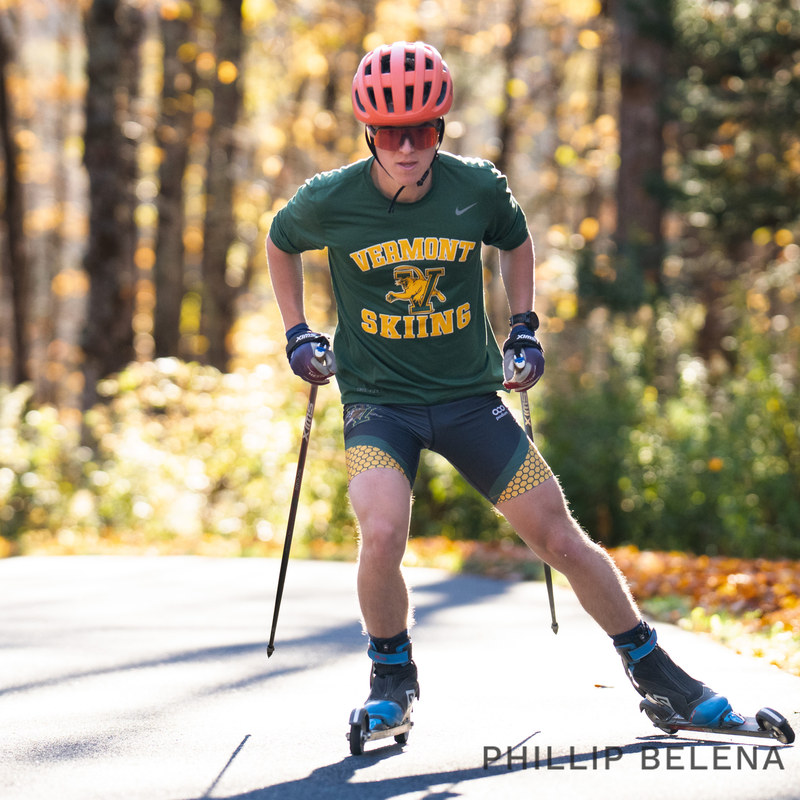
Anders Aukland – tough rollerskiing
30-year old Anders Aukland ended up tenth in last year’s overall World Cup, after several podium awards, especially in classical technique. Since this winter’s calendar is without any Olympic Games or World Championships, the goal is improving to top three in the overall World Cup.
The whole National team is training hard to fill the gap left by retiring star Thomas Alsgaard. New coach Krister Soergaard believes both Aukland and teammate Frode Estil are capable of going all the way to the top this year.
New training methods are being tried out. The women’s team is doing much more intensive training, and the men’s team is searching out harder and longer uphills to rollerski with the goal of building stronger upper bodies. “We come here to find longer uphills” says Aukland, “the hill we’ve used earlier is not long enough anymore”. Up the steepest part of the hill, Aukland is double-poling at a speed of 15 km per hour; skiing up the entire hill of 550 m (1800 feet) vertical elevation takes 50 minutes.
</font><BR></p>
<p><B>Tina Bay – kayaking</B></p>
<p>Tina is building a solid foundation for next season. She is not afraid of heading out on some true tests of strength to improve after last year’s disappointing season. Tina did not qualify for last year’s World Championship, and large parts of the season were lost due to illness.</p>
<p>“This year has gone well so far. Our team’s intensity project is working well for everyone, and this is also the biggest change in my training compared to last year”. </p>
<p>Tina’s philosophy is to build the best possible foundation for fall training and winter racing. “ I think it’s fun to do different things during the summer to build the base ahead of the winter season”.</p>
<p>And this year’s “fun” was to kayak up the bay between Norway and Sweden, from Gothenburg to Halden, about 220 km. “It took us about 42 hours of efficient kayaking over 5 days; we had some strong headwind, and some rough stretches” says Tina.</p>
<p>When she’s not kayaking 42 hours per week, her summer dryland training is about half of that. “My normal weeks are just over 20 hours, with exception of our intensity (project) weeks, when we reduce the volume”.</p>
<p><B>Tor Arne Hetland – overall strong</B></p>
<p>Tor Arne Hetland, the 2001 World Championship Sprint and 2002 Olympic Sprint Champion, wants to be among the three best overall Cross-Country skiers, and one of the most complete skiers, not just regarded as the best sprinter. Next year all sprint races count for the overall World Cup, had this been the case last season, Tor Arne would have ended up forth overall. It is therefore logical that he now becomes one of the favorites for next season’s overall cup.</p>
<p>“ I have ambitions of being top three overall. It means I must ski at least as well in the sprint races, and in addition also score points in traditional distances”, says Tor Arne.</p>
<p>Last season started phenomenally for Tor Arne, also on longer distances. Even though the main focus is still on sprint, it becomes now more important than ever to also ski well on the longer distances. This exact possibility to become the complete skier is enticing for Hetland.</p>
<p>“The overall World Cup becomes very interesting now that all races count. Then you have to be strong in at least two types of races, and also be a complete skier to measure up”.<br />
To be able to score point in an optimal way, Tor Arne would like to be able to choose the races he believes he’ll do best in. During other race periods, where he believes his chances are less, he’d rather stay home and train. This way he means he can stay in peak race shape the whole season.</p>
<p>This summer he is making the foundation for this winter’s results, and Tor Arne is on schedule.</p>
<p>“I have trained consistent and hard with intensive sessions, strength, explosiveness and speed. I try to build a solid base during the summer, and then specialize the training closer to the race season.”</p>
<p>What else does the summer mean for you?<br />
“That I get to train in warm weather, rest and recover between the workouts, and workout in new and varied locations”</p>
<p><B>Frode Estil – running in the mountains</B></p>
<p>Long runs in the mountains are the main ingredient in Frode Estil’s summer-recipe. He is prioritizing running ahead of rollerskiing in the summer heat. “I am prioritizing long runs in the mountains, and feel it gives me better leg strength than what I get from rollerskiing”, says Estil.</p>
<p>He feels this type of training is important enough to justify lots of it.</p>
<p>“I have always believed in this type of training during the summer. I would like to run even more, but I’m only awake 15 hours a day”.</p>
<p>How much training are you doing this summer?<br />
“About 3 hours per day, either one long session or two shorter”.</p>
<p>Any time for vacation?</p>
<p>“Summer for me is being home and training well. I am now up north and own a house that is in need of painting and such. Enough for a few projects other than training.”</p>
<p><BR><img decoding= "Edit/Preview")