
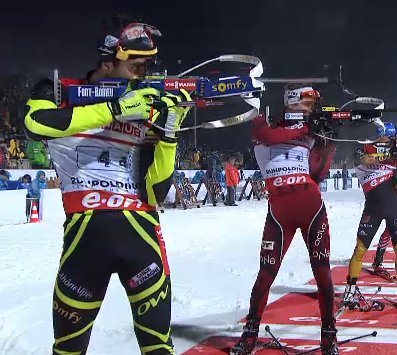
While the women got lucky with better conditions in Ruhpolding, Germany, on Wednesday, the men had new-fallen slush to contend with when it started falling during the second leg of the men’s 4 x 7.5 k relay. With each passing lap the tracks got slower and softer, but in the face of the added challenge one Martin Fourcade prevailed to anchor the French to victory.
Norway, anchored by Emil Svendsen, battled with Austria’s Christoph Sumann for second place and emerged just barely ahead. Norway finished 9.4 seconds behind France; Austria just 0.3 seconds behind them for third.
“I knew that Martin could win once he left the shooting range,” said Fourcade’s brother Simon, France’s scramble leg. “It was especially nice to take some revenge on the Norwegians after losing to them last year. When you have Martin as the last relayer you can always expect a successful day.”
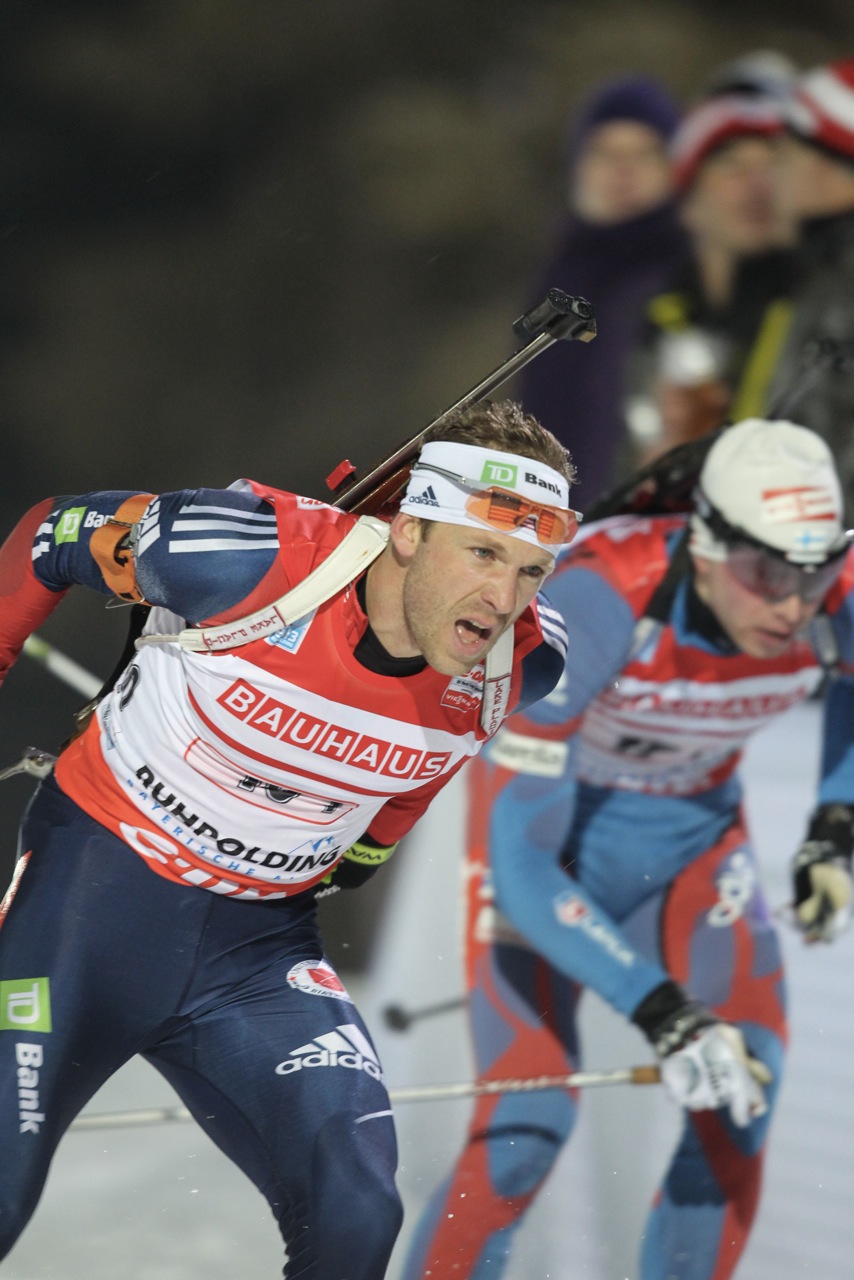
Up until the final 7.5 k it was an incredibly close race. Fourteen leadoff legs shot clean in the prone stage, including Simon Fourcade (FRA), Lars Birkeland (NOR), Simon Eder (AUT), Lowell Bailey (USA) and Jean Phillipe LeGuellec (CAN), and at the first exchange nine teams were practically skiing on top of each other. Fourcade tagged to Jean Guillaume Beatrix in fourth for France and Bailey finished his leg in eighth, and there were less than ten seconds between them.
“I just tried to stay calm during the opening lap knowing that on this range approach, most of the time the entire group comes together after the big downhill and there really isn’t that big of an advantage to coming first as opposed to coming in seventh or eighth to the shooting range,” Bailey said.
During the second leg wet snow began to fall, illuminated in the sky under the Ruhpolding lights. Germany’s Andreas Birnbacher led the train out of the stadium to push through the sloppy course, which had been modified to avoid a particularly sketchy hill. He shot clean in both prone and standing while his fellow leaders began to falter, and the field began to string out.
“It felt a bit different between the first and last lap because of the snowing; the track became very slow. I don’t know if it was more difficult than others, but wax was not the same for every team and some teams were better in the snow and some were not,” Beatrix said, adding that the French wax techs did a good job in the changing conditions
With the second leg the Americans appeared to be on the way to a repeat or better of their Oberhof performance, where the men were fifth. Leif Nordgren skied the best he has all year, and even though he needed three spare rounds between the prone and standing stages, people all around him made comparable mistakes. When he left the range after standing he was in third, and by the time he’d finished 7.5 k and come back to tag Russell Currier, he had moved the U.S. into second.
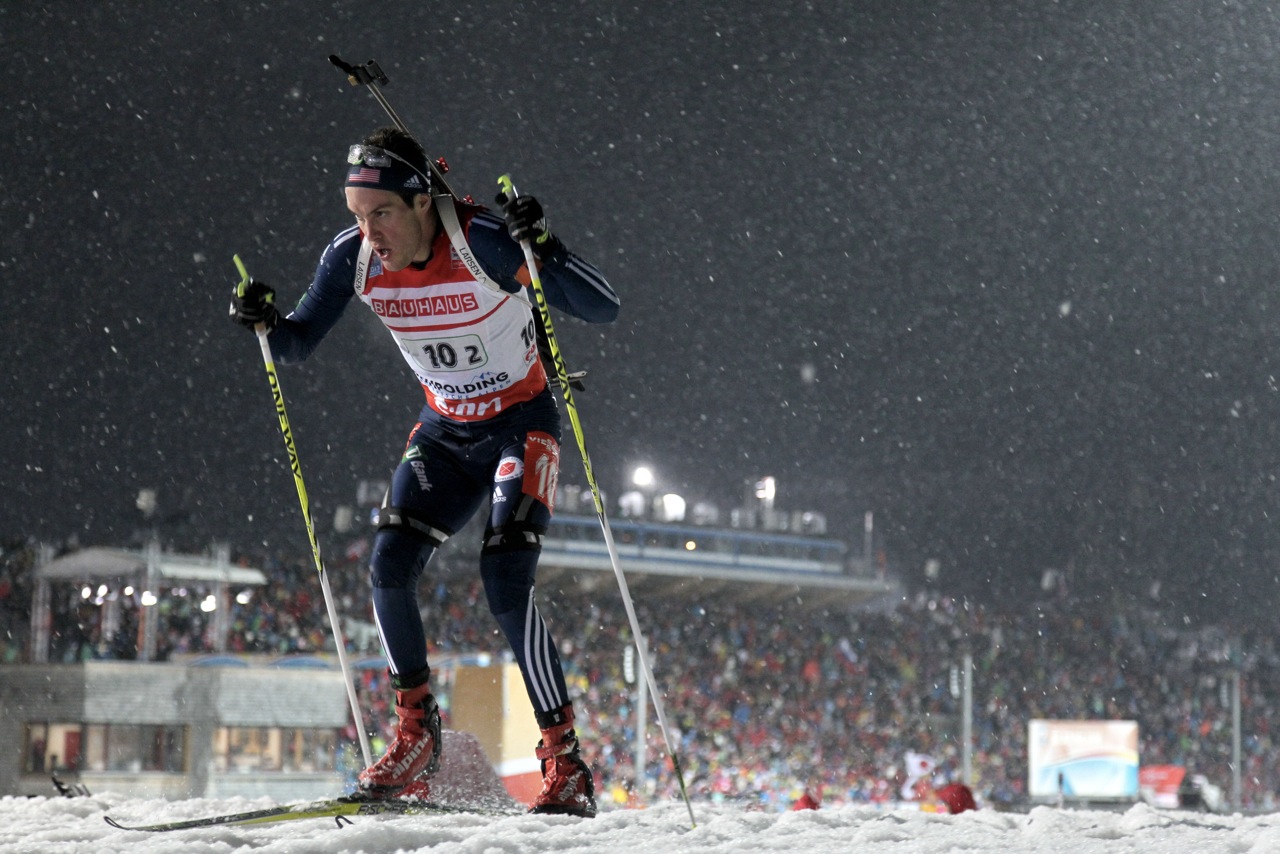
“I had some of the fastest skis I think I’ve ever skied on, and my shape was the best that I’ve had all year so far!” Nordgren wrote in an email.
“I died quite a bit after [standing], I was able to hang on to the group for most of the last loop, but I lost a few seconds right at the end.”