

Brian and Caitlin Gregg have long been known for their superb climbing abilities. Anytime a course features a lot of uphills or there is a hill-climb event, the Gregg name is one to look out for. This is hardly surprising, considering the duo has been hammering out intervals on the biggest hills around Minneapolis, Minn., for years. However, the Team Gregg athletes recently realized they were losing more time in races on flats and transitions, and have adopted a new intensity workout that they do every couple of months to improve that aspect of their skiing.
The first thing they needed for this workout they adopted from a Scott Johnston track exercise was a good loop. It had to be around a kilometer long and also incorporate good, undulating terrain.
“In this loop we have two 180s as part of the loop, one is across a crack, the other is a manhole cover, and then its got some good turns, some technical skiing. So it’s really fun to work on our weaknesses there, and I feel like it’s made a really big improvement,” Brian Gregg said of their 1 k loop.
In order to prepare for the workout, Gregg and his wife, Caitlin, do a 10 k time trial on the loop. During the time trial, they focus on pacing and try to have consistent lap times. After the effort, the Greggs note their average lap time, an important factor for the over under intensity workout.
A few days later, Team Gregg will go back to the same loop with their race pace lap time in mind as well as a threshold pace lap time, which is calculated by adding an extra 10 percent onto the race pace lap time. These two times, which for this example we will say are 2:45 and three minutes, are the lap time goals for the workout.
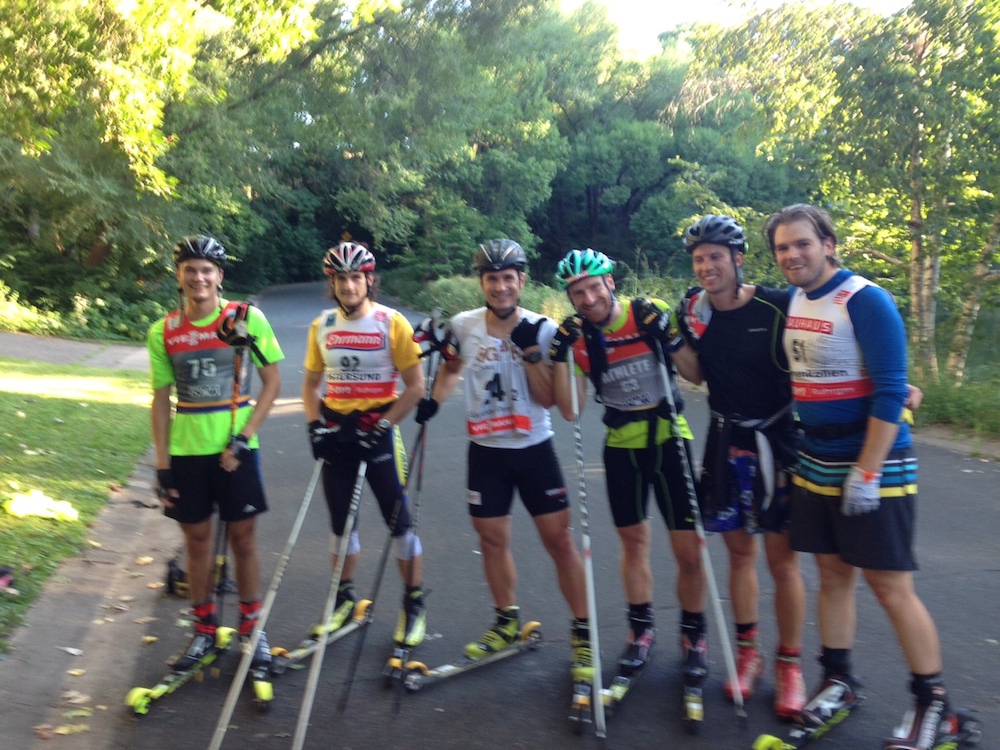
During the over-under-intensity workout, the objective is to ski about 15 kilometers, alternating between threshold lap times (3:00) and race pace lap times (2:45). So for example, Brian Gregg will ski one lap aiming for a three minute lap time, and then on his next lap, he will aim for 2:45.
After that lap he will once again aim for three minutes, going at a threshold pace in order to recover from the race pace lap. The idea is to alternate between slightly over threshold effort and just about threshold effort to increase the body’s ability to recover while still skiing at a relatively high pace.
“The goal is to hit that 2:45 time. So essentially you have a time you are looking to hit, and your goal is to have the heart rate as low as possible during that [loop]. I think it’s really good because all of a sudden the focus isn’t on trying to get the heart rate up, it’s on, ‘How can I hit this time with as little energy as possible?’ ” Gregg explained.