This article was made possible through the generous support of our voluntary subscribers. If you would like to see more articles like this one, please support FasterSkier with a voluntary subscription.

It’s Tour de France season, when the eyes of the endurance sports world turn toward the Alps, the Pyrenees, and the Champs Élyssées. For three weeks in the middle of summer, a field of aerobically gifted, whippet-thin cyclists race endless miles across France, conquering knee-wobbling mountain passes at unimaginable speeds. With these being the best cyclists in the world, it’s understandable that the race is still always decided on the climbs.
Bicycles are popular on the streets of Florida, on the bike paths of Los Angeles, in the cities of The Netherlands. And for one very good reason: those places are flat. It’s both easy and pleasurable to ride a bike where the pedaling is easy and the resistance is low. But professional cyclists in the Tour de France know that the flat sections are not where their living is made. Champions are crowned at the tops of the mountains . . . but, ironically, the “strongest” cyclist is not always the one who wins the. race to the top. That’s because racing bicycles have gears, sets of cogs and chainrings that distribute force differently, depending on the gear ratio, even as athletically-generated torque remains the same. Cyclists know that climbing the hill efficiently and effectively requires a variety of efforts, not just mashing on the pedals until the hill finally ends. They spin when they can, push when they must, stand on the pedals to accelerate or to rest briefly in a higher gear. The bicycle’s gearing allows those times of acceleration, those moments of rest. All the cyclist needs to do is shift gears . . .
Why, then, are so many of us skiers resistant to doing the same? Why is it that so many skiers have a favorite tempo, a comfortable degree of knee bend, a natural placement of their poles . . . and they continue to insist that these represent the most effective techniques for ascending a climb? Why don’t we ever shift gears? It would allow us to change speed, to change tempo, to alter our degree of knee bend, to alter the rhythm and intensity of our pole plants, or to have the rhythm of those pole plants drive our knees forward even a bit snappier. I think there’s a simple reason that skiers almost never shift gears: we just don’t practice it.
How many times has it happened to each of us? We assess the hill ahead of us, applying power to poles and ski pushes, confident in our ability to accelerate over the top, only to discover that the hill is actually a lot longer than we estimated. Now, mid-hill, all momentum stalls as lactic acid overtakes ambition, heart rate ponds through the roof, breathing gets raspy and desperate, speed slows to a crawl, and our once-beautiful hillclimb becomes just another ego-tarnishing slog to the top. Hitting a hill just right is a dream come true. Hitting it wrong is kind of a nightmare. The solution—often as not—is to be found in the strategy we choose at the base of the hill rather than the fitness we rely on at the top.
Spinning
Even the shortest cross-country ski races are pretty long—certainly long enough for skiers to experience oxygen debt (do we still call it that?) and the debilitating accumulation of lactic acid. And once those disasters occur during an endurance event, it’s nearly impossible to get your form back (especially in a sport as reliant on efficient technique as cross-country skiing). As athletes, we tend to think that the only way to avoid such consequences is to solve the situation with fitness. But there are racers among us who refine additional techniques to maintain momentum on the challenging parts of any race course. They don’t ski themselves into a lactic acid hole because they spin.
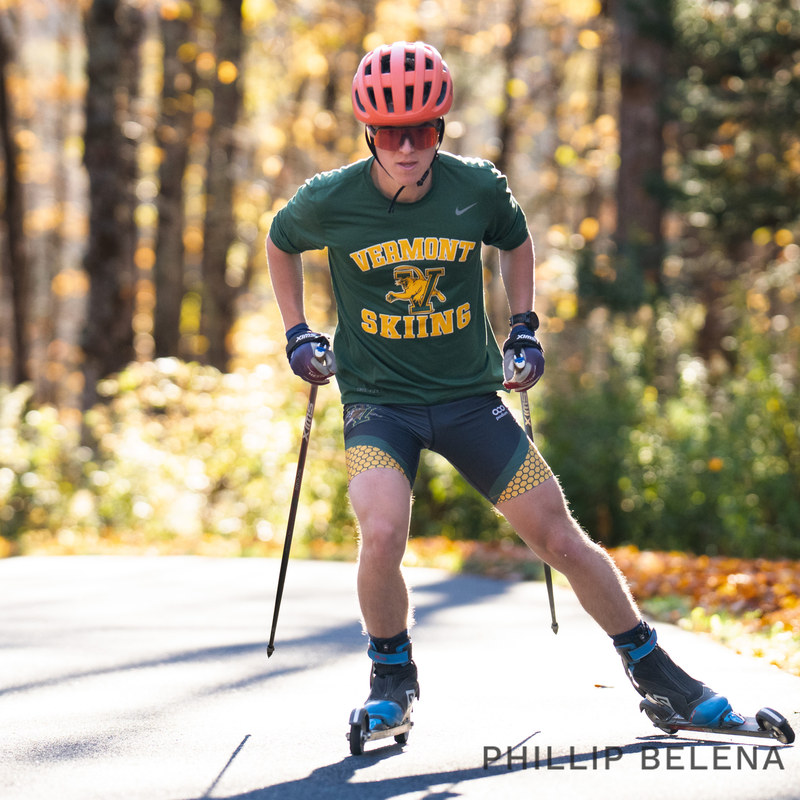
Like a cyclist shifting into an easier gear, skiers can establish a quicker, lighter tempo as they approach the bottom of the hill. Keep it quick, keep it light. You’re shifting gears, not increasing output. The goal on each hill should be to carry the quicker, lighter tempo as far as you can before committing to the power that will drive you over the top. In accomplishing this technique, nearly everything changes a bit: pole plants are shorter and closer to the ski edge, elbows remain even closer to the body, pole follow-through is abbreviated, the step up the hill is shorter (with the knee doing the leading, not the foot), any toe push-off is lessened (or eliminated).
And the breathing pattern/tempo? It can no longer match the tempo of your strokes in the same way. The habit many of us follow is to exhale on one push and inhale on the next, but the increased tempo of our strokes will also increase the tempo of our breathing (which will, in turn, increase heart rate). There’s a solution—more about breathing patterns in a subsequent article.
One way or another, the hill we climb often goes on longer than our eyes suggest it does—and often longer than that for which our fitness provides a solution. If my strategy is just to put my head down and grind, then the hill will often get the better of me. And recovering from such hubris in the middle of a race will prove difficult if not impossible. Far better it would be to shift gears before the hill becomes a problem, and to make up for any surrendered speed by charging over the top and down the other side.
John Teaford
John Teaford has been the coach of Olympians, World Champions, and World Record Holders in six sports: Nordic skiing, speedskating, road cycling, track cycling, mountain biking, triathlon. In his long career as a writer/filmmaker, he spent many seasons as Director of Warren Miller’s annual feature film, and Producer of adventure documentary films for Discovery, ESPN, Disney, National Geographic, and NBC Sports.