After son’s fourth straight gold in Italy, Klæbo’s father says “we’re just having fun”
Nathaniel Herz · February 15, 2026
This article was made possible through the generous support of our voluntary subscribers who have helped put our Nat Herz on the ground at the Olympics. If you value coverage like this, please support FasterSkier with a voluntary subscription.
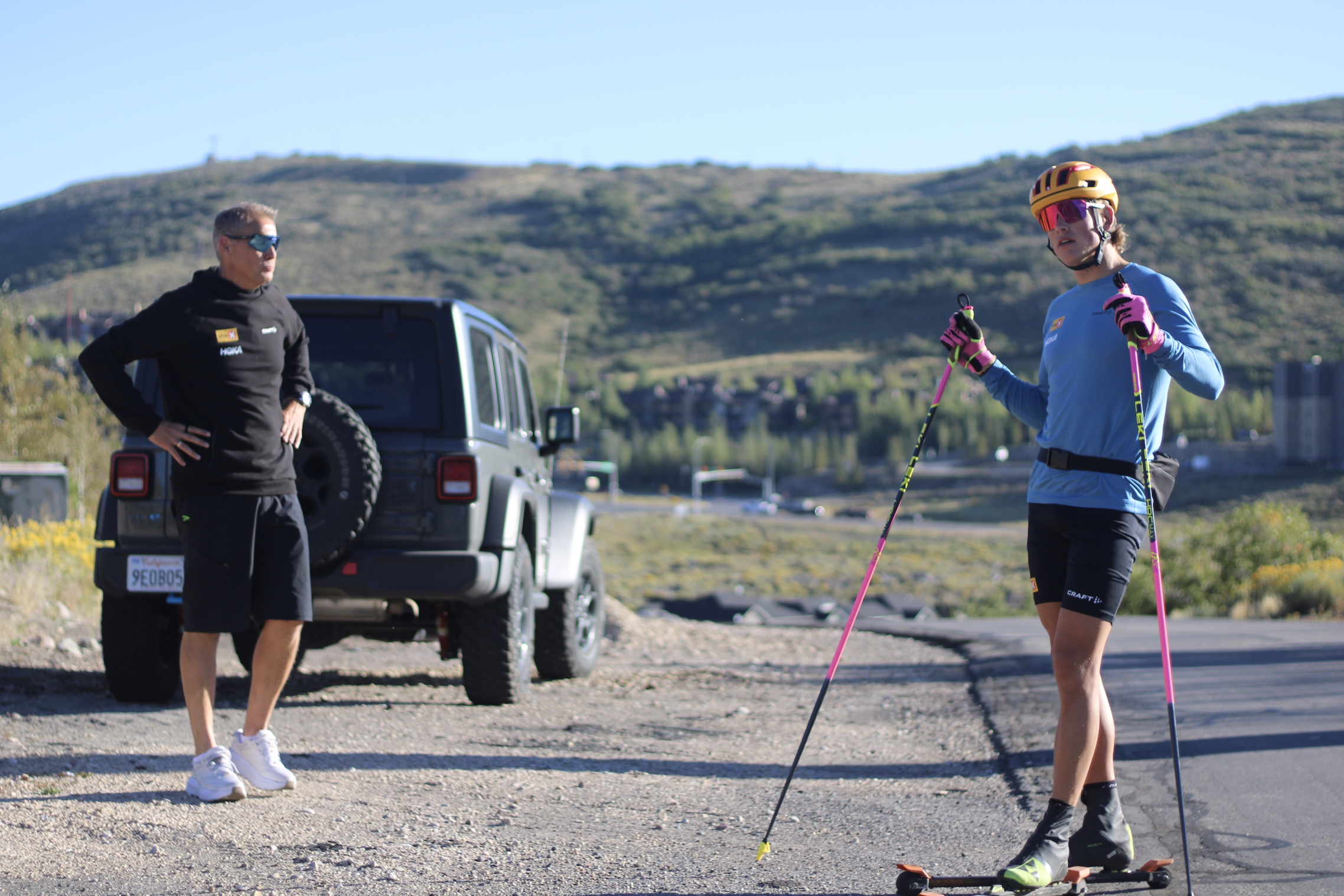
Johannes Klæbo stands with his father, Haakon, during a water break on a rollerski workout in Utah in 2023. (Nathaniel Herz/FasterSkier)
PREDAZZO, ITALY — Johannes Høsflot Klæbo is four for four — and officially the most golden Winter Olympian in history.
By anchoring Norway’s relay team to first place Sunday, Klæbo claimed his ninth Winter Olympic gold — moving him out of a tie, with two other Norwegian cross-country skiers and a Norwegian biathlete, for the most ever.
At a news conference afterward, Klæbo said he’d been drained by the effort it took to win Friday’s 10-kilometer individual start skate race — the first time he’d ever won an event in that discipline.
The next day, he said, “the only thing I did was lay in the bed and play on my PlayStation.” But by the time he woke up Sunday morning and checked his heart rate, he said, “it looked pretty good.”
After Sunday’s relay win over France and Italy, Klæbo is now poised to win the last two cross-country events at the Games, both of which — a team sprint, and a 50-kilometer mass start race in the classical technique — favor him.
At the news conference, he said he’s still taking it one day at a time. “We’ll see where we end up at the end,” he said. “But it feels, so far, so good.”
In search of some more revealing answers, we went looking for Klæbo’s father.
Haakon Klæbo, for the past week, has been a ubiquitous presence at the Olympic cross-country ski venue, watching races with the masses alongside the race trails with friends and family. We found him walking alone behind the stadium — where he was happy to answer a few questions before others broke in.
Nathaniel Herz: Are the Olympics a platform where Johannes is starting to go from a Norwegian to a global star, with these viral videos of him running up the last hill in the sprint race?
Haakon Klæbo: Yeah, it looks like at least it is. It is a huge interest in him. Olympics is really big in the U.S. But I also think that more U.S. citizens are learning how much time he spent there. He’s linked with (Utah physiotherapist) Megan (Stowe). She is really the one that has made his strength program, which is — it’s not that it’s secret, but if you look into it, he’s doing a lot of core strength. This is a program that he also follows at home (in Norway).
NH: How nervous were you for the 10-kilometer skate race two days ago?
HK: I was really nervous for the 10 k, and I knew that it was his weak point, or Achilles, in a way. We have to remember that he has never won a 10 k skate before, never — and this is in his whole career. I think that he has been in good enough shape, but this has been something in his head — and something that if you do not accomplish, it starts to become even more problematic.
Devon Kershaw, a retired Canadian World Championships gold medalist in cross-country skiing, who’s working as an expert TV commentator at the Olympics, walks up: Congratulations.
Herz, to Klæbo: You know this guy?
HK: No.
NH: This is Devon Kershaw.
DK. Congratulations, it’s been quite the show.
HK: Oh! Yeah — it is a little unbelievable, because you don’t expect it. And we had these crazy days in (the World Championships in) Trondheim last year, in which were hoping for like two or three (medals). (Klæbo won gold in all six events.)
And now, with four.
NH: Do you think going through this whole Trondheim experience last year is making this a lot easier for him now?
HK: Yeah. He had been training for that since he heard Trondheim would host the World Championships, and he has been the front figure. They used him (in their marketing materials), saying, ‘Born and raised.’ He’s standing there, like 18 years old — he had one pair of Leki ski poles at that time. He was wearing a suit that he had borrowed from a friend that was on the team. He was like, ‘This is my dream.’ And then he managed to do it. So, I think he was really stressed for it.
This season, it has just been fun. We’ve been together with (teammate and friend) Emil (Iversen). Me and him and Emil have been traveling around — it’s like being there with two boys playing around. So, I think he’s really much more relaxed. And you can see, also — I think he is even stronger, here, if you look at his sprint.
DK: I agree with you, 100%. Everyone made such a big deal of it, but winning the individual start skate. That’s the biggest thing to me, as a fan and a person that raced his whole life. I’m getting goosebumps thinking about what I saw two days ago. When you win that, then you’re really the king.
HK: And I said to Nathaniel that I think that he has been strong enough to do it for years. But it has been something up here (points to his head). He’s never won it.
NH: Do you think that’s his best accomplishment ever?
HK: Yeah, I think it is. And he was really tired after — he has been working really, really hard. I was afraid for this relay today — that he wouldn’t be able to run, because I think he put so much into the 10k. So much energy spent.
Johannes Høsflot Klæbo celebrates one of his four Olympic gold medals in Italy. (Davide Barbieri/NordicFocus)
NH: Was he at a disadvantage being first, in this individual time-trial style race, of all these Norwegian guys? That meant that he wouldn’t get as much information on the course from his coaches about how his times compared to the others.
HK: Actually, his best races from skate individual start are when he is just doing his own thing — just making his own pace, and doing what he’s good at. You could see that for the others, it was a disadvantage. I think, for (rival-teammate) Einar (Hedegart), it was trying to push on Johannes’ time (that was the problem). If you look at the two of them, racing, they’re pretty similar in taking it a little slow in the first two kilometers. Then starting to get faster and faster and faster, and having a crazy second half.
I think that that was what made Einar lose the silver. He pushed too hard — and he got burned and he lost 20 seconds in the last 1,000 meters.
NH : Will you be very stressed about the 50 kilometer race, the last event? Or do you feel like, once you get to the 50 k, so much has already been done that you can relax a little.
HK: The 10 k was what I was really afraid of. And now, I don’t know — we’re just here here enjoying and having fun. And then, everything can happen. And even if he is getting sick tomorrow, we’ve had four gold medals, and you’re the best Winter Olympian — and still, you can race for another Olympics. I think if you ask him, his dream Olympics would be to do a 50 k in Soldier Hollow (in Utah) — which is his home.
A middle aged fan carrying a Finland flag breaks in, screaming: “Klæbo! Klæbo! Number one!” The fan demands a photo, then ushers Klæbo away.
Help Support Our Olympic Coverage!
FasterSkier will have our own Nat Herz on the ground at the Olympics, which, to be honest, is a very big financial lift for us. If you value the thoughtful work and access FasterSkier provides at championships like this one, please consider becoming a Voluntary Subscriber. Your support directly fuels the work we do to cover the people, places, and moments that make our sport special.