Cross-country skiing demands stamina, coordination, and resilience. It’s not always easy to balance developing those skills with the demands of “real life”: work, family, and other commitments. But should you spend all of the time that you do have on improving your skiing directly, or cross-training?
For cross-country skiers, cross-training might include strength training, martial arts, running, cycling, swimming, roller skiing, tennis, and any number of other activities. Is such variety necessary, or even beneficial? The answer depends on how cross-training is planned and how well it supports the specific demands of skiing.
Pepa Miloucheva (l), head coach of the Craftsbury Green Racing Project, giving biathlete Susan Dunklee some sculling instruction at the Craftsbury Outdoor Center in June 2012. (Photo: Susan Dunklee)
Cross-training
As a skier, you’ll know that your aerobic endurance, upper body strength, and lower body strength are all challenged. Skiing requires efficient technique, balance, and the ability to sustain effort across varied terrain. Amateur skiers often have limited on-snow time, especially if they live in areas with short winters. Cross-training can help fill those gaps.
To develop your aerobic capacity, running, cycling, and rowing (for example) develop the cardiovascular system in ways that transfer well to skiing. These all allow skiers to maintain or build endurance during the off-season and during periods when snow conditions are not ideal.
Without strength training, you might plateau or risk overuse injuries. Resistance exercises like squats, lunges, pull-ups, and core work can improve power and stability. Even bodyweight routines performed at home can make a difference.
Cross-training can also provide mental variety. Repeating the same workout can lead to boredom, especially if you’re training alone (though some people enjoy the solitude). Mixing in new activities keeps motivation high and can help athletes stay consistent in the long term.
The principle of cross-training isn’t limited to physical sports. In many strategy-based activities, participants also improve by practising related formats that challenge similar skills. Poker players, for example, often sharpen their decision-making and probability assessment by playing other card games that require reading patterns, managing risk, and adapting to changing situations. This kind of variation helps develop the underlying skills that apply across multiple games, just as cyclists or swimmers might build endurance that later benefits their skiing performance. Players interested in exploring how different online card and casino games are structured can learn more about the platforms available to Canadian users, including how game formats, security standards, and payment systems vary between sites.
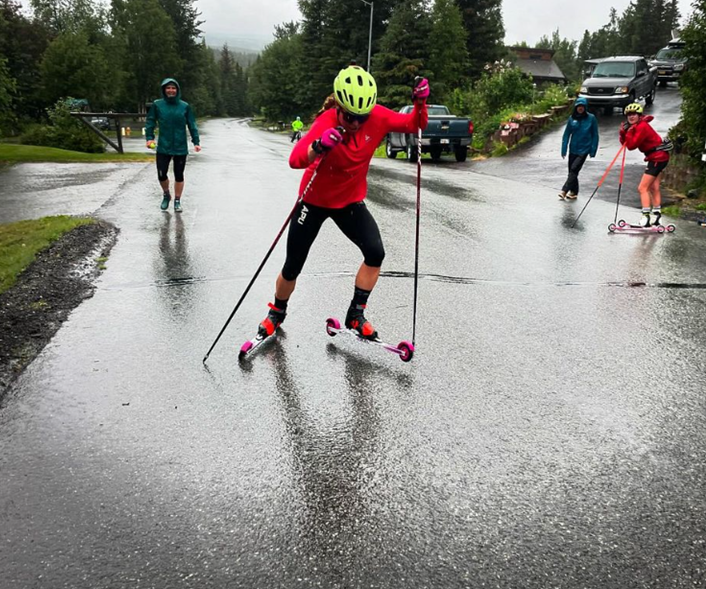
On snow or rollerskis, Brennan just keeps grinding away. (Photo: Rosie Brennan)
Types of cross-training that support skiing performance
Not all cross-training methods are equally useful. The most effective options mirror the movement patterns and energy systems used in skiing.
Roller skiing might be the closest substitute for on-snow training. You can practice technique, balance, and poling mechanics during the off-season. It requires specific equipment and safe pavement, but the skills transfer well.
Trail running echoes the varied terrain of many courses. Anyone who’s run up hills knows the cardio and strength demands. Downhill sections can help improve coordination and control.
Cycling is a good, low-impact way to build aerobic capacity. If you’ve had knee or ankle issues, it can provide endurance benefits without the repetitive pounding of running.
Swimming is good for the upper body and also promotes active recovery. It doesn’t replicate skiing movements very closely, but enhances lung capacity and muscular endurance while reducing stress on joints.
Julia Kern biking up New Hampshire’s Kancamagus Highway at a recent training camp. (Courtesy photo)
Managing injury risk and recovery
Professionals have dedicated coaches and medical support, but injury prevention can be trickier for amateurs. Cross-training can reduce overuse injuries by distributing stress across different muscle groups and movement patterns.
Skiing relies heavily on repetitive motions. When training consists only of skiing or ski-specific drills, certain muscles and joints bear the brunt of the workload.
Low-impact cross-training is particularly useful during recovery from minor injuries. For example, a skier with shin splints from running might switch to cycling or swimming to maintain their aerobic conditioning. Strength training can also address muscle imbalances that contribute to recurring issues.
Amateur athletes often underestimate the importance of rest days. Cross-training shouldn’t mean training harder every day. Light sessions such as easy swimming, gentle yoga, or tai chi can serve as active recovery, helping muscles repair while preserving mobility. Tai chi and yoga can also reduce inflammation and stress.
Active recovery differs from passive recovery – what you might think of as sitting on the couch. Passive recovery is important if you’re injured or in pain. You might also benefit from simply staying still if you’re particularly tired, either mentally or physically. A draining competition after much excitement and adrenaline leading up to the event, for example, might call for a more sedentary day (or days).
In short, a good approach to cross-training involves considering the skills you most need to improve, your physical and mental readiness, and your available time.
Disclosure
Press Release
Publishing press releases is a service we offer to the ski community, so please note these articles are not written by FasterSkier and therefore do not necessarily represent our thoughts and standards.




Comments
Commenting policyJoin the conversation. Comment and react with your Endurance ID — one account across the whole network.
Loading comments…