
This article was made possible through the generous support of our voluntary subscribers. If you would like to see more articles like this one, please support FasterSkier with a voluntary subscription.

I want to highlight a comparison between how we trained in the late 1970s and 80s, and what we now consider best practices. I’ve reviewed some old training logs to refresh my memory, though with time, those memories fade.
I started unstructured training around the age of 14–15. At the time, there was nothing like the coaching we have today, so I relied on advice from people like John Caldwell, who lived just up the road in Putney, Mike Gallagher, and others. I did some roller skiing, running, and a bit more biking. There was no such thing as intensity control, we just went out and trained as we felt. I’m pretty sure it was never easy.
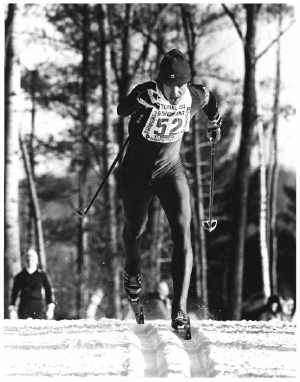
From 1974–1980, when I entered the international race scene, my training was far from random but not as structured as it could have been. I often did double workouts. In the spring and early summer, I rode my bike 50–60 miles a day, with many races in May-June and July, later in the summer shifting toward mostly running and roller skiing.
When I trained with others, Bill Koch, Tim Caldwell, Stan Dunklee, and others, we’d do group bike rides. Wednesday afternoons often meant 50–60 km roller skis, ending at the Caldwell’s for a sauna. These long skis weren’t easy, they tended to start easy-to-moderate and finish hard. For a couple of years Bill and I also had a weekly summer pilgrimage to Mt. Greylock where we’d roller ski both sides of the mountain: the first side as a warm-up building to moderate intensity, the second side at race pace. Sundays were often reserved for long runs or run/hikes in the mountains.
Other memorable workouts included running up Mt. Wantastiquet with weighted packs (about 20 lbs., if I recall) and weekly hill climbs on skis in a pine forest at Bill’s home in Guilford. That hill took about 10 minutes, and we’d break it into three sections of very high intensity, gliding down between efforts for recovery. We also experimented with roller ski resistance, wrapping O-ring material around the inner axle and packing it with grease to slow them down. It worked great until we hit rain, the grease washed away, and the O-rings burned up.
The Shift to More Systematic Training
My real training started around 1974 (age 18) and developed over the next decade. In 1980, after some disappointing Olympic results, including skiing in the top 5–7 for 45 km of the 50 km before completely blowing up and literally walking the last kilometer or two to finish just inside the top 20, I realized I needed change. That and a few other 50 km meltdowns were, in hindsight, the result of not knowing enough about pre-race nutrition and in-race fueling.
At the Olympics, I connected with Lennart Strand, who suggested that if I trained more systematically, I could be competitive in the World Cup. That was the start of a new chapter.
From that point forward, my training became more straightforward: 4–5 days a week of double sessions, roller skiing (primarily double poling) and running. There were usually two hard sessions per week, plus weekly speed work, a long roller ski, and a long run. High-intensity sessions were almost always in the second workout of the day. In summer, I also ran 2–3-foot races a month, building them into the training plan as one of the week’s hard efforts.
In fall and winter, the pattern was similar, but with much more skiing time. I was always on snow by mid-October, either at Hatcher Pass, West Yellowstone, or in Sweden at joint camps with the Swedish team. Those Swedish camps should have been a wake-up call, I was skiing much faster in training than legends like Wassberg, Ottoson, and Eriksson, but it didn’t register yet.
The Implementation Problem
For the time, my training plan was fine, but the execution left much to be desired. Heart rate monitors arrived in earnest around 1983–84. Even then, we didn’t fully understand how to use heart rate effectively for training control.
I have dozens of old workout printouts showing most of my distance training at 150–160 bpm when it should have been 120–140 bpm. The result? Chronic overtraining. When I was “on,” I was very good, but just as often, I was way off and terrible. My performance cycles were 2–3 weeks “on,” then a month or more “off,” with no predictability.
For intervals, my heart rate was 88–92% of max. In races, when rested, I could sustain 92–95% of max. My basic endurance training often ran at 72–80% of max. Today, we know my high-intensity training was fine for adaptation, but my endurance work was much too hard, above the intensity range where optimal aerobic adaptations occur.
One example of what’s possible when rested: In May 1985, I raced the Anchorage “Sixty-Minute Challenge” alongside Bill Rodgers. My goal was to cover 12 miles in the hour, a 5:00/mile pace. When the hour ended, I was about a minute short. My average heart rate was 192 bpm, well above what most would consider sustainable for that duration. That contrast between performance when fresh versus fatigued still stands out.

My Takeaways
The biggest issue in my training was the excessive intensity of my basic endurance work. My speed training and intervals were extremely effective, and I particularly benefited from short to medium intervals (30 seconds to 3 minutes) and very fast speed work. As I often say, it’s the intensity of endurance training that creates the slow, long-term burn of our energy reserves, undermining performance. Overdoing high-intensity work shows up immediately in poor results; overdoing endurance work is a slower burn that only becomes obvious when you’re already buried.
Then vs. Now — Not That Different
- The basic principles haven’t changed much. While our understanding of intensity control has greatly improved.
- Intensity control in endurance training is still the key variable because it makes up most of the training volume. My coach often told me to “let the duration, not the intensity, fatigue you” in endurance sessions, but my focus on technique and movement often overrode that advice.
- I did a lot of bike riding in the early years and maybe more of that should be added to training today. We know it appears to be the latest fad in the elite running world.
- Fewer, longer, controlled endurance sessions might have produced better aerobic gains.
- My biggest mistake wasn’t in the speed or interval work, it was not having the confidence and discipline to go easy enough in the basic endurance work.

Jim Galanes
Coach, competitor, correspondent, commentator—Jim Galanes has spent a lifetime on cross country skis, always serving as a keen observer of our sport. A three-time Olympian in both Cross-Country and Nordic Combined, Jim has tested the theories, initiated the instruction, assessed the results. Now, FasterSkier is thrilled to announce that Jim joins our staff of writers and contributors, adding his unique and time-tested insights to the editorial offerings of this publication.