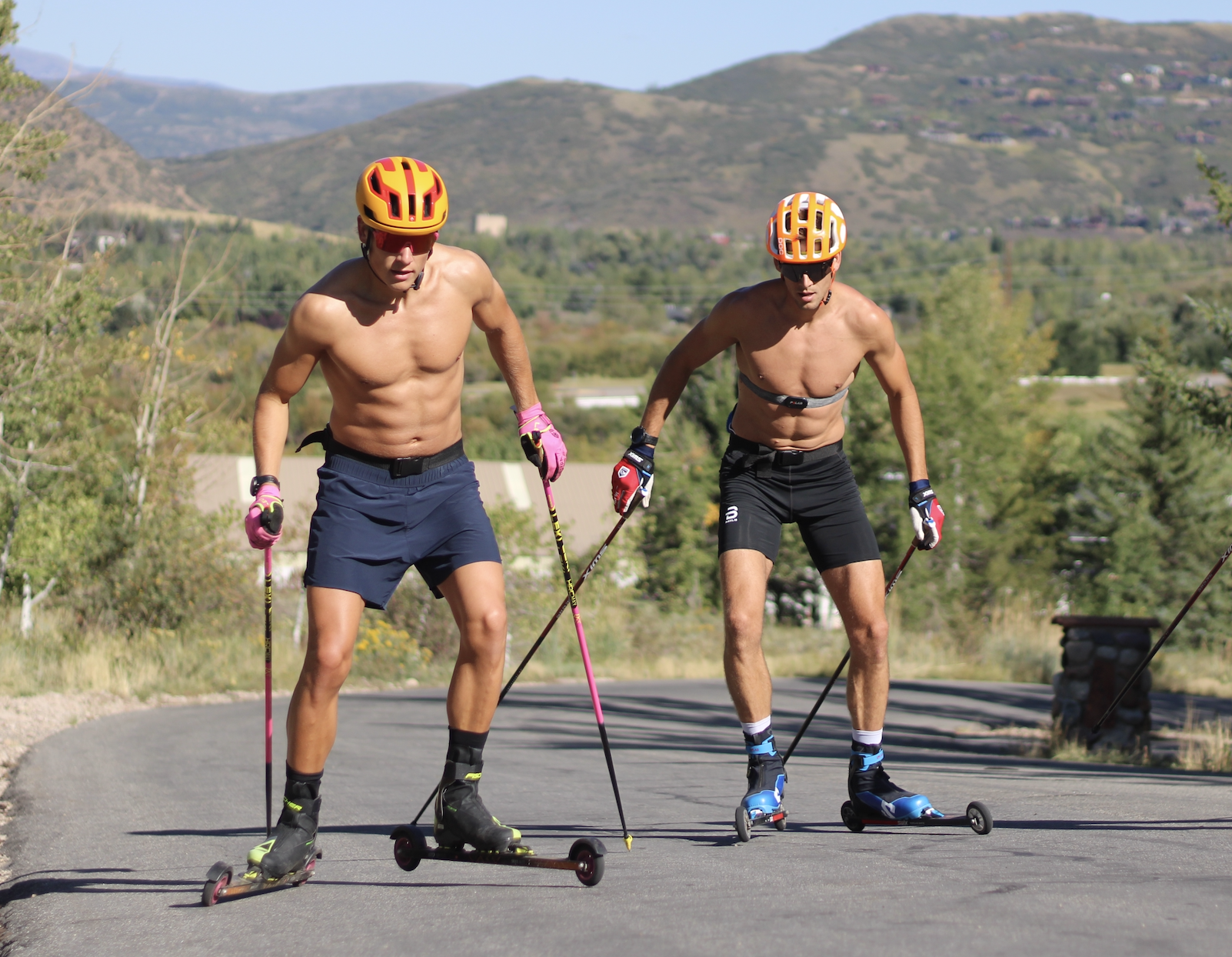
Johannes Klæbo and Kevin Bolger rollerski together during an easy workout in Park City, 2023. (Nathaniel Herz/FasterSkier)
I regularly share my thoughts on training through various social media platforms. My goal is always to spark discussion and share insight from decades of experience and study. But what I’ve noticed over time is that people often read between the lines and make erroneous assumptions that simply aren’t accurate.
Some suggest I don’t value high training volume. Others think I advocate only for easy training or that I always train in 2-3 day blocks. None of these assumptions reflect what I actually suggest. What I am advocating for is an approach to training that is grounded in science, proven in practice, and simple enough to serve as a durable foundation for long-term progress. Meaning, we need to be able to easily observe what works for each athlete.
Often, these posts lead to meaningful conversations that benefit everyone involved. Just last week, I shared a TED Talk by Stephen Seiler, whose work I have highlighted many times before. Some may disagree with me, or Seiler or any other views out there, but from my perspective it is important to be curious and see if there is something we can learn from others knowledge or experience. My goal is to demystify training. While physiology is complex, the more complex we make training especially for young people the more likely we will fail in the implementation and not truly see what works.
I’ve competed at the highest international level and made nearly every mistake in the book. I’ve read the studies, written some myself, and coached hundreds of athletes. And I’ve seen firsthand how many of our training habits in the U.S. Can do more harm than good.
What Is Training?
We often hear that training is about creating stress, breaking down, so the body can rebuild stronger. But in practice, this has morphed into a “more is better, harder is better” mentality.
I look at it differently.
Training should be about building, not breaking down. Done correctly, most (70–80%) of your workouts should be easy aerobic work, developing the physiologic structures and pathways that make you more efficient: capillaries, mitochondria, cardiovascular and respiratory systems. The remaining, workouts, (20–30%) can stress these systems to push capacity, but only as much as the athlete is prepared to absorb.
There’s ample research showing that when the bulk of training is done too hard, we blunt the positive effects we’re trying to create.
Johannes Klæbo, Kevin Bolger and Maja Dahlqvist rollerski during an easy workout. (Nathaniel Herz/FasterSkier)
How Much and How Hard?
I don’t discuss hours, well I do but only to frame a discussion. The duration a day, week, month, or year is inadequate when it comes to measuring training and how it is implemented. What matters is training load of each session which is function of both intensity and duration.
Using tools like Firstbeat analytics, or other platforms, we can track training loads against recovery. What I’ve seen is this: only small differences between the acute load (7-day) and chronic load (28-day) can be effectively adapted to. A ratio of 0.9 to 1.2 keeps things progressing steadily. Although in some periods it may not be appropriate or necessary to increase the load at all. We still can see improved fitness through the compounding effect of day-in-day-out training. Go beyond that, and the risk of illness, injury, or long recovery times increases dramatically. In those cases, the training may inhibit adaptation rather than stimulate it.
What Kind of Training?
As I said, I think we need to make training, especially for juniors and masters as uncomplicated as possible.
70–80% of all workouts (not time or distance) should be easy, at <70% of max HR, typical range 60-65%. Some may use lactate, VO2max test or other measures to determine this control point. I am far from convinced these are necessary except perhaps in the case of elite athletes.
20–30% of workouts should target strength, speed, and high intensity.
Going harder in endurance training doesn’t mean more benefit. In fact, it may interfere with aerobic development due to metabolic shifts.
For aerobic development, long sessions are more beneficial than more shorter sessions.
The effects of aerobic training, structural adaptations, improved energy production, are best achieved at 60–70% of max HR. That does not mean we peg our intensity at 70%, rather that is a ceiling, and we spend the majority of our training time well under that.. . High-intensity work has its place, but its dose and density must be proportional to the total aerobic volume.
The high intensity work can be spread across weeks and must evolve as the athlete progresses. Most juniors can handle 1-2 high intensity sessions per week, but the dose need not be that high. For juniors especially, I recommend 1–2 speed workouts per week focused, not sprinkled into endurance work. These sessions might include 5–6 x 20 seconds (1-2 sets) at max speed with 3–4 minutes of full recovery. Each rep should be all-out, with effective technique, with full recovery to ensure quality.
Julia Kern enjoying Davos sunshine while strength training on the road. (Photo from Kern’s IG)
Strength and BFR
Strength is a key pillar of endurance performance. We’ve had great success with both traditional lifting and BStrong BFR (blood flow restriction) training. BFR allows athletes to safely develop strength and aerobic capacity with lower mechanical stress and far shorter recovery time. It’s especially effective for athletes who need to maintain strength gains while managing endurance training load.
Eliminate the Junk
Get rid of the gray-zone training, what I call Level 2-3, where you’re working too hard to get the metabolic aerobic benefit but not hard enough to get effective aerobic capacity adaptation. It’s high risk, low reward. For elite athletes, as we see today, high intensity training just under the so called anerobic threshold may be beneficial. But this is primarily for athletes with a well-developed VO2max and high fractional utilization.
On “Overtraining”
Some argue that I talk too much about overtraining, or that I discourage hard work. Let’s be clear: I’m not suggesting that elite athletes don’t need to train hard or often. I’m saying that training must be done right, and monitored closely, to be effective.
Overtraining isn’t just about high volume. If an athlete is tired all the time, stuck at a plateau, or far off their best on race day, they’re probably training wrong, over trained. I’ve seen it firsthand. One athlete came to me training 4–5 days per week, with a very high proportion of Level 3, as much as 50-60%. They were stuck and too tired to improve. That’s junk training, and it gets you nowhere, other than broken, ill or tired.
Should Juniors Train at Level 1?
Yes, but here’s the nuance. I’ve tried many ways to improve juniors’ movement velocity at low intensity. Letting them train by feel didn’t work. Adding more speed training helped, but not dramatically. Finally, with guidance from top physiologists, I tried the unthinkable: I had them ski walking before the heart rates reached the top of Zone 1.
Why? Because aerobic efficiency wasn’t there. Without it, the body ramps up anaerobic energy production even at low speeds. And if you don’t take the time to build aerobic efficiency, the problem persists and compounds.
In my experience, correcting this requires 2–3 months or more of systematic and disciplined easy training. The reward? Stronger aerobic foundations and sustainable improvements in pace and performance.
Data and Monitoring Matter
Data tells the truth. It shows how training is implemented, how much load is being absorbed, and what works, or doesn’t, for each athlete.
I often hear people say athletes need “X” number of hours to succeed. But one hour of training isn’t always the same. I’ve seen juniors train 8–10-hour weeks that were so load intensive they produced the same load as 12–16-hour weeks of well-structured training.
Similarly, I’ve seen athletes go to camps and train 20–25 hours in a week, too much, too hard, with no time to adapt. That’s not training, it’s load dumping. The benefits of these big camp weeks for juniors are far gone before they ever recover.
At a recent camp, some athletes logged a two-hour ski. But when I reviewed their data, they’d stood still for 25–30 minutes. That’s not a two-hour session. Add in that the moving time was too hard, and you’ve got a workout that’s ineffective on multiple levels, too short for structural adaptation and too intense to be metabolically beneficial.
Final Thoughts
The key to effective training is the discipline to implement correctly, individualized approaches, and the athletes understand the intent and objective of the workout. Focus on building, workout upon workout, not breaking down. Develop aerobic efficiency, go easy even if it feels stupid. Respect training load don’t try to increase loads too fast. Eliminate the junk. Monitor progress. And above all, stay patient and consistent.
That’s how you create a training process that leads to long-term performance, health, and, just as important, enjoyment.
Coach, competitor, correspondent, commentator—Jim Galanes has spent a lifetime on cross country skis, always serving as a keen observer of our sport. A three-time Olympian in both Cross-Country and Nordic Combined, Jim has tested the theories, initiated the instruction, assessed the results. Now, FasterSkier is thrilled to announce that Jim joins our staff of writers and contributors, adding his unique and time-tested insights to the editorial offerings of this publication.