The Life That Grew Our Sport: John Caldwell, 1928–2026
Jim Galanes · March 3, 2026
John Caldwell, born November 28, 1928, passed away February 27 at 97 years old. John’s contribution to cross-country skiing in the United States is unquestioned.
John Caldwell, November 28, 1928 — February 27, 2026. (Photo: Robert George)
He was a 1952 Olympian in Nordic Combined. He wrote several books on cross-country skiing that became our training guidance, our bibles, in the early and mid-1970s. He was a long-time teacher and coach at The Putney School, an early U.S. Ski Team coach, and a member of the coaching staff at the Winter Olympics in 1960, 1964, 1968, 1972, and 1984. In the mid-1990s he founded the New England Nordic Ski Association (NENSA), stepping in to fill a regional void the U.S. Ski Association had abandoned at the time.
That’s the high-level resume. But that doesn’t capture what happened. It’s beyond me to catalog everything John did for the sport. What I can offer is a personal perspective, what it was like to grow up skiing with his influence.
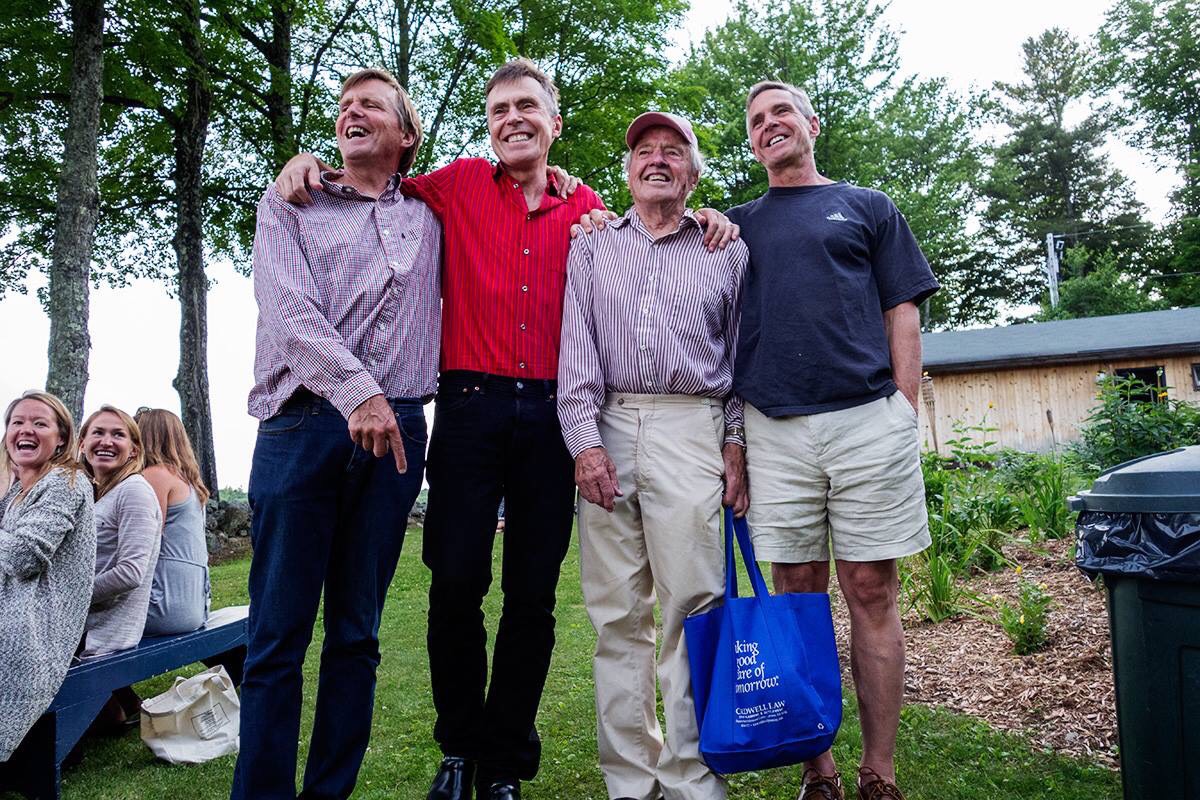
Left to right: Jennifer, Peter, Sverre, Tim, Hep, and John. (Photo: Courtesy Image)
My earliest memory of JC was driving to Putney with my dad to buy a pair of skis from him. Later I saw him at the Washington’s Birthday races, local races in Putney, the Samsonite/Dannon Series, and the night races of the late ’60s and early ’70s.
In 1967 or so, John reached out to Inga Löwdin in Sweden to bring women to the U.S. to race. That exchange helped spearhead women’s skiing in this country, particularly the career of Martha Rockwell, then a student at Putney. In the early ’70s he also brought Norwegian skiers over to compete in what was then a surprisingly robust night race circuit in the Northeast.
I’m not sure he was thinking in terms of “athlete development” as we define it today. His goal was simpler: to grow the sport. Get people involved. Raise the level by exposure.
He was integral in founding the Washington’s Birthday race in southern Vermont, one of the first popular cross-country races in the country. The race rotated locations from Marlboro, Guilford, Brattleboro, Putney, and Westminster West. It reportedly grew from 54 participants in the first year to several hundred within just a few years.
It was not an accident, even before Bill Kochs success the sport was going through a growth and participation spike that fuels the sport still today.
In junior high I would go up to Putney School for occasional training sessions. I remember skiing long loops and being far behind. In high school, Labor Day training camps organized by JC brought national team skiers into our backyard, Bob Gray, Tim Caldwell, Charlie Kellogg, Peter Davis, Joe McNulty. That was normal in Windham County. There were always good skiers and cyclists around for a workout.
Chris Osgood, Mary Heller Osgood, Jennifer Caldwell (daughter), Peter Caldwell (son) and John Caldwell arriving in Australia for a ski trip. (Photo: Courtesy Image).
By the early to mid-’70s, Putney graduates like Bob Gray and Martha Rockwell, along with the next wave, Bill Koch, Tim Caldwell, Stan Dunklee, myself, were training and competing together more regularly. John didn’t “coach” us in the modern sense. He rarely prescribed workouts. Instead, he would ask what I was doing for training, then share what he was hearing from Russians, Norwegians, and Finns.
“This is what they’re doing. Maybe it makes sense to try it.”
Between 1974 and 1978, and through the 1980 Olympics in Lake Placid, our local group trained together more often. Long runs from Putney to Saxtons River and back. Weekly 50–60 km roller skis, usually ending at the Caldwell sauna. For a few years we did a 220-mile bike ride straight up or down the spine of Vermont, depending on Bill’s forecast of prevailing winds.
John didn’t script those sessions. He didn’t stand there with a stopwatch. His influence, and his openness to ideas from abroad, shaped the key workouts we implemented. Many of them still hold up today.
I spent a lot of time around Putney in those years, so JC and I worked frequently on technique. He pushed me to experiment. Not necessarily because he knew the movement would be faster, but because adapting to new movement patterns develops skill. Most of our technical work happened on uphill’s. Back then, equipment and grooming limited how much time you could gain on flats and downhills. Uphill efficiency mattered most or so I thought. We worked on short, quick tempo striding. Shuffling. Even running movements not far from what people now call the Klaebo run.
John Caldwell and the art of flexing skis. Here, he’s helping his granddaughter Sophie Caldwell, a former U.S. Ski Team member, pick skis in 2017. (Photo: Sophie Caldwell)
In December 1979, John was contracted by the U.S. Ski Team to work with me in early, season Nordic Combined World Cups. I was skiing well and trying to hold form heading toward the 1978 World Championships in Lahti. I’m not sure how much he knew about ski jumping at that point. But he knew enough to keep things relaxed and low-key in the days before competition, including an afternoon visit to the Hofbräuhaus in Munich.
In Reit im Winkl, I was third in jumping and won the cross-country by a substantial margin. That week, at least, he did just fine as a coach!
At the 1982 World Championships he was there in a wax-support role. Back then, that mostly meant Swix Purple or Toko glide and a binder plus hard wax for kick. There wasn’t extensive testing. Athletes prepared their own skis. He was there as support team, especially for those of us from the Putney Ski Club. His last international trip with us was the 1984 Olympics in Sarajevo.
In later years, John served on a steering committee overseeing the U.S. cross-country program. I’d like to say it was a productive collaboration between staff and the steering committee. It wasn’t. The structure didn’t allow for effective dialogue. Good intentions don’t automatically produce good governance.
From left to right: Sverre Caldwell, Tim Caldwell, John Caldwell, and Peter Caldwell. (Photo: courtesy Sophie Caldwell)
In the early to mid-1990s, I worked at Stratton Mountain School. Being close to Putney again meant more time with JC, and many discussions that eventually led John to the formation of NENSA. As a founding board, we saw the early organizational stages and the hiring of its first staff. Summers often included time at the sauna, the best conversations happened when only a few of us were there, often ending around the big dinner table.
The last 30 years of my friendship with John were mostly phone calls, emails, and the occasional Facebook comment. Often cryptic. Once, commenting on a photo of me skiing in my 60s, he wrote that I still skied like a donkey. Not entirely inaccurate.
Other times it was, “What do you make of the results at X race?” Or, “Whose technique is best?” He was always curious and engaged. Thinking about the sport at a higher level than most others during those years
The last time I visited him was last June during a short trip through New England. Tim told me it was JC’s nap time, but I was on a tight schedule and stopped in anyway. The caretaker let me into his apartment. I walked in and said, “JC, what the hell is going on?” Before he even saw me, he replied, “Galanski, what the hell are you doing here?” We spent two hours talking about old times, friends, and family. Mentally, he was as sharp as ever, even as his body was failing.
John’s contributions to skiing can be measured by the roles he held, the teams he coached, and the organizations he helped build. Harder to measure, and ultimately more important, is what happened in southern Vermont simply because he was there. A culture took shape that valued learning and curiosity, exposure to the highest levels, and consistent, broad-based participation. Athletes trained hard, thought broadly, and held themselves to a higher standard, without being told to do so. John didn’t try to manage the sport or own its direction. He created the conditions where it could grow. And for decades, it did.
Note: An official obituary for John Caldwell has been published by his family. Those wishing to honor John’s legacy may consider making a donation toNew England Nordic Ski Association(NENSA), the organization he helped found to strengthen and grow cross-country skiing in the region. Contributions in his memory will continue the work he cared so deeply about — supporting athletes, coaches, and the future of American Nordic skiing.
John Caldwell, front left, with his, Hep, and all 10 of their grandchildren. Photo: courtesy of Sophie Caldwell.
The Life That Grew Our Sport: John Caldwell, 1928–2026 – FasterSkier