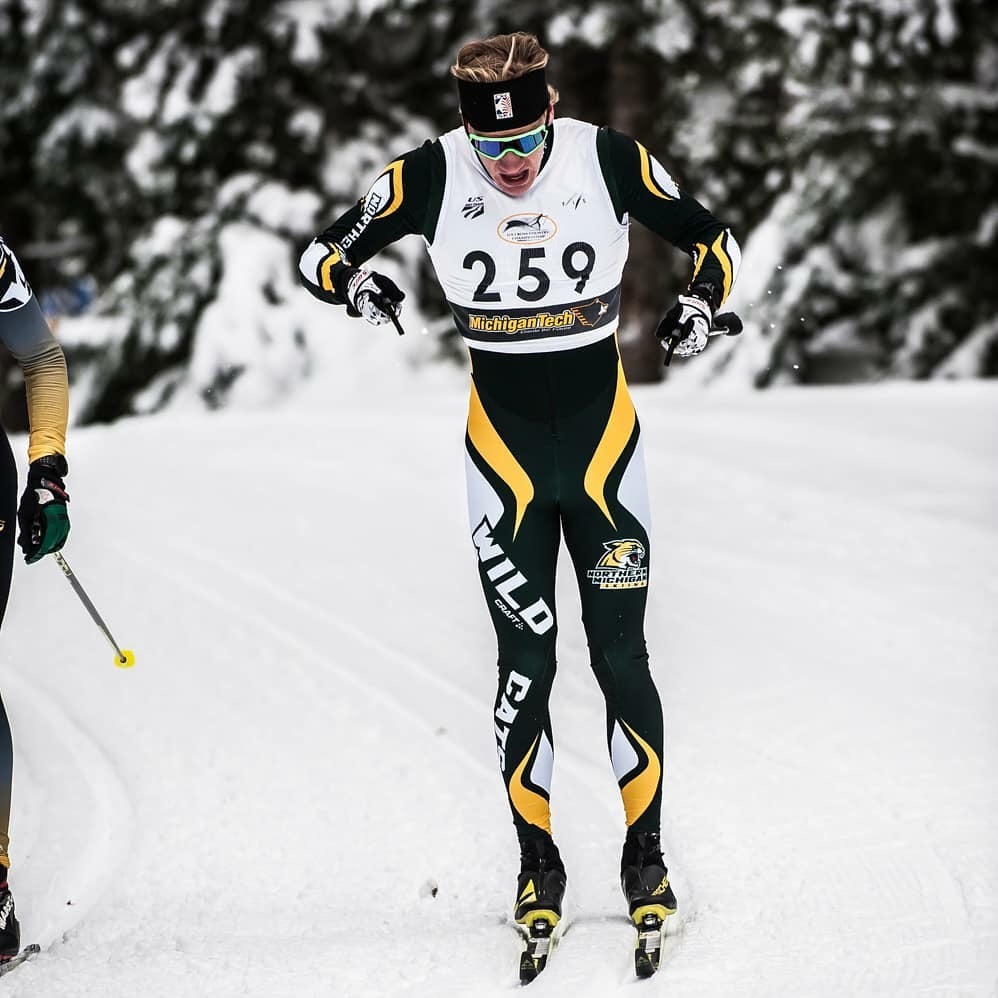
Zak Ketterson (USA) during the 10 k Classic in Toblach, Italy, as part of the 2026 Tour de Ski. (Photo: Vanzetta/NordicFocus)
On Monday, a clear winter morning in northern Italy, Zak Ketterson skied intervals while his teammates enjoyed a point-to-point on an idyllic pre-Olympic winter day. The sun was out. The snow was good. He was working.
“I did some hard intervals,” he said later. “So it was still nice and sunny and everything, but not as enjoyable.”
That small distinction — between the workout that feels good and the workout that gets you ready — has followed Ketterson for most of his career. He has never been the prodigy. He has never been the junior who arrived early, polished, and inevitable. His path to the Olympic start line has been indirect, uneven, and occasionally fragile. It has also been intentional in ways that only make sense in hindsight.
At 27, Ketterson is preparing to race at his first Olympic Winter Games, starting with the Skiathlon on Sunday, the culmination of a season that has quietly redefined his place in American men’s cross-country skiing. He has been competitive across formats, consistent across weekends, and calm in moments that once rattled him. But none of that came from doing things the “right” way — at least not the way modern development systems tend to define it.
Ketterson arrived here by starting late, resisting structure, leaning into racing before training, and trusting that if he kept showing up long enough, the pieces might eventually fall into place.
They have. Just not quickly.
Ketterson’s favorite sports as a child were football and baseball. (Photo: Courtesy Photo)
A Winter Without a Script
Ketterson grew up in Minnesota, where winter is not an inconvenience so much as a condition. The days shorten. The lakes freeze. School calendars and community life bend around the cold. You don’t opt out of winter there; you adapt to it.
In many households, adaptation means skiing. For Ketterson’s, it meant something else first.
“For me, I was always really into football and baseball,” he said. “That was my fall sport and my spring sport.”
Those sports gave his year shape. Football stretched into late autumn. Baseball pulled him toward summer. They came with teammates, structure, and a clear sense of belonging. Winter, by contrast, arrived as a blank space.
Basketball — his favorite sport to this day — lived somewhere between play and possibility. He loved it but never formally committed to it. Organized winter athletics never quite settled into his life. Not yet.
Before skiing was ever part of his life, Ketterson dreamed of being a pro athlete. (Photo: Courtesy Photo)
Cross-country skiing entered almost accidentally, carried in by family rather than ambition.
“My brother, for whatever reason, was more into cross-country running, track, and cross-country skiing,” Ketterson said. “He kind of convinced me, like, yo, you don’t have anything going on in the winter, you should just try this.”
It wasn’t a calling. It was a solution.
He was thirteen — late by elite skiing standards, but early enough to slip into the margins of the system. In Minnesota, seventh graders could train and travel with high school teams. Ketterson joined at the JV level, young and mostly anonymous.
The draw wasn’t the work. It was the race.
“I really liked racing, especially mass starts and sort of the competitive head-to-head aspect of it,” he said.
Training, on the other hand, felt like an obstacle.
“I absolutely hated that,” he said. “When it came to going into the woods and just doing a two-hour ski or something, I hated it.”
Sometimes, hatred turned into avoidance.
“There were a lot of practices where I would hide in the woods,” he said. “My friends and I would just pretend that we trained, but we were actually just building snow forts.”
If this were a conventional development story, it might end there. Plenty do. A late start, uneven buy-in, resistance to structure — those are often warning signs.
But Ketterson kept finding himself back on start lines.
Early days on skis for Zak Ketterson. (Photo: Courtesy Photo)
Racing as the Through Line
What sustained him through those early years was not discipline, but opportunity. Each step forward offered another race, another environment where effort produced immediate feedback.
Junior Nationals. Then World Juniors. Eventually, college.
“The thing that kept me in the sport initially was just the racing,” he said.
That instinct — to measure himself against others rather than against a stopwatch or a training plan — would define much of his early relationship with the sport.
By the time he reached Northern Michigan University, skiing stopped being seasonal. It became daily. The margin for avoidance narrowed.
“I started to develop more of a relationship with the training aspect of it,” he said. “Especially in college, I began to really enjoy the process of trying to improve and optimize things.”
Sleep. Nutrition. Recovery. The quiet details, that barely registered when skiing was something you fit around football and baseball, suddenly mattered.
The shift wasn’t romantic. It was practical.
That change carried him into a professional career after graduation — not as a finished skier, but as someone finally willing to do the work consistently.
A young Zak Ketterson (Midwest/Loppet Nordic Racing) leads the U16 Boys 5 k Classic Mass Start at the 2013 Junior Nationals in Fairbanks, Alaska. (Photo: bertboyer.zenfolio.com. Proceeds go to NNF)
Northern Michigan, Daily Work
Northern Michigan University didn’t transform Ketterson overnight. It narrowed the margins.
Skiing there demanded repetition. Cold mornings. Tired legs. Routine. Improvement stopped being incidental.
The biggest shift came junior year, when he began dating his now wife, Julie Ensrud, and skiing stopped being something he did mostly alone.
“When I started dating her my junior year in college,” Ketterson said, “that really coincided with when I started doing a lot better in skiing.”
Julie grew up in Norway, in a system that treated sport as something you lived inside rather than something you added on. She attended a specialized Norwegian sports high school. She trained at volume. She understood structure.
“She was kind of living semi-professionally from the age of 16,” Ketterson said.
She noticed the basics first.
“I started going to bed a lot earlier,” he said. “I would always just be on my phone until 11 or 11:30.”
Food followed.
“Not only eating healthier,” he said, “but eating more of the right things. More carbs. The timing of what you eat with training.”
By living together senior year, Ketterson’s bad habits became visible.
“She’s probably the hardest worker and most efficient person I’ve ever met,” he said. “She gets an email and does it immediately.”
Ketterson noticed the contrast.
“I used to be super disorganized,” he said. “I used to lose stuff and leave things everywhere.”
Being around someone who treated time deliberately changed how he approached his own days.
“She comes to basically every interval session I do,” he said. “Takes video. Takes lactates. Gives technique tips.”
What could have felt like a sacrifice became shared life.
“If I were single and just kind of doing this grind alone,” he said, “it would feel like a much bigger sacrifice.”
Ketterson (NMU) racing at the CCSA opener in Houghton, Michigan during his college days at Northern Michigan University. (Courtesy photo)
Learning How to Stay Anyway
Leaving college did not feel like an arrival. It felt like exposure.
Professional skiing offered fewer guarantees. Results came without permanence. Progress was harder to measure.
“This is maybe my fifth year as a professional,” Ketterson said. “I feel like I’ve just been sort of taking small steps each year.”
From the outside, those steps were hard to see. He qualified. He scored points. Then momentum faded.
“I’ve had glimpses here and there of being quite good on the World Cup,” he said. “But it was so inconsistent and few and far between.”
One year, sprint qualification came easily while distance slipped. Another season, the opposite.
“I would qualify every sprint but struggle in distance,” he said. “Or I wouldn’t qualify in sprints, but I’d get a lot of top-30s in distance.”
The belief stayed intact.
“I believed I had that all-around potential,” he said.
Belief, however, doesn’t quiet doubt when seasons stack without resolution.
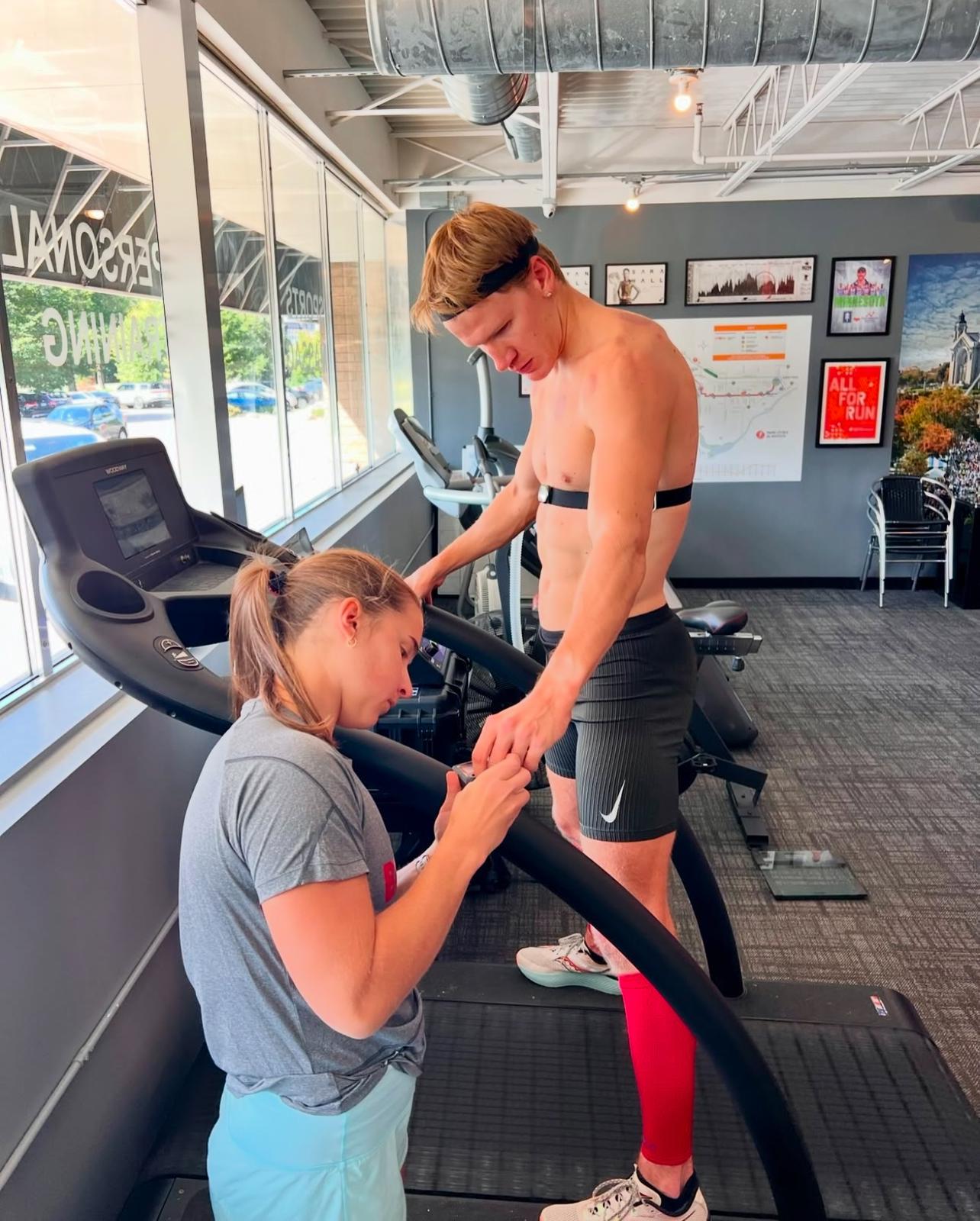
Ketterson’s wife, Julie Ensrud, assists him with lactate testing during a treadmill session. (Photo: Zak Ketterson)
Choosing a Place That Could Hold the Work
For American skiers, Europe is often something you pass through. For Ketterson, Norway eventually became something else.
Julie’s family lived outside Oslo, close to training venues and the airport. There was also a cabin — quiet, familiar.
“It works out super well,” Ketterson said. “I can just get these three- or four-day stints at the cabin and unpack my bag and feel really at home.”
Most American skiers live out of their bags.
“There are a lot of Americans who just live out of their bag and are constantly in hotels,” he said.
In Norway, life slowed just enough for training to accumulate rather than reset.
“They’re super into skiing,” Ketterson said of Julie’s family. “Her brother skied competitively growing up.”
Her father, especially, was absorbed by the details.
“He’s so into ski waxing and the nitty-gritty stuff,” Ketterson said.
The support wasn’t motivational. It was stabilizing.
“They’ve sort of adopted me,” he said. “Like, how can we support him?”
Norway wasn’t the breakthrough. It was the ground beneath it.
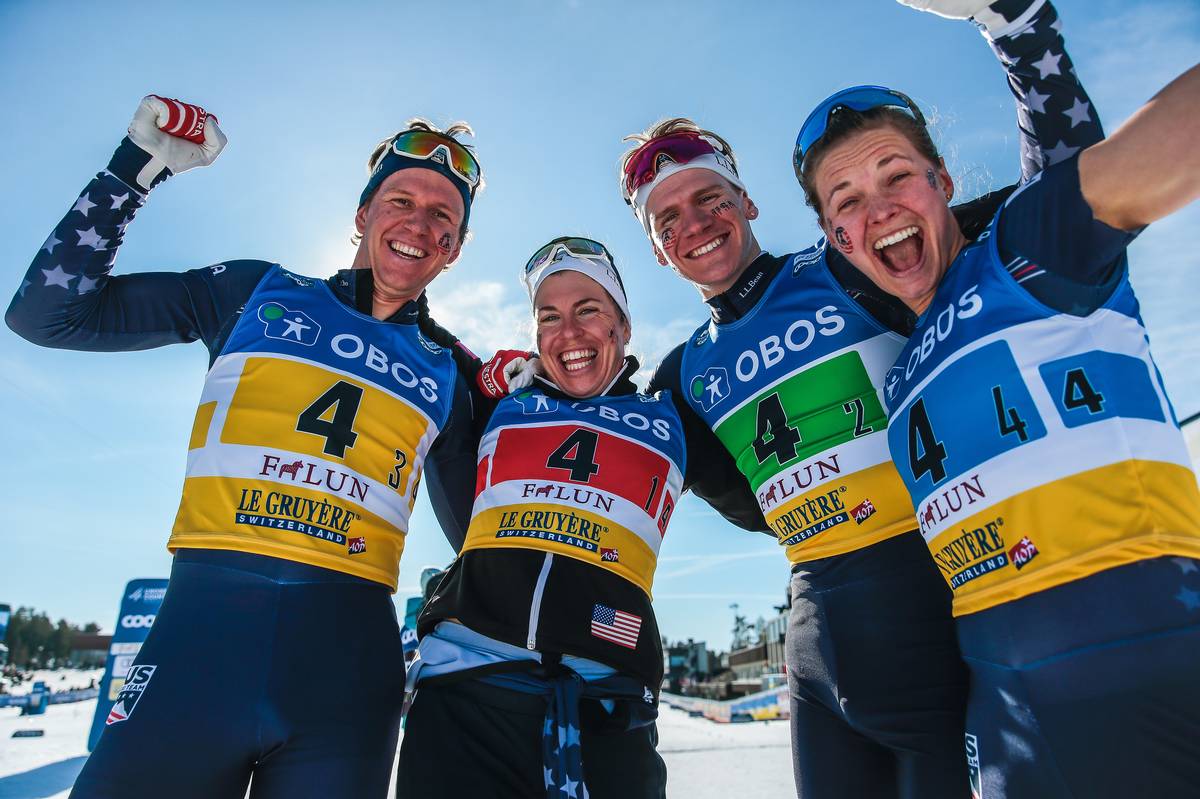
USA I takes the win in a rare World Cup 4 x 5 k mixed relay in 2022. From left to right, Scott Patterson, Rosie Brennan, Zak Ketterson, and Jessie Diggins. (Photo: NordicFocus)
Nothing Fancy, Just Better
With stability in place, the training changed.
“I started working with a coach in Oslo,” Ketterson said.
The relationship was loose.
“He created the framework,” Ketterson said. “But I was still writing probably 90 percent of my training.”
The biggest change was subtraction.
“I used to do strength twice a week, sometimes even three times a week,” he said. “Now it was basically once every ten days.”
The logic was blunt.
“If you want to get better at double pulling,” he said, “you just need to double pull more.”
He replaced strength with ski-specific work. Fitness became the priority.
His training rhythm flattened.
“My training became much more consistent,” he said. “Every week was pretty similar.”
No dramatic rest weeks. No spikes. Stress accumulated steadily.
He returned to the same hills. The same treadmill sessions.
“If something feels way worse than the last six times,” he said, “then you know you need rest.”
Zak Ketterson logs some roller-ski hours in Minneapolis with Team Birkie. (Photo: Instagram @zaketterson)
Toppidrettsveka
Late in August, Ketterson lined up at Toppidrettsveka, Norway’s popular roller-ski stage race.
“I was expecting to be absolute middle of the pack,” he said.
Instead, he stayed with the leaders.
“From the first race — a mass start 50k — I was fighting for the win,” he said.
Three years earlier, he had been dropped halfway.
“That was one of those moments where it’s like, wow,” he said. “This is a really big difference from anything I’ve felt before.”
Across stages, the pattern held.
“That gave me a lot of confidence,” he said. “Like, okay — what we’re doing is really working.”
Still, he waited.
The Ultimatum
By autumn, the feeling hadn’t faded.
“I told Julie that this had been by far my best off-season ever,” Ketterson said.
Then came honesty.
“I told her that if I’m not good this year,” he said, “or if I don’t make a really big jump, then I kind of want to retire.”
It wasn’t dramatic. It was diagnostic.
“If this doesn’t work,” he said, “then I don’t know anything about training.”
Zak Ketterson (USA) and Friedrich Moch (GER) (l-r) lapping through the stadium during the Men’s 20 k Mass Start Freestyle in Ruka, Finland, at the beginning of the 2025/2026 season. (Photo: Modica/NordicFocus)
Ruka
Ketterson finished 14th in the World Cup opener in Ruka.
“I was crying in the finish,” he said.
Not from disappointment.
“It was such an emotional rush,” he said. “All the work that I’d put in, and that my wife had supported — it finally got some validation.”
For the first time since college, the feeling matched the effort.
The season didn’t spike. It held.
“For the first time,” he said, “regardless of whether it’s a sprint or a distance race, I feel like I can compete that day.”
Zak Ketterson (USA) racing on the Olympic Sprint Course in Val di Fiemme, Italy, during the 2026 Tour de Ski last month. (Photo: Vanzetta/NordicFocus)
Arrival Without a Finish Line
Ketterson will start his first Olympic race just days from now — older than most of his teammates, newer to the stage, and unusually calm.
“I’m just treating it like any other race,” he said.
There is no demand for the outcome. Only execution.
“What would haunt me,” he said, “is doing something that was within my power not to do.”
So he will race. He will pace. He will pay attention.
The long way in has given him that luxury.
Help Support Our Olympic Coverage!
FasterSkier has our own Nat Herz on the ground at the Olympics, which is a significant financial lift for us. If you value the thoughtful work and access FasterSkier provides at championships like this one, please consider becoming a Voluntary Subscriber. Your support directly fuels our work to cover the people, places, and moments that make our sport special.
As owner and publisher of FasterSkier, Matthew Voisin manages the day-to-day operations, content, and partnerships that keep the site gliding smoothly. Away from the desk, he’s doing his best to keep pace with his two energetic sons.