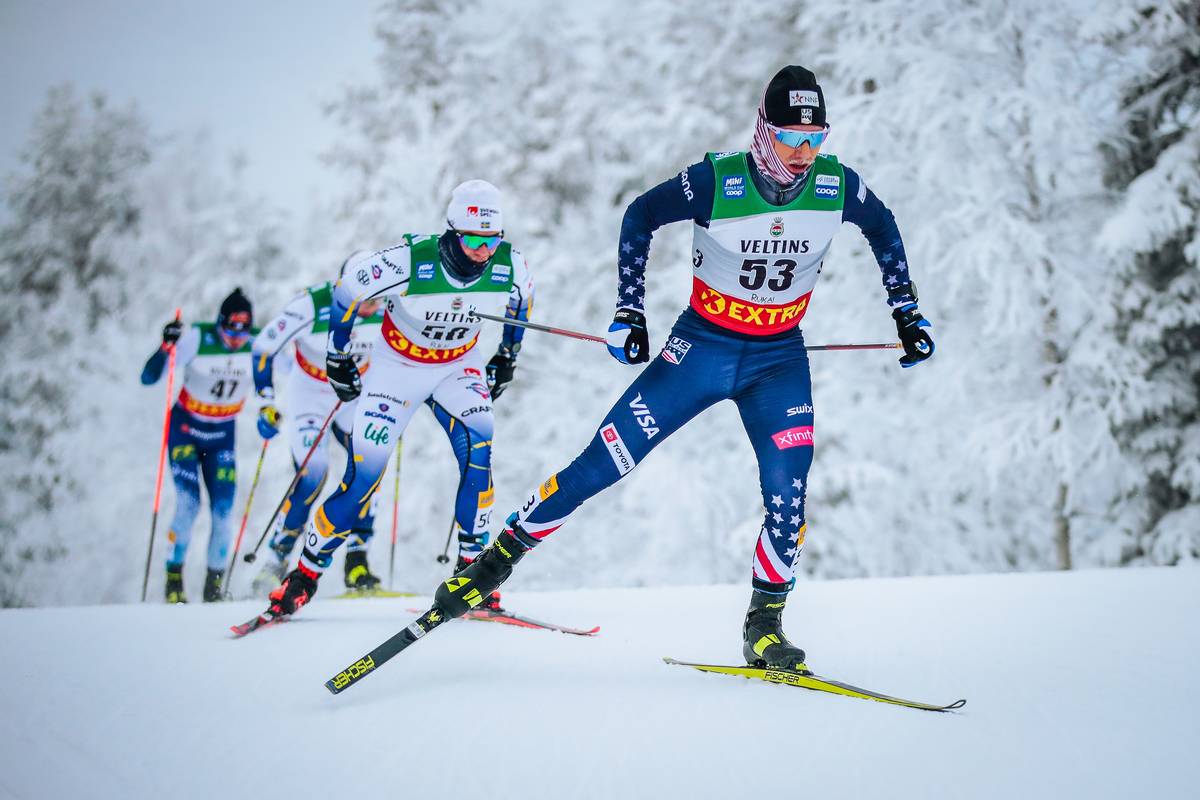
Zanden Mcmullen (USA) during the World Cup 10 k Freestyle in Trondheim (NOR) in December. (Photo: Modica/NordicFocus)
There is a particular kind of quiet that settles in before a decisive weekend—not the calm that follows certainty, but the stillness that comes when outcomes are no longer yours to predict. Zanden McMullen arrived in Oberhof, Germany, this week carrying that quiet with him. Period Three of the World Cup season is underway. These races are the final ones that will be considered for U.S. Olympic Team selection. The committee will meet after Sunday’s races. Until then, there is nothing to do but race.
“I’m pretty much taking it one week at a time right now and keeping my hopes up,” McMullen said earlier this week via text. “The races should be really fun this weekend, and my focus is on those right now.”
It is the kind of message that sounds simple until you sit with it. One week at a time. Focus on the races. Fun. Behind those words is a career that has moved forward incrementally, without shortcuts, and a season that has already required recalibration. McMullen’s path to this weekend—both geographically and personally—has been anything but linear.
Growing Up Where Winter Is Normal
McMullen was born and raised in Anchorage, Alaska, a place where winter does not arrive as a novelty or an interruption. It simply is. He grew up outdoors, moving easily between sports—hockey, soccer, lacrosse—before skiing gradually took precedence.
“I grew up doing a bunch of sports,” he said. “Skiing wasn’t really a main focus until maybe, like, first year of high school, when I was like, all right, this is going to be my main sport.”
Cross-country skiing entered his life less as an ambition than as a community. His mother took him out. He joined a club. He found friends. He was good enough that there was never much reason to stop.
“I just kind of found my group,” McMullen said. “And then as I progressed and just kept getting better and better, there was never really a reason for me to leave.”
Anchorage has produced lots of elite skiers, but McMullen has never been particularly interested in mythology. When asked why Alaska continues to turn out athletes capable of racing at the highest level, his answer is understated.
“We have access to great outdoor activities,” he said. “And I feel like that’s probably a pretty big foundation to our success. The community is great and has always been supportive of ski racing.”
It is not a romantic explanation. It is a practical one. Snow matters. Time outside matters. People matter.
Zanden McMullen (APU/Team Alaska), center, won the men’s U18 10K classic mass start race Friday at the 2019 U.S. Ski & Snowboard Cross Country Junior National Championships at Kincaid Park. Johnny Hagenbuch (Sun Valley SEF/Intermountain), left, was second, followed by Griffin Wright (Craftsbury Nordic Ski Club/New England), right. (Photo: Michael Dinneen)
The First Crack in the Horizon
For much of his early skiing life, McMullen’s world remained bounded by Alaska. The high school circuit was competitive enough that it was difficult to tell where he stood nationally. That changed almost accidentally.
“A pretty pivotal point in my ski career was the Anchorage U.S. Nationals,” he said. “I wasn’t planning on going. I was still pretty young, but because it was in Anchorage, it was like, sure, of course I’ll do those races.”
In the mass start 10-kilometer race, McMullen had what he still describes as a standout performance. The result earned him a spot on a U18 international trip.
“That was one moment where I was like, holy crap, I can’t believe I made that,” he said.
The next year, he qualified for World Juniors. Then another benchmark. Then another.
“Every year was like I hit that next benchmark,” McMullen said. “And I was like, okay, wow, this is really happening.”
What is striking in retrospect is how little certainty accompanied those steps. McMullen did not grow up believing he would race World Cups. He arrived there gradually, often surprised by his own progress.
“I never really believed that I was going to be able to do that,” he said. “All the way up until, like, pretty much two years ago when I was like, damn, I’m really ripping the World Cup circuit.”
Zanden McMullen races a skate pursuit in Ruka, Finland in November, 2021. (Photo: NordicFocus)
Learning the Long Way
McMullen’s development has mirrored that of a broader cohort of American men who have risen together, without a single breakout prodigy defining the group. The men’s team has become competitive not through sudden transformation, but through accumulation.
“There’s definitely a core group of us that have been doing this for a long time and have just been hitting that next level every year together,” McMullen said. “Honestly, I’d say we just have a great attitude towards it, and I think that’s really contagious.”
Central to McMullen’s progression has been his relationship with coach Eric Flora, who began working with him after high school. The partnership is not flashy. It is deliberate, methodical, and built on constant communication.
“We all have individual phone calls with him about once a week,” McMullen said. “He’ll be driving to practice every morning, and he’ll just rip through all of us.”
Training plans are personalized but similar. Adjustments are fluid. There is room to adapt when conditions—or bodies—require it.
“Training is super fluid,” McMullen said. “There’s no reason to be super methodical about it.”
If there is a defining value that underpins the approach, it is consistency. McMullen returns to the concept repeatedly, almost reflexively.
“I don’t enjoy when I’m hot and cold,” he said. “I know I’m in a good place when I’m just consistent.”
Racing Through Fog
Consistency, however, is not something that can be summoned on demand. When the World Cup season opened in December, McMullen entered Period One with a clear process goal: race distance events, avoid panic, see where he stood.
“It’s so challenging going into Ruka every year,” he said. “You just have really no idea what kind of shape you’re in.”
He described the feeling as “looking through fog.” The metaphor fits. Fitness tests and workouts provide clues, but racing offers the only real clarity.
“Those could both result in amazing races,” he said. “Or they could be pretty crappy races. I have no idea.”
December did not unfold the way McMullen had hoped. Results were not disastrous, but they were not convincing enough to quiet questions—his own included. Olympic qualification, with its layers of objective criteria and discretionary judgment, hovered in the background, offering no reassurance.
“Nothing’s for sure until the last race is over,” he said.
As Period One ended, McMullen faced a decision that athletes rarely frame publicly: whether to stay in Europe and press on, or to step away and reset.
Davos to Regroup
McMullen stayed in Davos to train and regroup during the holidays before flying back to the United States for Nationals.
The decision was not dramatic. It did not come with declarations or explanations. It was simply what made sense.
Settling in to training through the holidays stripped things back to essentials. Favorite trails. Simple routines. Fewer variables.
For McMullen, training has never been a place to escape. It is where things become clear.
The reset did not guarantee anything. But it restored something harder to quantify: alignment between effort and intention.
By the time McMullen boarded a flight for Lake Placid in January, he carried less expectation and more readiness.
Zanden McMullen charges for the win in the Men’s 20 k Freestyle Mass Start last week at the US National Cross-Country Ski Championships in Lake Placid, New York. (Photo: Nancie Battaglia)
Lake Placid: Evidence
The U.S. Senior National Cross-Country Ski Championships arrived with their own weight. Nationals are never just Nationals in an Olympic year. Results echo beyond the finish line.
On Thursday, McMullen won the 20-kilometer Freestyle Mass Start. The race unfolded honestly, favoring patience and pacing. McMullen looked comfortable in control.
The next day, he returned to win the Classic Sprint.
Two wins, two very different demands, back to back.
The performances were not loud. They were authoritative.
For an athlete who measures progress in consistency, the week in Lake Placid did not feel like redemption. It felt like confirmation.
Zanden McMullen with his second win in two days in the Classic Sprint last week at the US National Cross-Country Ski Championships in Lake Placid, New York. (Photo: Nancie Battaglia)
Oberhof
From Lake Placid, McMullen traveled to Germany for the final races that will be considered in the Olympic team selection. Oberhof will decide whether his season will continue toward Milan or pivot elsewhere.
“I’ll know by the end of the weekend if I have made the Olympic team,” he said via text. “If I don’t, I’ll head back with a little bit of Birkie fever.”
The phrasing is characteristically restrained. There is no bargaining, no projection beyond what he can control.
“I’m in Oberhof now for P3 World Cup, and will stay with the team through Goms,” he said. “I’m pretty much taking it one week at a time right now.”
That outlook has been hard-earned. McMullen understands that racing well is not the same as demanding belief. His approach is simpler.
“Let the racing speak,” he said in November. “There’s no reason to freak out about it.”
The Space Before the Answer
By Sunday evening, the committee will meet. Names will be discussed. Arguments will be weighed. Decisions will be made.
McMullen will not be in the room.
What he will have is a body of work that stretches back much further than this weekend: a childhood shaped by Alaska winters, a career built on incremental belief, a season that required adjustment rather than insistence, and a January that reaffirmed who he is as a racer.
Whether or not the Olympic team includes his name, McMullen has reached a threshold that is difficult to cross. He is no longer auditioning for relevance. He is racing for a place.
“I just want to be consistent,” he said. “I feel like when you are consistent, and you find yourself in a position where you might have a standout result, then it’s just that much higher.”
In Oberhof, consistency will not announce itself. It rarely does. It will show up quietly, in decisions made at speed, on terrain that rewards honesty.
For now, that is enough.
Love stories like this? Help keep them coming.
Feature stories like this one take time, access, and care to produce. If you value thoughtful storytelling and independent ski journalism, please consider becoming a Voluntary Subscriber. Your support directly fuels the work we do to cover the people, places, and moments that make our sport special.