
The first time you meet Patrick Weaver, you might not realize you’re talking to one of the most quietly influential coaches in American skiing. There’s no bravado, no self-promotion. Just an easy Vermont calm — a man who measures his words the same way his athletes measure their training: carefully, purposefully, with feel.
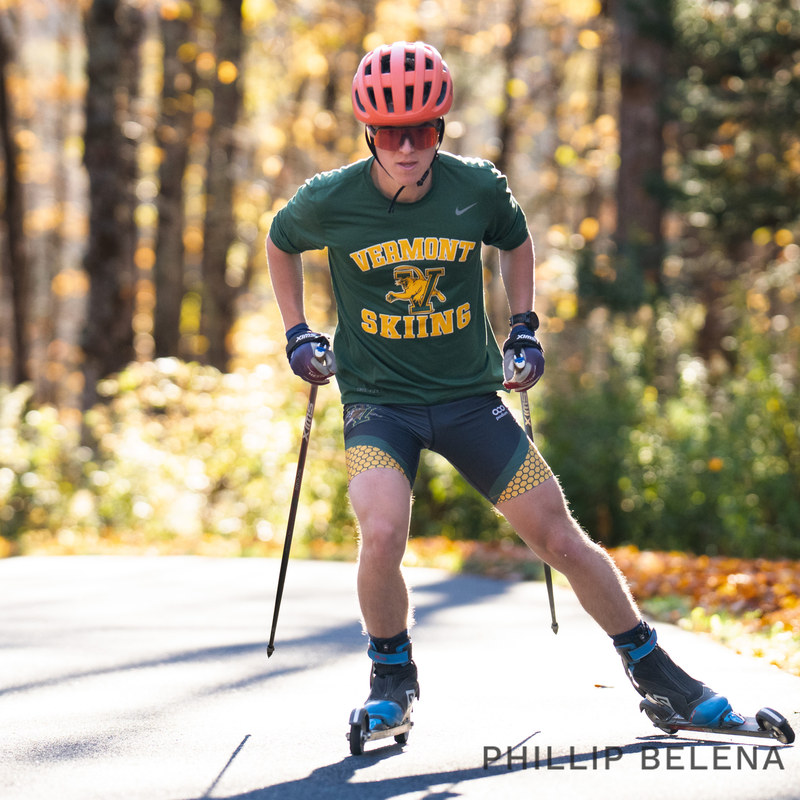
On a fall morning, the UVM Nordic team threads through the mist at the Craftsbury Outdoor Center, the quiet hum of rollerskis against asphalt echoing in the distance. Weaver watches from the side, hands in his jacket pockets, hat pulled low. He doesn’t bark instructions. He doesn’t need to. The rhythm of his teams speaks for itself.

“I always say it’s not the individuals that make the team fast — it’s the team that makes the individuals fast,” he says. “Once they believe that, the motivation takes care of itself.”
For nearly twenty years, that philosophy has shaped the University of Vermont into one of the most respected programs in NCAA skiing — not through hype or heavy recruiting, but through a culture of trust, humility, and balance.
Lessons in Motion
Weaver’s path to coaching wasn’t linear. It’s more like a relay through decades of ski mentors who left their fingerprints on his philosophy.
“I never had one coach through my whole career,” he says. “There were a lot of influential people — high school, Stratton, college, the national team. I just learned to take things from each of them.”
He spent a post-graduate year at Stratton Mountain School under Sverre Caldwell before skiing for Cory Schwartz at UNH — a relationship that would define his sense of what a team could feel like.
“Cory was probably the most influential,” he says. “The way he ran that program — it was a family. I took that with me when I came to UVM.”
After college, Weaver worked under a rotating cast of national and international coaches: Gordon Lange, Christer Skog, Sten Fjeldheim, Torbjørn Karlsen. Each brought a different rhythm to training. The mosaic of ideas shaped the adaptable style he’s known for today.
“There’s not one way to coach,” Weaver says. “And because of my background, I’m not a ‘my way or the highway’ coach. I’ve seen too many ways that work.”

The Season He Cut His Hours
In 2002, the year of his second Olympics, Weaver did something radical. He trained less.
After years of logging 800-plus-hour seasons, he realized the grind was killing his joy. So he cut down to 600 hours — just one session a day, mornings only.
“I was kind of burned out,” he says. “I’d dread the afternoon workouts. I loved the sport, but I wasn’t feeling good anymore. When I stopped doing the PM sessions, I felt better — I started looking forward to training again.”
It’s a story he still tells his athletes, not as dogma but as permission. Permission to rest. Permission to find balance.
“I’m never afraid to tell an athlete to train less,” he says. “Sometimes that’s the thing that gets them going faster.”
That season became a turning point — not just in Weaver’s career, but in his view of what performance really means. It was the seed of a coaching style rooted not in metrics, but in intuition.
Coaching Ben Ogden — and the Art of Listening
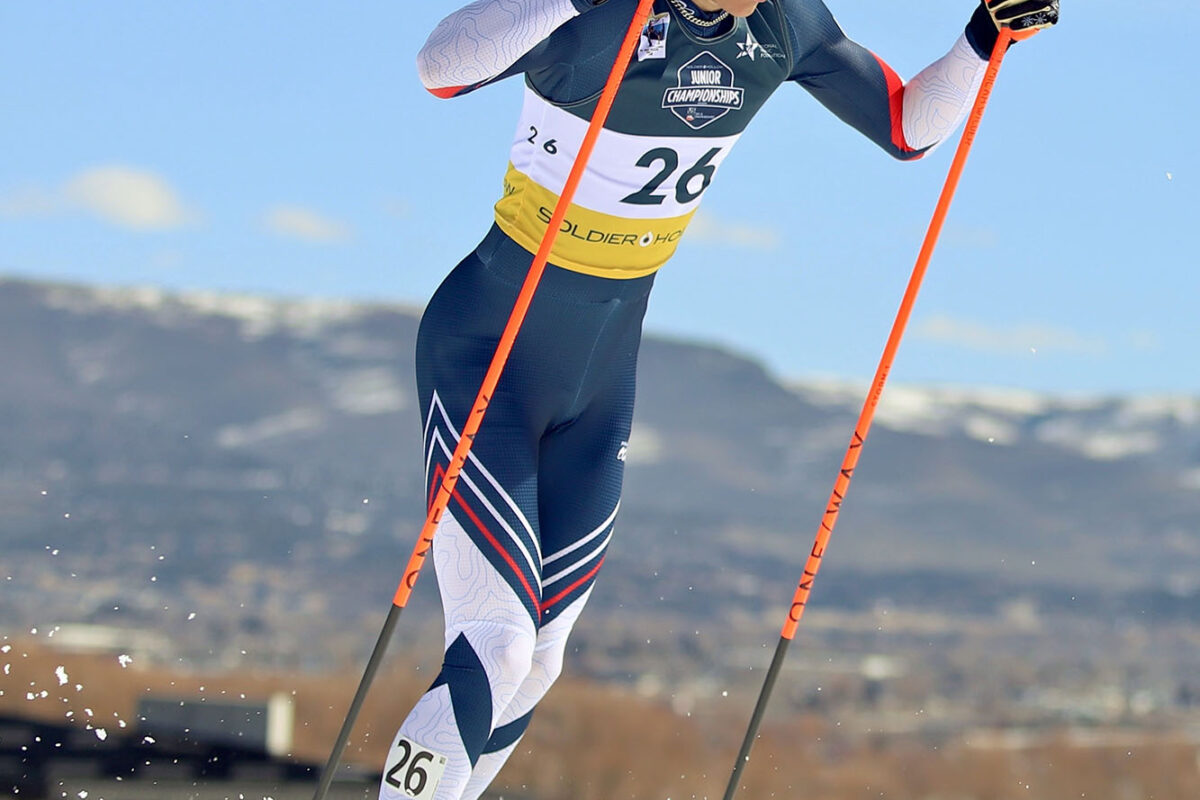
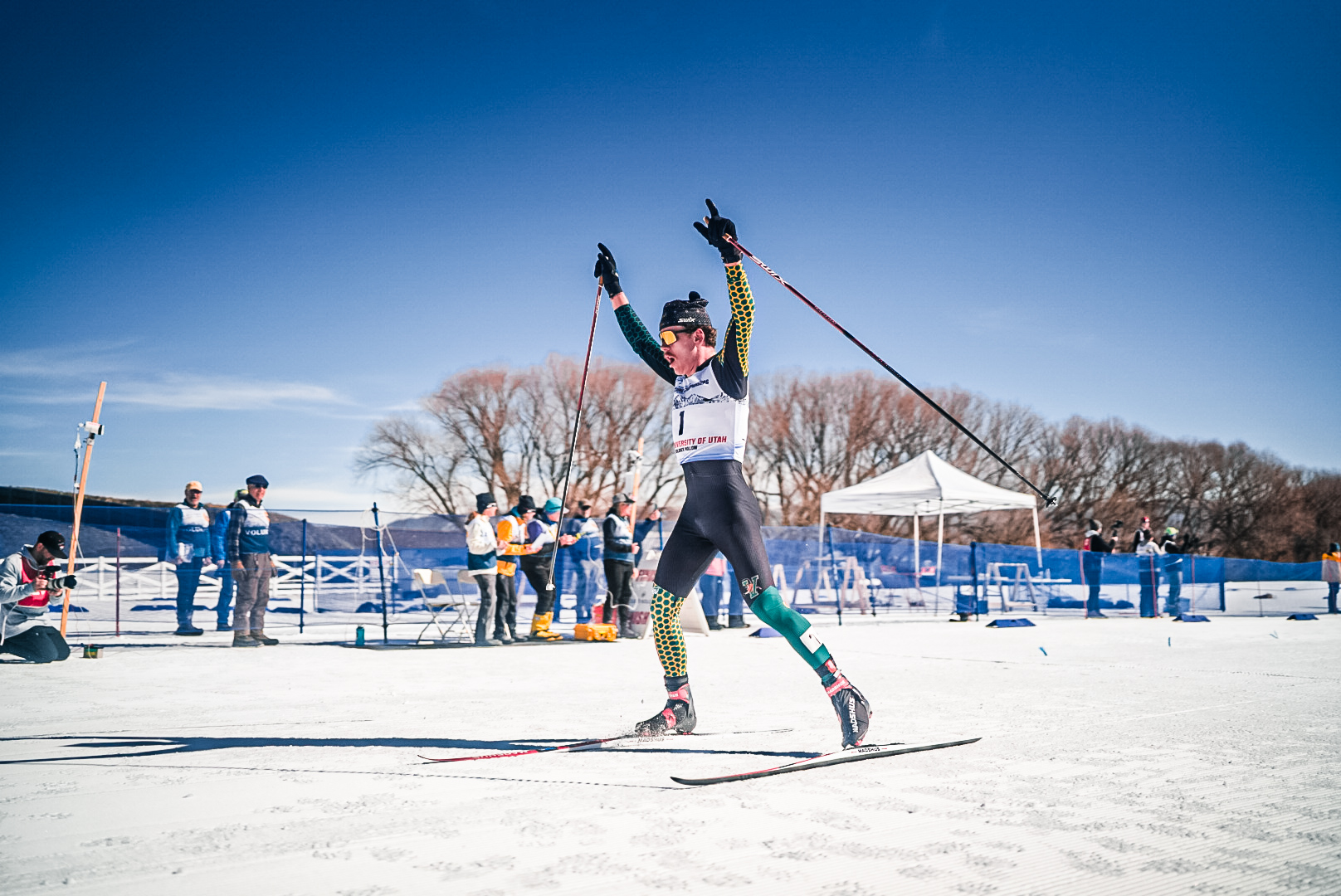
If Weaver’s name is not immediately known outside the NCAA world, it should be. One of his former athletes — UVM graduate Ben Ogden — is now one of the most dynamic racers on the World Cup circuit. Their partnership, built over seven years, is the epitome of Weaver’s coaching DNA: patient, collaborative, and deeply human.
“I’m not Ben’s day-to-day coach,” he explains. “He’s got great people at Stratton and the U.S. Ski Team. But we talk — a lot. Strategy, planning, recovery, the big picture. And it’s never me saying, ‘Do this.’ We talk it through and find what makes sense logically.”
That logic isn’t written in a spreadsheet. There are no lactate meters, no elaborate testing protocols.
“We’re very unscientific,” Weaver says with a grin. “Ben appreciates the go-with-the-flow training plan. It’s all feel-based. If it feels good, we go with it.”
The two share what they call the “Gus Workout” — a set of smooth, fast intervals inspired by Gus Schumacher. “It’s not about killing yourself,” Weaver says. “It’s about moving fast with good technique.”
It’s fitting that one of America’s most promising World Cup athletes traces his development back to a coach who believes that skiing, at its best, is about rhythm and relationship more than data and drive.
The UVM Way
Weaver took over the Catamount program with a straightforward goal: strip away the clutter.
“When I first got here, I just explored,” he says. “I found training venues close to campus — trails and loops that were right here. We stopped driving hours to ski. It simplified everything and gave athletes more time to recover.”
That ethos — local, focused, efficient — defines UVM’s identity. Training isn’t glamorous, but it’s deliberate. The team atmosphere is close-knit, even familial. “There’s nothing special about UVM,” Weaver jokes, “and that’s what makes it special.”
He points to the campus support network — trainers, nutritionists, sports psychologists, and strength coaches all under one roof — as one of the program’s hidden advantages. “It’s on par with professional teams,” he says. “The athletes can see everyone they need in one day.”
That infrastructure helps athletes stay healthy, grounded, and balanced — which, for Weaver, is the real key to longevity.
“We’ve had international athletes come in liking skiing, and they leave loving it,” he says. “That’s when I know we’ve done something right.”

Through Change and Uncertainty
Weaver has been around long enough to see college skiing evolve from a regional stepping stone to a legitimate World Cup pipeline. He’s also watched it collide with new realities: NIL money, early recruitment, the escalating costs of youth development.
“When I was at UNH, I was training 500 hours a year and thought that was a lot,” he says. “Now I’ve got athletes training 700 or 800 hours — and managing school on top of it.”
That dedication, he says, is a sign of progress — but also a warning.
“Kids are training more and more at a younger age,” he says. “Sometimes it worries me. Are they doing it because they want to, or because they’re being told to?”
He worries, too, about the economic side. The college landscape, reshaped by NIL and revenue sharing, could make Olympic sports harder to sustain.
“We’re fundraising to pay athletes while big schools make $200 million a year off TV deals,” Weaver says. “It’s hard to see how that’s sustainable.”
He laughs softly when asked what NCAA skiing looks like fifteen years from now. “I hope we’re still here,” he says. “I really do.”
The Long Game
If the world of college skiing is shifting underfoot, Weaver’s motivation remains rooted in something simple: people. Every year brings a new roster, a new set of personalities, a new chance to start fresh.
“You do something long enough, it’s hard to stay motivated,” he admits. “But each fall I get new athletes, new relationships. First-year students I barely know become seniors I can’t believe are leaving. That cycle keeps it exciting.”
He pauses, then adds, almost to himself:
“Maybe that’s what success really is — watching them fall in love with skiing all over again.”

Vermont’s Quiet Legacy
Weaver doesn’t measure his legacy in NCAA titles or Olympic appearances, though UVM has had plenty of both. He measures it in the quiet mornings at Craftsbury, Jericho, or Sleepy Hollow, where athletes rediscover why they started skiing in the first place.
He doesn’t see himself as a gatekeeper of results but as a caretaker of culture — one that prizes simplicity, joy, and belonging in a sport that often forgets how to slow down.
In a world obsessed with metrics, Weaver’s story is a reminder: sometimes the best architectures of success are invisible — built in the space between workouts, in trust, and in the quiet confidence that skiing, at its best, should always be fun.
“The best thing I can do,” he says, “is help people love the sport.”


Matthew Voisin
As owner and publisher of FasterSkier, Matthew Voisin manages the day-to-day operations, content, and partnerships that keep the site gliding smoothly. Away from the desk, he’s doing his best to keep pace with his two energetic sons.