 This coverage is made possible through the generous support of Marty and Kathy Hall and A Hall Mark of Excellence Award. To learn more about A Hall Mark of Excellence Award, or to learn how you can support FasterSkier’s coverage, please contact info@fasterskier.com.

Maybe the Americans really are that good . . .
With the Olympic Games just around the corner, American men (lots of them!) are surging toward the front of the World Cup field. And while the last few World Cup weekends have been events that were only sparsely attended by the sports brightest stars, today’s Classic Sprint in Goms Switzerland was a fully stacked field with most of the primary contenders present. Many of them would be hoping that this event would be a dress rehearsal for the Classic Sprint that will be raced during the Olympics in Val di Fiemme.
Over the last few weeks, it’s been kinda cool to see what racing would look like in the absence of Johannes Hoesflot Klaebo . . . but now it’s time to turn from things as they have been, and return to things as they should be. Klaebo is back, and it’s an amazing time to watch ski racing: perhaps the greatest ever to do this sport is currently racing and skiing among us. Who knows? Maybe this will be his final season. If he were to succeed during the Olympic Winter Games of Milano-Cortina in the same way he succeeded at last year’s World Championships in Trondheim (six races, six wins, Nordic skiing immortality), there would virtually be nothing left for him to win. This skier has taken us to a rare place in sport history: Babe Ruth is alive and swinging, Muhammad Ali dances across the ring, and we get to watch history played out on live-streamed broadcasts. Let’s enjoy it—and marvel at it—while we can.

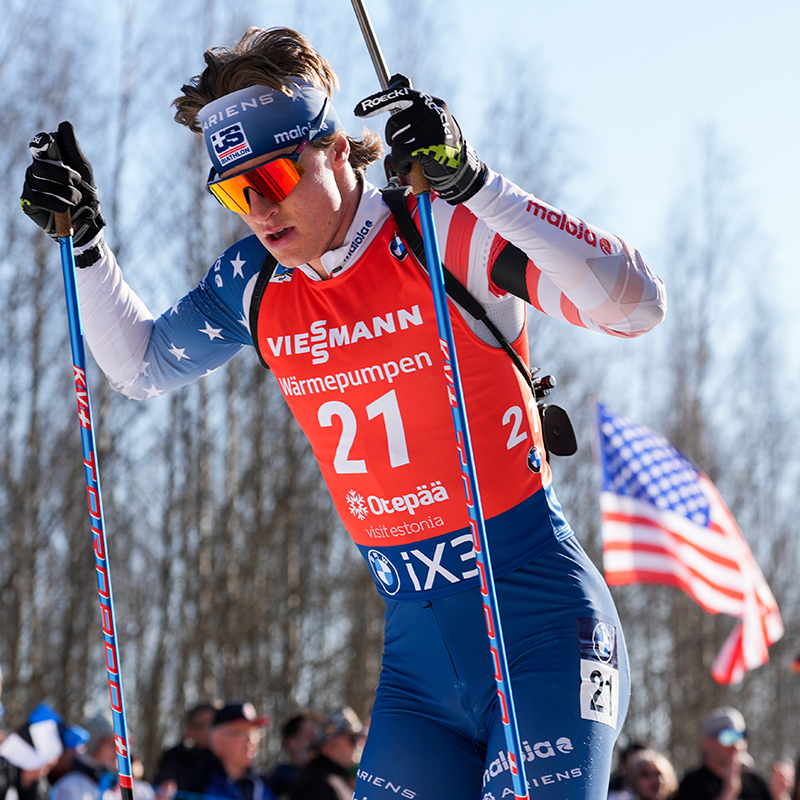
While Klaebo is back on tour—and coasted to yet another World Cup Classic Sprint victory—it felt more like an American coming out party and less like yet another Klaebo coronation. Gus Schumacher led the way with a brilliant and confident second place, ahead of a bull-headed Edvin Anger (SWE) who continues to think that Klaebo can be beaten with brute force and raw power. Klaebo proved Anger wrong yet again . . . but it was Schumacher who stole the show.
“These courses are really hard, like that hill is about a minute long,” said Schumacher. “And yeah, being an all around athlete—like having some distance ability—it really helps me out there.”
And Schumacher was not the only American to deliver standout performance in Goms. Five American men qualified in the top 17: Ben Ogden 6th, Zak Ketterson 9th, Schumacher 12th, Schoonmaker 13th, Zach Jayne 17th. Jack Young did not produce the Classic sprinting result he may have hoped for. He finished qualifying 39th, just over a second outside the advancing standard. Kevin Bolger also would’ve found himself disappointed this morning in Goms, completing his qualifying round in 61st.

Americans Crowd the Heats
The beginning of the Sprint heats made it look like Klaebo was involved in a different sort of drama . . . after the strong qualifying effort of Individual Neutral Athlete, Savelii Korostelev. With the Olympics approaching—and Korostelev improving his performances each week (especially in Classic events)—Klaebo may have felt it prudent to give the young Russian a better look so that he didn’t find himself surprised in Milano-Cortina. Facing Korostelev in Quarterfinal 1, Klaebo drifted craftily to the rear for a clearer view of the young Russian. There Klaebo stayed through the first uphill, and the second where Lauri Vuorinen lost momentum, blocking Klaebo’s progress and wedging him behind Korostelev. But all it took was one extra push from Klaebo over the top to send him flying down the other side—past Vuorinen, past Korostelev, past Valnes, and across the finish line for the heat win. Valnes held on for second in. front of a fast-closing Korostelev.
Ogden followed Edvin Anger through the second quarterfinal, holding on for second ahead of a fast-charging Hovard Moseby (NOR) who would also secure a lucky loser spot.
Zachary Jayne and JC Schoonmaker entered Quarterfinal 3 alongside Even Northug (NOR) and Oskar Opstad Vike (NOR). Jayne went straight to the front, determined to use his evident qualifying speed to insure a fast heat. Jayne’s enthusiasm would be quickly curbed by the thin air of high elevation and the slow snow that resulted from overnight accumulations. Jayne would fade to the rear of the field (ultimately finishing 27th on the day) while Schoonmaker surged forward in pursuit of Theo Schley (FRA). Schoonmaker would hold his advantage, even easing up a bit before the line ahead of Anton Grahn (SWE), Vike, and Northug.
“The heats were just on another level,” said Jayne. “The heat selection was particularly stressful and something I have never experienced before. I chose heat 3 because, statistically, it has the most lucky losers. My position at the front just happened organically and I paid the price for a fast start. Happy to race the way I did, but unsatisfied with the outcome, more to learn and more to reach for. Great day for the Americans and I am truly honored to be a part of it, no matter how small my contribution.”
After his all-out chase onto yesterday’s Team Sprint podium, it would be understandable if Schumacher appeared sluggish in Quarterfinal 4. But that’s not the way Schumacher races. He seems to have an ability to recover quickly, and to ride waves of seasonal momentum. He popped to the front at the top of the final climb (ahead of an inexplicable stall from Joni Maki), and surged down the other side where he would hold his advantage across the finish line
Ketterson found himself at the front of what initially appeared to be a tactical heat. He employed an earlier diagonal stride on the first uphill than the rest of his heat, remaining light and quick. If there’s a smart way to ski at the front of a slow heat, Kettterson was demonstrating it. He scampered up the final hill as the field crowded around him, then veered, regretably, into the tracks on the shorter righthand side, slamming the door (as it turns out, a bit over-zealouslys) on Sweden’s Georg Ersson who was lucky to escape with poles and skis intact. Ersson would overcome Ketterson in the finishing straightaway, advancing to the semifinal. Ketterson would find himself disqualified in what would otherwise have been a personal best Classic Sprint performance.

Classic Sprint Semifinals
Three American men—Ogden, Schoonmaker, Schumacher—advanced to the Sprint semifinals. Three guaranteed finishes in the top 12: that’s a sign of a seriously strong team. But while it’s great to qualify for a Sprint semifinal, the names on the roster when you get there can be pretty daunting. Semifinal 1: Klaebo, Anger, Schoonmaker, Valnes, Ogden, Northug. That’s a seriously stacked heat. In that semifinal, Klaebo’s start was far more assertive than his quarterfinal, and it produced the result of luring Anger out into an early lead. On-air commentator, Andrew Kastening, got it totally right: “You’d think as time would go on, that Edvin Anger would learn to let Klaebo lead,” said Kastening. Evidently, Anger is not the quickest learner . . .
Ogden and Schoonmaker maneuvered through the pack, their kick wax seeming sufficient on the ascent of the first hill, but their glide on the downhill seeming less than stellar. Anger continued to lead over the top of the second hill. On the subsequent downhill, Klaebo glided into a too-small gap on the inside of Anger, who held his line and allowed Klaebo to ease through without issue (well done, Edvin). The move allowed Klaebo into the lead, but it sent ripples through the skiers behind the leading duo. Valnes found his ski tips tangling with Schoonmaker’s tails . . . Valnes ended up flopping spectacularly onto his backside while Schoonmaker was launched through the V-boards and into the soft snow of the infield. Schoonmaker somehow managed to avoid complete disaster, stayed on his feet, and managed to find his way back on course. Ogden wove through the carnage to finish third, where he’d wait to see if he would advance to the final as a lucky loser. Schoonmaker would finish fifth behind Northug. Valnes would limp home in sixth.
The second semifinal was relatively less star-studded, though still featured Sprint standouts such as Vike, Ersson, Joni Maki (FIN) Simone Mocellini (ITA), Anton Grahn (SWE), and Schumacher. Mocellini would make most of the pace in the heat, cresting the final hill with a slim lead over Schumacher. Schumacher would ride fast skis down the final slope, and step deftly inside of Mocellini as they entered the final double pole sections. Schumacher would hold on to cross the finish line first, and advance to the Sprint Final where he would join Ogden.

Classic Sprint Final
Two Americans advanced to the Classic Sprint Final—that’s a seriously legit statistic—where they’d be joined by Anger, Mocellini, Northug, and the omnipresent Klaebo. Ogden had already looked fatigued in the semifinal (after a high-intensity podium finish in yesterday’s Team Sprint, who can blame him?), but Schumacher continued to look fresh and fast.
“I was definitely pretty tired from the Team Sprint yesterday,” said Ogden. “Gus and I were pretty fired up; hard to fall asleep (so) I was feeling yeseterday, today1 And with the training block I’ve been doing the last few weeks, I think that was on full display in the final. But I’m still stoked with how today went, for sure. The plan was not to be the best version of myself this weekend—maybe like second best version—so I’m feeling pretty good about how that went down!”
“I think I still capitalized,” continued Ogden. “And got away with a really really solid day. Good stuff . . . awesome for the team, awesome for everybody!”
Anger never seems to learn. Maybe one day he’ll become as dominant as his ski tactics currently imply he thinks he is . . . but in Goms’ Classic Sprint Final he was just another guy playing right into Klaebo’s hands. Schumacher is a quick study, though; he’s learned where he nees to be, and he slotted in right behind Klaebo who skied the very same race as in the semifinals: let Anger lead across the flats, step into an open lane to keep from getting bunched on the first uphill, while continuing to force Anger to keep his nose in the wind. Poor kid . . . he imagines himself in a rivalry with Klaebo, who seems only to consider Anger as a convenient stepping stone to ever more Sprint victories.
That’s when Klaebo switched it up—flowing past Anger on a downhill, powering up the final climb, high-tempo diagonal stride from bottom to top, effectively deciding the race with 400 meters still to go. Schumacher rocketed past Anger as the rest of the field locked up behind the stultified Swede. Schumacher showed his tremendous form and fitness, remaining quick and snappy to the end, powering across the line just behind a relaxed and coasting Klaebo. Schumacher—and Team USA’—would earn a second World Cup podium in as many days. It’s bizarre to watch a Sprint Final become a death march, but such was the level of exhaustion that the Goms Sprint course had loaded into the arms and legs of these racers. Anger survived across the finish line in third. Ogden faded to sixth. Even so, two Americans in a Classic Sprint Final . . . there haven’t been many days that Team USA would celebrate more than this one.
Schumacher summarized his progress,and his prospects: “The way it’s set up, these races actually probably will give me a bit of a boost, fitness wise, which is cool to think about.”
Klaebo continues to lead in all World Cup categories this season: Sprint, Distance, and Overall. His level of dominance is unprecedented as the field approaches the Olympic Winter Games.
Men’s Classic Sprint RESULTS
Men’s Classic Sprint QUALIFYING
Help Support Our Olympic Coverage!
FasterSkier will have our own Nat Herz on the ground at the Olympics, which, to be honest, is a very big financial lift for us. If you value the thoughtful work and access FasterSkier provides at championships like this one, please consider becoming a Voluntary Subscriber. Your support directly fuels the work we do to cover the people, places, and moments that make our sport special.
Join the FasterSkier community!
John Teaford
John Teaford has been the coach of Olympians, World Champions, and World Record Holders in six sports: Nordic skiing, speedskating, road cycling, track cycling, mountain biking, triathlon. In his long career as a writer/filmmaker, he spent many seasons as Director of Warren Miller’s annual feature film, and Producer of adventure documentary films for Discovery, ESPN, Disney, National Geographic, and NBC Sports.