
This article was made possible through the generous support of our voluntary subscribers who have helped put our Nat Herz on the ground at the Olympics. If you value coverage like this, please support FasterSkier with a voluntary subscription.

PREDAZZO, ITALY — The snow in Val di Fiemme had finally settled. After a colder night and a full day’s distance from the most recent snowfall, the surface beneath the men’s skis on Sunday morning felt less negotiable than it had twenty-four hours earlier. It was firmer, faster, and exacting—the kind of track that rewards decisiveness and punishes hesitation. On a course defined by momentum, there would be no neutral moments.
By the time the leaders crested the Zorzi Climb for the final time, illuminated by the bright northern Italian sun, one truth had been clarified: the Olympic Men’s Skiathlon had not produced a surprise. It had produced a confirmation.
Johannes Hoesflot Klaebo arrived in Val di Fiemme as the most accomplished skier of his generation, the reigning master of range—sprint speed married to endurance patience, and the man who, one year earlier at the World Championships in Trondheim, Norway, became the first skier ever to win gold in every event. On Sunday, in the opening men’s race of the 2026 Olympic Winter Games, he did not reinvent himself. He simply waited, watched, and delivered exactly what the sport has come to expect.
But the Skiathlon is never only about the man who wins it. It is about where the race breaks, who is caught on the wrong side of that break, and how little time there is to recover once it happens.
In Val di Fiemme, that truth arrived early—at a fast right-hand corner about two kilometers into the race—and again, more quietly but just as decisively, midway through the skate leg, when a tangle in the pack ended one of Norway’s strongest medal threats.

Firmer Conditions, Faster Consequences
The men’s skiathlon opened with a 10-kilometer classic leg, mass start, with athletes seeded by season-long results. It is a procedural detail that becomes strategic fact the moment the gun fires: the highest-ranked skiers line up at the front, while those just behind them must navigate the churn.
On Sunday, the pace was relentless from the first kilometer. The field stretched quickly as athletes fought for position ahead of the course’s first defining technical feature—a fast right-hand corner roughly two kilometers in, where the trail bottoms out before pitching uphill again.
It was the same corner where Jessie Diggins fell in Saturday’s women’s race. And once again, it reshaped the day.
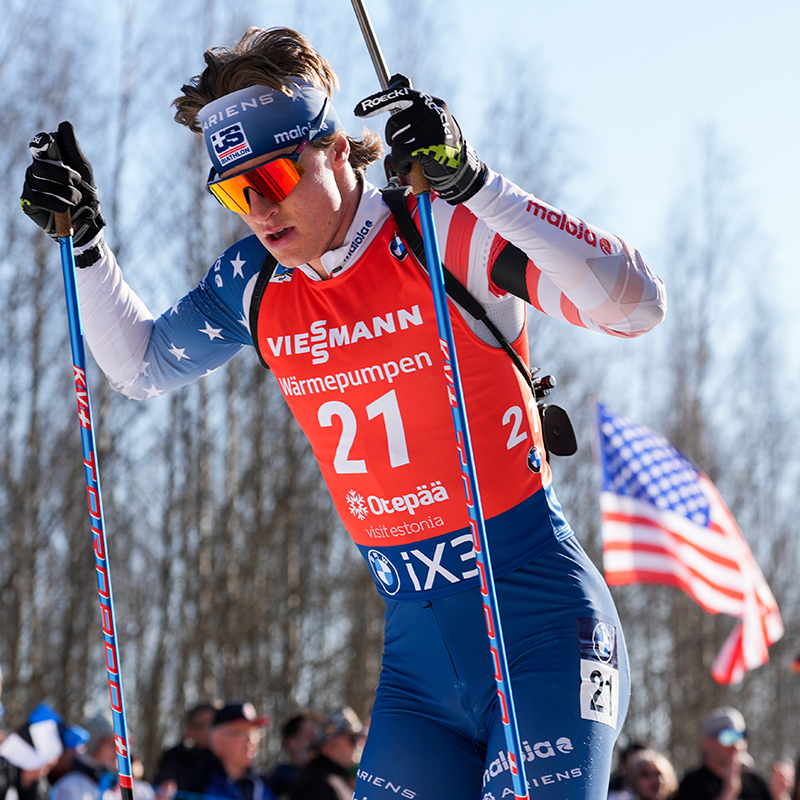
Several skiers went down in the crash, including Edvin Anger (SWE), Zak Ketterson (USA), and Gus Schumacher (USA)—all athletes with legitimate top-ten potential under normal circumstances. The cost of falling there was immediate and severe: not just lost momentum, but lost momentum at the precise moment the leaders were accelerating uphill and creating separation.
“I was dead last after the fall,” Schumacher said afterward. “Unfortunately, Zak fell right in front of me. It was tight coming into that corner, and I didn’t see what happened to Zak, but into the dropdown I got one ski around him and the other caught and spun me around off track.”
“I did what I could, but when the people at the front are still going as fast, it’s hard to catch them. All I could do was ski as smoothly as I could for the next 18 k. At that point, it’s an individual race. I feel like I skied well for being back there.”

Ketterson’s version of the same moment underscored how quickly the situation unraveled.
“I fell on that same corner Jessie Diggins fell on yesterday,” he said. “I was hopeful we’d ski it well, but coming into it everyone started snowplowing and freaking out and someone in front of me fell.
“I fell pretty hard, but I got back up and just burned so many matches catching back up to the group. I was fighting from there to the finish.”
Ahead of them, the race did not wait.

Control Without Calm
With the early chaos, the classic leg splintered the field. A front group formed, thinned, and re-formed, the pace steady enough to discourage attacks but high enough to extract a cost from anyone forced to chase.
For the U.S. team, there was at least one quiet positive. Head coach Matt Whitcomb felt far better about ski preparation than he had the day before.
“We had, in general, very competitive skis today,” Whitcomb said.
But ski quality can only matter if contact is maintained.
“When you get taken out of contact with the leaders,” Whitcomb said, “the people you’re drafting off of are slower than the leaders. It’s kind of negative compounding—you just drift away.”
By the time the top eight skiers entered the stadium for the ski exchange at the end of the classic leg, the race had already begun to select for those who could tolerate discomfort without revealing it. Among them were Norway’s Mattis Stenshagen, who soon faded, France’s emerging depth, and Klaebo himself—observant and patient.
Then the skis changed, and the race revealed its teeth.

A Quiet Turning Point in the Skate Leg
The opening kilometers of the freestyle leg altered the race more subtly, but no less decisively.
At approximately 11.5 kilometers, Harald Oestberg Amundsen (NOR)—who had positioned himself exactly where Norway would want him entering the skate portion—tangled skis with Savelii Korostelev (AIN). Amundsen went down. The lead group did not.
He remounted quickly, but the elastic had snapped. His chance to fight for a medal in the opening race of the Games was gone.
For Norway, a team that has dominated the men’s World Cup season at times filling nearly the entire top ten, it was a small moment with outsized implications.

Desloges, a Yellow Card, and a Protest That Went Nowhere
As the race accelerated, Mathis Desloges (FRA) briefly found himself leading at the end of the first skate lap. In a moment of confusion, he mistakenly turned into the ski exchange lane before cutting back through the V-boards and rejoining the course.
The detour shortened his route by only a few meters and offered no meaningful advantage. The race jury issued Desloges a yellow card warning and allowed the result to stand.
After the race, AIN filed a protest, arguing that the infraction should result in disqualification and elevate Korostelev, who finished fourth, to the bronze medal position. The jury rejected the protest.
Desloges framed the day not around controversy, but around progression.
“I’m very happy,” he said. “The preparation was very good. Two years ago today, I became [the U23 World Champion], and now it’s different. I’m better than two years ago.
“This medal is for my family, for my friends, and for everyone on the French team—the staff and my family.”

Klaebo on the Zorzi Climb
There are moments in ski racing that feel preordained—not because they are inevitable, but because the athlete who executes them has taught the sport to expect them.
Klaebo’s move on the Zorzi Climb belonged to that category.
He waited. He measured. And then, on the final ascent, he applied a pressure no one else in the group could answer. The gap opened quickly, almost unbelievably so if he had not done the same thing so many times before, and by the time the course tipped back toward the stadium, the Olympic gold medal was no longer in doubt. Klaebo came to the finish with enough margin to ease up, take off his poles, and ski the final meters, celebrating in front of the stadium crowd.
For Klaebo, the performance was the product of both familiarity and tension.
“The last couple of days have been nerve-racking,” he said. “I’ve had a very high resting heart rate these days. I’ve been very nervous, but this is my third Olympics, so you get a little bit of experience. This is a track and course that we know a lot from previously—we’ve done a lot of World Cups here.”
When the skis changed and the race accelerated, that experience showed.
“I had good skis, my body felt good,” Klaebo said. “It’s always good to start a championship in good shape.”
One year removed from his historic sweep in Trondheim, Klaebo arrived in Val di Fiemme carrying questions that extended well beyond a single race. Six gold medals are available in Milano Cortina. No man has ever won them all.
“We’ll see,” Klaebo said. “I’m going to take one race at a time. But it’s a pretty good start. With the weather and the crowds, it was amazing out there.”

Nations in Contrast
France: Depth and Belief
If Norway remains the benchmark, France is no longer content to chase quietly.
Desloges acknowledged Norway’s status entering the race, but did not concede anything beyond the present tense.
“The French athletes are very strong,” he said. “Of course, the Norwegian guys are also very strong, but I believe we can be better. Today, I’m very good, and I’m happy.”
France backed up that belief with the most comprehensive team performance of the day, placing second, fifth, ninth, and fifteenth.
“We see the French team on a similar level as our team,” Whitcomb said. “When we have success, they’re one of the first teams to congratulate us. They’re just a really passionate group, and we love to see them succeed.”

Norway: Gold, Bronze—and Perspective
For Norway, the medal count told only part of the story. A gold and a bronze would thrill nearly any other nation, but the context surrounding this team—deep enough to leave world-class skiers at home—made the result feel more measured.
Bronze medallist Martin Loewstroem Nyenget (NOR), racing his first Olympic event, framed the day not as a shortfall, but as an arrival.

“I’m really happy and proud,” Nyenget said. “It’s a result of training, but also of time away from family and a lot of hard mental work. The past days and weeks, I’ve been nervous, so it’s good to be done with my first Olympic race.
“To have this first race in this atmosphere, with these blue skies, and have my wife and little kid in the stadium somewhere—it’s a really good day.”
Asked whether gold and bronze constituted a satisfactory outcome, Nyenget was direct.
“I think so,” he said. “We have some really high pressure. We’ve been doing crazy good in the World Cup, but usually in championships, all racers are at their very best. You see today that there is strong competition from the French, and we took two podium places. It’s good.”

United States: Disappointed, Not Discouraged
For the U.S. team, the early crash changed everything.
Schumacher and Ketterson were forced into playing chase. Zanden McMullen, who avoided the crash, felt the day slip away in the skate leg.
“Today’s race was not great, but not horrendous,” McMullen said. “I felt really good in the classic leg and then I don’t know what happened in the skate portion. I was cramping up quite a bit and just didn’t have it.”

Hunter Wonders, making his Olympic debut, focused instead on the scale of the task.
“It was hard,” Wonders said. “It was a hard course with tricky conditions. The skiathlon is difficult because it mixes up the muscle groups you use and takes a second to transition, but it was fun. Great Olympic debut.”
Whitcomb struck a measured tone.
“I’m feeling good, not great,” he said. “Slightly disappointed, but not discouraged. Nothing about that feels negative to me. This is just one of the days of the Games, and now it’s behind us.”

Canada: The Race of a Lifetime
For Canada, the day belonged to Xavier McKeever, who finished 13th after spending much of the race on the edge of the top ten.
“Oh man—that was incredible,” McKeever said. “I can’t believe what just went down, to be honest.”
He described a race that improved with each kilometer.
“I felt like I skied it really smart—tried to conserve as much energy as possible—and I just felt better and better,” he said. “The skate felt really good, which is sweet, because that’s usually a weak spot for me.”
Mid-race, the realization crept in.
“You can’t really comprehend what’s going on,” McKeever said. “You’re just like, ‘Holy crap, I’m here right now, fighting for top ten.’ It’s surreal, but you’ve got to focus on the race.”
The result carried deeper meaning.
“To be honest, I was about a foot away from not making this Olympic team,” he said. “To come here and have the best race of my life so far on the first day at the Olympics—I couldn’t ask for anything more.”

One Race Down
The skiathlon rarely offers mercy, and Val di Fiemme offered none.
There will be more races, more chances, and more medals to chase. Klaebo will insist he is taking this one race at a time. Everyone else will count.
On firmer snow, with no ambiguity left beneath the skis, the hierarchy revealed itself plainly—and the Olympic Winter Games began exactly where cross-country skiing so often does: with Johannes Hoesflot Klaebo setting the standard.
Olympic Winter Games – Men’s Skiathlon – RESULTS
On the ground reporting by FasterSkier’s Nat Herz.
Help Support Our Olympic Coverage!
FasterSkier has our own Nat Herz on the ground at the Olympics, which is a significant financial lift for us. If you value the thoughtful work and access FasterSkier provides at championships like this one, please consider becoming a Voluntary Subscriber. Your support directly fuels our work to cover the people, places, and moments that make our sport special.
Join the FasterSkier community!

- Canada cross country skiing
- cross country skiing news
- FasterSkier Olympic coverage
- FIS Cross Country Skiing
- France cross country skiing
- Gus Schumacher
- Hunter Wonders
- Johannes Hoesflot Klaebo
- Klaebo Olympic gold
- Martin Loewstroem Nyenget
- Mathis Desloges
- Men's skiathlon
- men’s Olympic skiing
- Milano Cortina 2026
- nordic skiing
- Norway cross country skiing
- Olympic Cross Country Skiing
- Olympic race recap
- Olympic ski racing
- Olympic skiathlon
- skiathlon mass start
- US Cross-Country Ski Team
- Val di Fiemme
- Xavier McKeever
- Zak Ketterson
- Zanden McMullen

Matthew Voisin
As owner and publisher of FasterSkier, Matthew Voisin manages the day-to-day operations, content, and partnerships that keep the site gliding smoothly. Away from the desk, he’s doing his best to keep pace with his two energetic sons.